
Quick answer
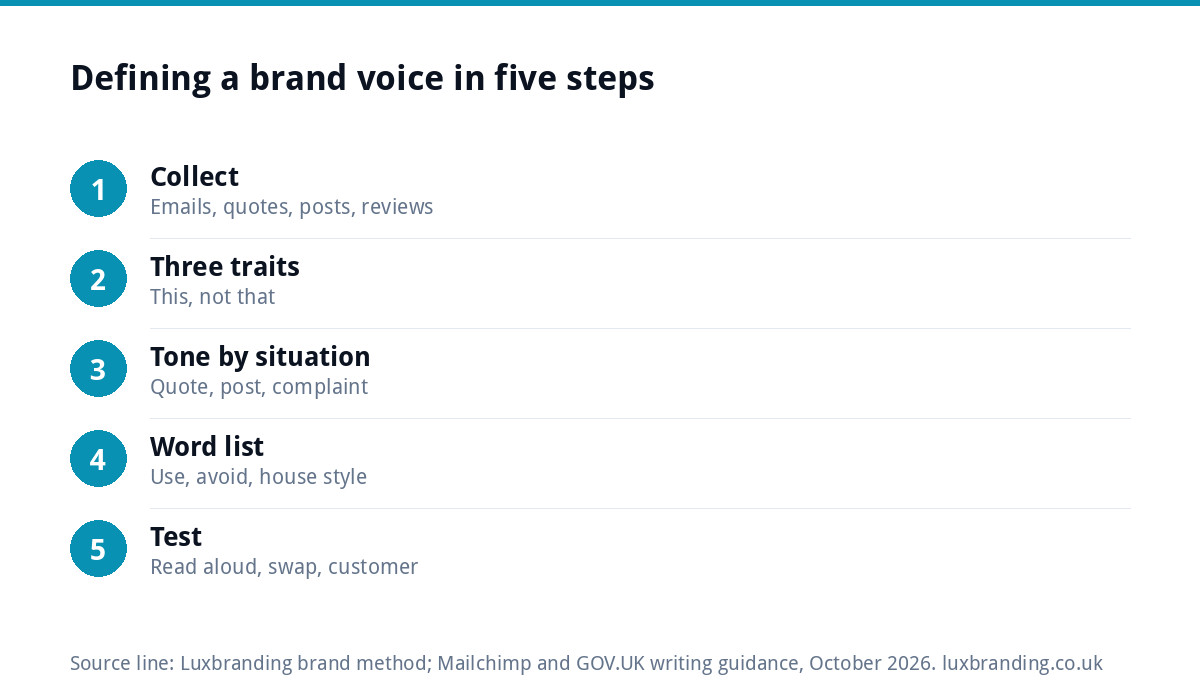
To define a brand voice, collect what you and your customers already say, pick three voice traits written as “this, not that”, decide how the tone shifts between situations such as quotes and complaints, build a short list of words to use and avoid, then write examples and test them. The whole method fits on one page.
Your voice is how the business sounds in every quote, reply, post and invoice reminder. Most small businesses never define it, so it changes depending on who is typing and how busy they are. This guide gives a five-step method that a sole trader can do in an afternoon, with worked examples you can adapt.
Voice versus tone: the difference that matters
Your voice is your personality in words. It stays the same everywhere. Your tone is how that voice adjusts to the situation. Mailchimp’s well-known content style guide puts it simply: you have the same voice all the time, but your tone changes, just as you speak differently to a close friend and in a meeting with your boss.
For a small business, that means a plumber can be friendly and straight-talking everywhere, but sound lighter in a social post and calmer and more careful when replying to a complaint. The voice holds the brand together; the tone keeps it appropriate.
Why a small business needs a defined voice
- Consistency. When two people answer enquiries, customers should not feel they are dealing with two different firms.
- Speed. A clear voice makes writing quicker: you are not reinventing your style each time.
- Trust. A steady, recognisable way of speaking makes a business feel established.
- Better briefs. Designers, copywriters and anyone helping with social media can match you without guesswork.
A defined voice also sits naturally alongside your visual identity. When the words and the look match, the brand feels deliberate. When they do not, it can look as though several businesses share one logo, a problem we cover in our guide to a brand that looks inconsistent everywhere.
Step 1: collect what you already say
You already have a voice; it is just not written down. Gather ten to twenty real examples:
- emails and messages you were pleased with;
- quotes and the notes you add to them;
- your best social posts;
- customer reviews, especially the words customers use to describe you.
Highlight phrases that sound like you at your best, and anything that makes you wince. Reviews are particularly useful: if several customers say “no-nonsense” or “really patient”, that is a voice trait customers already value.
Step 2: pick three traits, written as “this, not that”
Choose three adjectives that describe how you want to sound. On their own, words like “friendly” or “professional” are too vague, so pair each with what it does not mean.
| Trait | This | Not that |
|---|---|---|
| Straight-talking | Clear prices, honest timescales, plain words | Blunt or dismissive |
| Friendly | Warm, uses first names, thanks people | Over-familiar, jokey in serious moments |
| Expert | Explains why, gives the right detail | Jargon, lecturing, showing off |
| Calm | Measured, reassuring, solution-first | Flat or uninterested |
| Local | Mentions places and local details customers know | Forced slang or in-jokes |
Pick the three that fit your business and customers best. A wedding florist and a commercial electrical contractor will choose very differently, and both can be right.
Step 3: decide how the tone shifts
List the situations you write in most often, and how the tone should adjust in each while the voice stays the same.
| Situation | Tone | Example line |
|---|---|---|
| Quote | Clear, confident | “Here is your fixed price, including materials and clearing up.” |
| Social post | Lighter, proud of the work | “Finished this one in Headingley today. Happy with how the tiling came out.” |
| Complaint reply | Calm, careful, no defensiveness | “Thank you for telling us. I’m sorry this happened, and here is what we’ll do.” |
| Payment reminder | Polite, firm, factual | “A quick reminder that invoice 1043 was due on Friday.” |
| Website service page | Helpful, specific | “Most boiler services take about an hour. Here is what we check.” |
Step 4: build a word list
A short list of words to use and avoid does more for consistency than any description. Include:
- Words you use: how you describe your services, your customers (“customers” or “clients”?), and your standard phrases.
- Words you avoid: jargon customers do not understand, clichés such as “solutions” and “second to none”, and anything that sounds like every competitor.
- House style: do you write “we” or “I”? Do you use contractions such as “we’re”? Exclamation marks, or none?
The UK government’s guidance on using the right tone is a useful reference even for a small firm: it recommends writing conversationally, as if talking to someone one-to-one, and using the active voice. The Plain English Campaign promotes the same principles of short, clear wording.
Step 5: write examples and test them
Rewrite three real pieces in the new voice: a quote email, a social post and a reply to an unhappy customer. Then test:
- Read aloud. Does it sound like you on a good day?
- Swap test. If a competitor’s name replaced yours, would it still fit? If so, it is too generic.
- Customer test. Show it to a regular customer and ask whether it sounds like your business.
- Staff test. Ask someone else to write a message using your one-page guide. Does it come out sounding like you?
A worked example: before and after
Take a hypothetical two-person roofing firm in Derby that chooses three traits: straight-talking, calm and expert. Here is a quote email before the voice guide:
“Dear Sir/Madam, Further to your recent enquiry please find attached our quotation for the works discussed. We pride ourselves on providing a quality service second to none. Please do not hesitate to contact us should you have any queries. Kind regards.”
And after:
“Hi Sarah, thanks for showing me the roof on Tuesday. Your quote is attached: £2,350 to replace the flat roof over the kitchen, including removing the old felt and taking it away. We can start the week of 10 March and it takes two days, weather permitting. If anything in the quote is unclear, just reply and I’ll explain. Thanks, Dan.”
The second version is not more casual for the sake of it. It is clearer: it names the customer, the job, the price, what is included, the start date and the next step. The voice traits show in the details. Straight-talking means the price is in the email, not buried in an attachment. Calm means “weather permitting” is stated plainly rather than as a disclaimer. Expert means the scope is described in terms the customer understands.
Notice what was removed as well: “further to”, “please find attached”, “second to none” and “do not hesitate”. None of them carried any information, and all of them sound like every other firm’s quotes. Cutting stock phrases is often the quickest single improvement a small business can make to how it sounds.
Putting it on one page
Your finished voice guide should fit on a single page:
- a one-sentence summary (“We sound like a straight-talking, friendly expert who explains things plainly”);
- the three traits with “this, not that”;
- the tone table for your main situations;
- the word list;
- two or three before-and-after examples.
Keep it with your brand guidelines so anyone who writes for the business sees both together. If you do not have guidelines yet, our guide to brand guidelines explains what they usually contain.
Common mistakes
- Choosing traits nobody could disagree with. “Professional, reliable, quality” describes everyone.
- Copying a big brand’s voice. A cheeky national brand’s tone can feel odd from a local accountant.
- Forgetting difficult moments. Complaints and late payments test a voice more than social posts do.
- Writing the guide and never using it. Share it with everyone who writes for you, and check new material against it.
Trade businesses in particular often have a strong natural voice in person that disappears in writing; our guide to branding for trades businesses covers how to carry it across vans, quotes and paperwork.
Where we can help
Our Brand Identity Design is £299 and covers the logo, colours, typography, imagery and brand guidelines; send your one-page voice guide with the brief and we will design the visual side to match it. If you would like help writing in your voice regularly, our content and blog writing service works from the same guide. Prices for everything are on our pricing page.
Get the UK Branding Budget Worksheet (free)
A printable worksheet: decide what your brand needs now and price it against fixed published prices and the IPO trademark fee.
No spam. UK GDPR compliant. We only use your email to send this resource, unless you tick the box to hear from us.
Frequently asked questions
What is the difference between brand voice and tone? +
Voice is your personality in words and stays the same everywhere. Tone is how that voice adjusts to the situation: lighter in a social post, calmer in a complaint reply, firmer in a payment reminder. A plumber can be friendly and straight-talking throughout while changing tone to suit each moment.
How do I find my brand voice? +
Start with what you already write. Collect ten to twenty emails, quotes, posts and customer reviews, highlight phrases that sound like you at your best, then choose three traits written as this, not that. Reviews are especially useful because they show the words customers already use to describe you.
How many voice traits should a brand have? +
Three is a practical number for a small business. Fewer can feel thin; more become hard to remember and apply. Pair each trait with what it does not mean, such as straight-talking but not blunt, so that anyone writing for the business interprets it the same way.
Should a small business write as we or I? +
Either works if you are consistent. We suits businesses with a team or plans to grow, and it keeps the business as the voice. I can feel personal for sole traders. Decide once, put it in your voice guide, and use it in quotes, emails and the website.
Does Luxbranding create brand voice guides? +
Our Brand Identity Design, £299, covers the logo, colours, typography, imagery and brand guidelines. Send your one-page voice guide with the brief and we design the visual side to match. Our content and blog writing service can then write in that voice. Prices are on our pricing page.