Quick answer
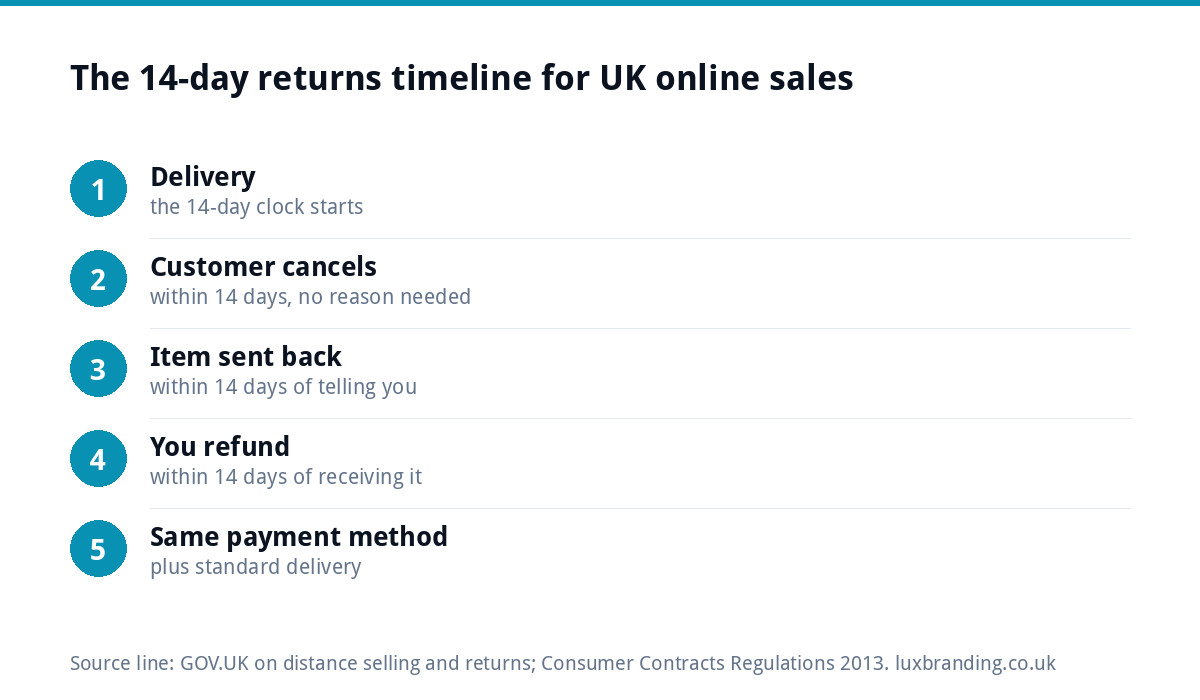
A UK online shop’s returns policy must tell customers they can cancel within 14 days of delivery without giving a reason, then have 14 more days to send items back. Say who pays return postage, that you refund within 14 days of receiving the item including standard delivery, which items are exempt, and how to contact you.
A returns policy is one of the pages shoppers check before buying from a small shop they have not used before. It is also a legal page: UK distance selling rules decide most of what it must say, and getting them wrong can extend a customer’s right to cancel to a whole year. This guide covers the time limits, what you can and cannot deduct, which items are exempt, and gives wording you can adapt. It is practical guidance, not legal advice.
The rules your policy has to reflect
When you sell online, by phone or by mail order, customers get extra rights because they could not see the goods before buying. GOV.UK’s guide to online and distance selling says you must tell customers they can cancel their order up to 14 days after it is delivered, without giving a reason. It adds a sting: if you do not tell them about this right, they can cancel at any time in the next 12 months.
GOV.UK’s page on accepting returns and giving refunds also says it is illegal to restrict or take away customers’ rights, or to mislead them about their rights, for example with a sign saying you do not accept returns. A “no returns” line on a website does not remove the right; it just puts you in the wrong.
The time limits at a glance
| Step | Time limit | Source |
|---|---|---|
| Customer tells you they want to cancel | Within 14 days of receiving the item | GOV.UK returns guidance |
| Customer sends the item back | Within 14 days of telling you | GOV.UK; Consumer Contracts Regulations, reg. 35 |
| You refund the customer | Within 14 days of receiving the item back | GOV.UK returns guidance |
| If you never told them about the right to cancel | They can cancel for up to 12 months | GOV.UK distance selling guidance |
| Faulty item returned | Repair or replace within 6 months unless you prove it was not faulty | GOV.UK returns guidance |
Refunds: what to include and how
When a customer cancels within the rules, you refund the price they paid, and GOV.UK says you must also refund the cost of standard delivery if they paid for it. If they chose a more expensive option, such as next-day, you only need to refund the cost of standard delivery.
The Consumer Contracts Regulations 2013 say the refund must go back using the same payment method the customer used, unless they have expressly agreed otherwise. So a card payment is refunded to the card, not as store credit, unless the customer chooses credit.
Who pays to send it back
Under regulation 35 of those regulations, the customer bears the direct cost of returning goods, unless you have agreed to pay it, or you failed to tell them before they bought that they would have to pay. If your policy does not say who pays return postage, the cost falls on you.
Many small shops choose to offer free returns as a selling point, especially for clothing and gifts. That is a business decision, not a requirement. Whatever you choose, say it clearly in the policy and on the product or delivery page.
What you can deduct, and what you cannot
GOV.UK says you cannot deduct any fees from a refund unless the item has been used or damaged. The regulations allow a deduction for loss in value caused by handling beyond what is needed to establish the nature, characteristics and functioning of the goods, which they describe as handling beyond what might reasonably be allowed in a shop.
| Situation | Can you deduct? |
|---|---|
| Item returned unused, in its original condition | No: full refund |
| Packaging opened to look at the item | No: that is normal handling |
| Item clearly used beyond trying it, or damaged | Yes, for the loss in value |
| A “restocking fee” on every return | No |
| You never told the customer about the right to cancel | No deduction allowed |
Items that are exempt
Some goods do not have to be accepted back unless they are faulty. GOV.UK lists examples including:
- Personalised or custom-made items, such as made-to-measure curtains or engraved gifts.
- Perishable items, such as flowers or food.
- Sealed items that cannot be returned once opened for health or hygiene reasons, such as underwear or some cosmetics.
Name the exempt categories in your policy and on the relevant product pages, so customers know before they buy. Exempt items must still be refunded, repaired or replaced if they are faulty.
Faulty items are a separate right
The 14-day cancellation right is about changing your mind. Faulty goods are covered by separate rights, which apply whether the customer bought online or in person. GOV.UK says you must repair or replace an item if it is returned within 6 months, unless you can prove it was not faulty when sold, and customers have up to 6 years to make a claim. Keep the two clearly separate in your policy, so nobody thinks faulty items are only covered for 14 days.
Exchanges, gifts and trade buyers
Exchanges are a nice extra, but they cannot replace a refund when someone cancels within the 14 days: the choice is the customer’s. For gifts, say whether the person who received the item can return it and how the refund is handled, since it normally goes back to the original payment method. And remember that the cancellation right comes from consumer law. If you also sell to trade buyers, you can set separate trade terms, but every consumer should see the consumer policy.
Wording you can adapt
Here is a plain-English starting point for a small shop. Adjust it to your products, and have it checked if your situation is unusual.
- Changed your mind? You can cancel your order within 14 days of receiving it, without giving a reason. Email us at [address] or use the form on our contact page.
- Sending it back. Please return the item within 14 days of telling us, to [returns address]. [You pay the return postage / We provide a free returns label.]
- Your refund. We refund the price you paid and our standard delivery charge within 14 days of receiving the item back, to your original payment method.
- Condition. You can open and inspect items as you would in a shop. If an item has been used or damaged beyond that, we may reduce the refund to reflect its loss in value.
- Items we cannot accept back unless faulty: [personalised items, perishable goods, sealed hygiene items once opened].
- Faulty or wrong items. Contact us straight away. This does not affect your statutory rights.
- Contact. [Business name, email, phone and address].
Where to show it on your shop
- A dedicated returns page linked from the footer of every page.
- A short summary on product pages, near the price and delivery details.
- A link in the basket and at checkout, one click away.
- The cancellation information in the order confirmation email, which GOV.UK says must include a copy of the contract the customer can save.
Clear delivery and returns information is part of what makes a new shop feel safe to buy from. If your shop gets visits but few sales, our guide to a store with traffic but no sales covers the trust signals shoppers look for, and our website launch checklist includes the legal pages every site needs.
Mistakes to avoid
- “No refunds” or “exchange only” wording that misleads customers about their rights.
- Saying nothing about return postage, then charging for it.
- Refunding as store credit by default.
- Forgetting to refund the original standard delivery charge.
- Hiding the returns page so deep in the site that shoppers cannot find it before they buy.
- Exempting whole product ranges that are not genuinely personalised or perishable.
Getting your shop built with the right pages
Our E-commerce Website is £499 one-off for up to 20 products on WooCommerce or Shopify, with Stripe and PayPal payments. Good packaging cuts damage-related returns too; our guide to packaging design for small brands covers what is worth investing in. See the full running costs of a small shop in our e-commerce website cost guide, and every fixed price on our pricing page.
Get the UK Website Project Brief Template (free)
A two-page template for briefing any UK web designer: sitemap, integrations, audience and deliverables. Cuts revision rounds in half.
No spam. UK GDPR compliant. We only use your email to send this resource, unless you tick the box to hear from us.
Frequently asked questions
What must a UK online shop's returns policy include? +
It should explain that customers can cancel within 14 days of delivery without a reason, then have 14 days to return the item, and that you refund within 14 days of receiving it back, including standard delivery. Say who pays return postage, list exempt items such as personalised goods, and give contact details. Keep faulty-goods rights separate.
Do I have to pay for return postage? +
Not if you tell customers before they buy. Regulation 35 of the Consumer Contracts Regulations 2013 says the customer bears the direct cost of returning goods unless you agreed to pay it, or you failed to tell them they would have to. If your policy is silent on return postage, the cost falls on you.
Can I refuse refunds on personalised items? +
Yes, for change-of-mind returns. GOV.UK lists personalised or custom-made items, perishable goods and sealed health or hygiene items once opened as examples that do not have to be refunded unless faulty. Name these categories in your policy and on product pages. Faulty items must still be repaired, replaced or refunded.
Can I charge a restocking fee? +
Not as a standard charge. GOV.UK says you cannot deduct fees from a refund unless the item has been used or damaged. The regulations allow a deduction for loss in value caused by handling beyond what would be allowed in a shop, and no deduction at all if you never told the customer about their right to cancel.
Can you build an online shop with these pages in place? +
Our E-commerce Website is £499 one-off for up to 20 products on WooCommerce or Shopify, with Stripe and PayPal payments. Your returns policy wording is yours to set and check against the rules in this guide, and the page should be linked from the footer, product pages and checkout. Every fixed price is on our pricing page.