Quick answer
Your company name is the legal name registered at Companies House, usually ending in Ltd. A trading name is any other name you trade under, and it must not include Ltd. Your brand name is the one customers see and remember, on your van, website and logo, which we design from £129. One business can use all three.
Plenty of owners use these terms as if they mean the same thing, and most of the time nobody minds. It matters when you print invoices, set up a website footer, order van graphics or try to protect a name. This guide explains each one in plain English, shows where each must appear, and covers the mistakes that lead to an awkward rename.
Three names, three jobs
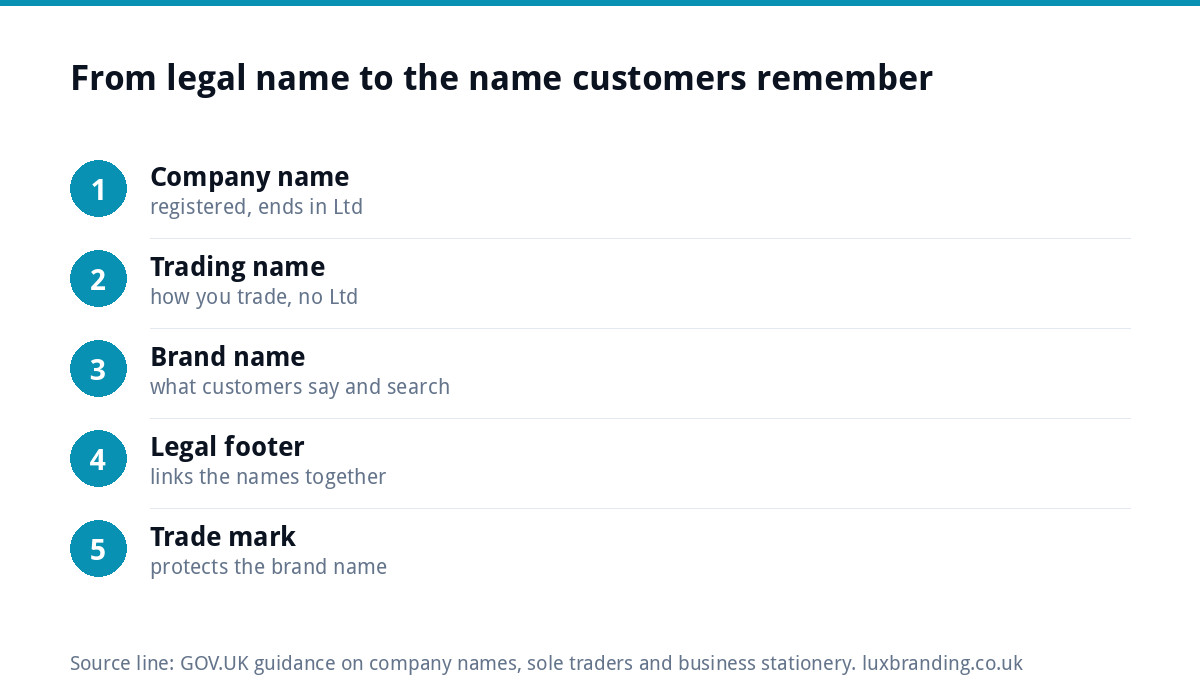
Think of them as layers. The legal name sits underneath and appears where the law asks for it. The trading name is how the business presents itself day to day. The brand name is what lives in customers’ heads, and it is often the same as the trading name, shortened or styled.
Take a plumbing firm registered as J Hartley Heating Services Ltd. It trades as Hartley Heating, and customers know it as Hartley, with the word set in a bold typeface on the vans. All three names are correct in different places.
Company name, trading name and brand name compared
| Company name | Trading name | Brand name | |
|---|---|---|---|
| What it is | The legal name of a limited company | A name you trade under that differs from the legal name | The name and identity customers recognise |
| Who has one | Limited companies and LLPs | Any business that chooses one | Every business, whether planned or not |
| Set by | Registration at Companies House | You, subject to naming rules | You, through your logo, website and marketing |
| Can include “Ltd”? | Usually must end in Limited or Ltd | No | Usually left off |
| Protected by | The register stops identical company names | Nothing automatic | A registered trade mark, if you apply |
| Where it appears | Website footer, invoices, letters, contracts | Signs, adverts, social profiles, website | Logo, vans, uniforms, packaging |
What a company name is
If you run a limited company, its registered name is the one on the Companies House register. GOV.UK’s guide to choosing a company name says the name must usually end in Limited or Ltd, and that you cannot register a name that is the same as one already on the register.
Sole traders do not have a company name. Their legal name is their own name, which matters for invoices, as you will see below.
What a trading name is
A trading name, which GOV.UK also calls a business name, is any name you use that is not your registered company name or, for a sole trader, your own name. GOV.UK’s guide to becoming a sole trader says you can choose a trading name or use your own name.
The same company name guidance says a trading name must not include “limited”, “Ltd”, “LLP” or “plc”, and must not contain a sensitive word or expression unless you get permission. It also warns that if your business name is too similar to another company’s trade mark, you may have to change it if someone complains.
That warning is the one that catches people out. Choosing a trading name is quick, but nothing about it stops someone else holding rights to the same words.
What a brand name is
Your brand name is not a legal category at all. It is the name customers use when they recommend you, search for you or spot your van at a red light. It might be the trading name, a shortened version, or a product range name inside a bigger business.
The brand name is the one that does the commercial work, so it is the one to check most carefully: is the domain available, are the social handles free, and does it clash with anyone in your trade? Our free business name checker runs the first checks in one go, and our guide to choosing a UK business name covers how to build a shortlist.
Where each name must appear
This is where the difference has real consequences. The rules are different for limited companies and sole traders.
| Place | Limited company | Sole trader using a trading name |
|---|---|---|
| Website | Registered name, registered number, registered office and where registered | Your trading name; adding your own name helps trust |
| Invoices | Company name, address and contact details | Your own name, the business name and an address for legal documents |
| Letters and order forms | Registered number, registered office and that it is a limited company | Trading name and your contact details |
| Premises | A sign showing the company name where the business operates | No set rule; your brand on the door |
| Vans, uniforms, social profiles | Brand name | Brand name |
The limited company rows come from GOV.UK’s page on signs, stationery and promotional material, which says business letters, order forms and websites must show the registered number, registered office address, where the company is registered and the fact that it is a limited company. The sole trader invoice row comes from GOV.UK’s page on what invoices must include.
In practice, the website footer is where most small businesses fall short. A single line such as “Hartley Heating is a trading name of J Hartley Heating Services Ltd, registered in England and Wales, company number…” with the registered office address covers it.
Protecting the name customers know
Registering a company name and choosing a trading name both feel official, but neither gives you the strongest protection over your brand name. That comes from a registered trade mark, which covers the name, and often the logo, for the goods and services you list.
Whether a trade mark is worth applying for depends on how much you plan to invest in the name. If you are about to brand ten vans, it is worth a search first. Our guide to logo copyright and trade marks in the UK explains the difference between copyright and a registered mark, and when each matters.
When the names drift apart
Trouble starts when the three names stop matching in a way customers can follow. Common examples:
- A company bought by a new owner keeps the old registered name, while the vans show a new brand, and customers cannot find the business online.
- A sole trader trades as one name on Facebook, another on the website and a third on invoices.
- A domain was registered years ago under an old trading name and still points to the website.
- The logo shows a shortened brand name that nobody searches for.
The fix is usually simple: choose the brand name, use it everywhere customers look, and keep the legal name in the places the law requires. Our guide to domain names for UK businesses covers keeping old domains pointing to the right place.
Changing one of the names later
The three names can change independently, which is useful. A limited company can change its registered name through Companies House without touching its brand. A business can start trading under a new name and keep the same company. A brand can be refreshed while the legal name stays exactly as it is.
What matters is the order. If you are changing the name customers know, settle the new brand name first, then check the domain, social handles and trade marks, then update the legal footer and invoices, and only then order new vans, workwear and signage. Doing it the other way round is how businesses end up paying for graphics twice.
Keep the old name visible for a while too. A line such as “formerly Hartley Plumbing” on the website and in your email signature helps returning customers, and it stops past reviews and recommendations feeling like they belong to someone else.
One name, used the same way everywhere
Whatever you choose, use the brand name in exactly the same form on your website, Google Business Profile, social profiles, quotes and vans. Small differences, such as “Hartley Heating” on Facebook and “Hartley Heating & Plumbing” on Google, make the business harder to find and look less established. Adding extra keywords to a Google profile name is also a common reason profiles get flagged.
Getting the brand name right on everything
Once the name is settled, the identity is what makes it recognisable. Our Logo Design is £129 one-off, with unlimited concepts and stacked, horizontal and icon-only layouts included. Our Brand Identity Design is £299 and adds colours, typography, imagery and brand guidelines, so the name looks the same on a van door as it does on an invoice. If you run a trade, our guide to branding for trades businesses shows how that plays out on vans and workwear. Every fixed price is on our pricing page.
Get the UK Branding Budget Worksheet (free)
A printable worksheet: decide what your brand needs now and price it against fixed published prices and the IPO trademark fee.
No spam. UK GDPR compliant. We only use your email to send this resource, unless you tick the box to hear from us.
Frequently asked questions
What is the difference between a company name and a trading name? +
A company name is the legal name of a limited company, registered at Companies House and usually ending in Ltd. A trading name is a different name the business uses day to day. GOV.UK says a trading name must not include Ltd, LLP or plc, and must not use sensitive words without permission. Many businesses use both.
Can a sole trader use a trading name? +
Yes. GOV.UK says a sole trader can choose a trading name or use their own name. If you use a trading name, your invoices must still show your own name and the business name, plus an address where legal documents can be delivered to you. Your website and social profiles can lead with the trading name.
Does registering a company name protect my brand? +
Not fully. The register stops another company registering the same name, but it does not give you the rights a registered trade mark does. GOV.UK warns that if your business name is too similar to another company's trade mark, you may have to change it if someone complains. Search trade marks before you invest in the name.
What must a limited company show on its website? +
GOV.UK says business letters, order forms and websites must show the company's registered number, its registered office address, where it is registered and the fact that it is a limited company, usually by giving the full name with Limited or Ltd. Most businesses put this in a single line in the website footer.
Can you design a brand around my trading name? +
Yes. Our Logo Design is £129 one-off with unlimited concepts and all layouts included. Brand Identity Design is £299 and adds colours, typography, imagery and brand guidelines, so the name customers know looks the same on vans, invoices, the website and social profiles. Every fixed price is listed on our pricing page.