Quick answer
A good About page answers three questions a customer has before they pick up the phone: who are you, can I trust you, and are you right for my job? Open with the customer’s problem, tell your story in a few sentences, show real photos, list credentials they can check, add proof, and finish with one clear next step.
For most small businesses, 250 to 500 words does the job. Below are the seven parts in order, a fill-in template, the legal details limited companies must show, and the mistakes that make visitors skip straight past the page.
What the About page is really for
People rarely land on an About page first. They arrive from a service page or a Google search, like what they see, and click “About” to check you are real before they get in touch. That makes it a trust page, not a history lesson.
Google thinks about trust in a similar way. Its guidance on creating helpful, reliable content asks whether visitors can easily find background about the people or business behind a site, and mentions a site’s About page as one place that information lives. A thin or missing About page leaves that question unanswered for customers and search engines alike.
So the test for every sentence is simple: does it help a stranger decide to trust you with their job? If not, cut it.
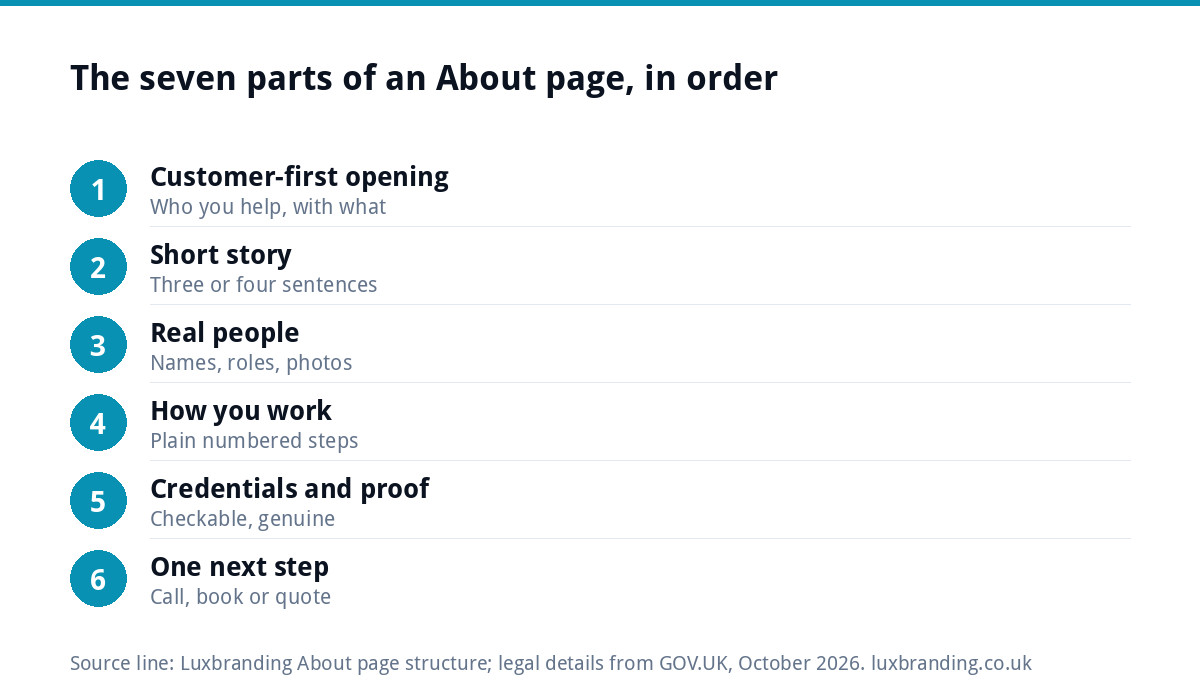
The seven parts of an About page
Use this order. Each part is short, and together they answer the three questions.
| Part | What to write | Example line (fictional firm) |
|---|---|---|
| 1. Opening line | Who you help and with what, from the customer’s side | “We help homeowners in Leeds get loft conversions finished on time and without surprises.” |
| 2. Short story | How and why you started, in three or four sentences | “Dan started as an apprentice joiner in 2006 and set up on his own after a decade on site.” |
| 3. The people | Names, roles and real photos of who turns up | “Dan runs every job. Priya handles quotes and scheduling.” |
| 4. How you work | Your process in plain steps | “Free survey, written fixed quote, a start date you can plan around.” |
| 5. Credentials | Accreditations, insurance, memberships, with numbers | “Fully insured. Member of a recognised trade body.” |
| 6. Proof | Two or three genuine reviews or a link to recent work | A short quote from a named customer, with permission |
| 7. Next step | One clear call to action | “Book a free survey” with your phone number beside it |
Part 1: open with the customer, not the company
Most About pages start with “Established in 2009, we are a family-run business committed to excellence.” Every word of that is about you, and none of it tells the visitor whether you can solve their problem.
Turn it round. Start with who you help and what you help them with. “We help landlords across Nottingham keep their properties safe, legal and let” says more in one line than a paragraph of history. Then the history becomes supporting evidence rather than the headline.
Parts 2 and 3: a short story and real people
Keep the story to three or four sentences. Where you trained, when you started, why you set up on your own and what you do differently. That is enough. Customers want a sense of who you are, not a memoir.
Then show the people. For a small business, the people are the brand. Use real photos: you on a job, the team by the van, your workshop. Stock photos of smiling models are spotted instantly and undo the trust the rest of the page builds. A clear, well-lit phone photo is fine.
Decide early whether to write as “I” or “we”. A sole trader writing “we” can sound like they are hiding something; a team of six writing “I” sounds like nobody else matters. Pick the one that is true and stick to it across the whole site, including your quotes and emails. Our guide to branding for trades businesses covers how photos, vans and workwear work together.
Parts 4 and 5: how you work and what can be checked
Explain your process in a few steps, because uncertainty is what stops people enquiring. What happens after they call? Do you visit? How do quotes arrive? When do you take payment? A short numbered list removes most of that worry.
Then list credentials, and make them checkable. A membership number someone can look up on the scheme’s own website is worth far more than a row of logos. Include insurance cover if you hold it, trade body memberships, qualifications and any accreditations relevant to the work. If you bid for commercial work, this section matters even more; our guide to winning commercial contracts explains what buyers look for.
Part 6: proof that is real
Add two or three short reviews that mention specific things, such as turning up on time, keeping the site tidy or sticking to the quote, rather than generic praise. Name the customer or their town where you have permission.
Make sure every review is genuine. The Competition and Markets Authority’s guidance on fake reviews, published in April 2025 alongside legislative changes, sets out what businesses must not do with reviews. Invented testimonials are not worth the risk, and customers can usually tell.
Part 7: one clear next step
End the page with one action, not five. For most trades that is a phone number and a short form, or a button to book a survey. Put it at the bottom and, on longer pages, once in the middle too. A visitor who has read your About page is warm; do not make them hunt for how to reach you.
Also link the About page from the places people look for it: the main menu, the footer and, where it fits, the home page. A sentence such as “Read more about who we are” under a short introduction on the home page sends curious visitors to the page built to win them over.
The details limited companies must show
If you trade as a limited company, there is a legal element too. GOV.UK’s guidance on signs, stationery and promotional material says your website must show your registered number, your registered office address, where the company is registered, and that it is a limited company. These details often sit in the site footer, and the About page is a natural place to repeat them.
Sole traders do not have the same requirement, but showing your trading name, where you are based and the areas you cover still builds trust.
A fill-in template
Copy this outline and replace the brackets. Aim for 250 to 500 words in total.
- Headline: We help [who] in [where] with [what].
- Story: [Name] started [when] after [background]. We set up [business] because [reason]. Today we [what you do now].
- People: [Name, role]. [Name, role]. Photo of the team or the owner on a job.
- How we work: 1. [first contact]. 2. [visit or survey]. 3. [quote]. 4. [the job]. 5. [aftercare].
- Credentials: [accreditations with numbers], [insurance], [memberships].
- Proof: two short reviews with names or towns.
- Next step: [Call / book / request a quote] with the number or button.
Common mistakes and how to fix them
| Mistake | Why it hurts | Fix |
|---|---|---|
| Opening with the founding year | Says nothing about the customer’s problem | Lead with who you help and how |
| Stock photos | Look fake and erode trust | Real photos, even from a phone |
| “We are passionate about quality” | Every competitor says the same | Show it with a specific example or review |
| Wall of text | People skim on phones | Short paragraphs, a list, a table of credentials |
| No call to action | A trusting visitor has nowhere to go | One clear next step at the end |
| Out-of-date team or details | Suggests the business has changed or closed | Review the page twice a year |
That last point catches a lot of businesses. If updating your own site is a struggle, our guide for owners who cannot update their own website sets out the options.
Where to go from here
Write the page in a document first, read it out loud, and ask a customer or friend whether it sounds like you. Then check it against our website launch checklist before it goes live.
If you are building a new site, an About page fits comfortably within our custom WordPress website, which is £499 for up to eight pages, and a one-page website at £299 can carry a short About section. Our guide to website costs in the UK covers the wider market, and every package is on our pricing page. Order online or email us at support@luxbranding.co.uk.
Get the UK Website Project Brief Template (free)
A two-page template for briefing any UK web designer: sitemap, integrations, audience and deliverables. Cuts revision rounds in half.
No spam. UK GDPR compliant. We only use your email to send this resource, unless you tick the box to hear from us.
Frequently asked questions
What should an About Us page include? +
An opening line about who you help, a short story of how you started, the real people behind the business, how you work, credentials customers can check, two or three genuine reviews, and one clear next step. Limited companies should also show their registered number, registered office and place of registration somewhere on the site.
How long should an About page be? +
For most small businesses, 250 to 500 words is enough. Visitors use the page to check you are trustworthy before getting in touch, usually on a phone, so short paragraphs, a list of how you work and a small table of credentials serve them better than a long history of the business.
Should I use stock photos on my About page? +
Avoid them. Stock photos of models are easy to spot and undermine the trust the page is meant to build. Real photos of you, your team, your van or your workshop work better, even if they are taken on a phone, as long as they are clear and well lit.
Do I need my company number on my website? +
If you trade as a limited company, yes. GOV.UK guidance says a company website must show its registered number, registered office address, where it is registered and that it is a limited company. Many businesses put these details in the footer so they appear on every page, including the About page.
Can Luxbranding write and design my About page? +
An About page fits within our custom WordPress website, which is £499 for up to eight pages and includes custom design, a mobile-first build and an SEO foundation. A one-page website at £299 can carry a shorter About section. Order online or email support@luxbranding.co.uk to discuss your pages.