Quick answer
Fix whichever is actually losing you work. If people find you but do not enquire, the website is usually the problem; if the business looks amateur everywhere, start with the logo. When both need doing, do the logo first, then build the website around it, so you only design the site once. A £50 logo edit sometimes avoids a redesign.
Plenty of small business owners feel their image is out of date but cannot tell which piece to fix first, and budgets rarely stretch to everything at once. Get the order wrong and you either pay twice for a website or put a fresh logo on a site that still does not bring in enquiries. This guide gives five questions to decide, worked examples and the costs of each route.
Logo and website do different jobs
A logo is recognition: on the van, the invoice, the uniform, the Google profile. It tells people who you are and whether you look established. A website is persuasion: it answers questions, shows proof and turns a visitor into an enquiry. A great logo cannot rescue a website that is slow, confusing or hard to use on a phone, and a great website struggles when the brand at the top looks home-made.
That is why the answer depends on where you are losing people. Nielsen Norman Group’s research on how long users stay on web pages found that people often leave within 10 to 20 seconds, and that you must communicate your value proposition within about 10 seconds to hold attention for longer. A website has to work fast, and the logo is only part of that first impression.
Five questions to decide which comes first
- Are people finding you but not enquiring? If you get traffic or profile views but few calls or forms, the website is the bottleneck.
- Does the logo work on a van, a sign and a phone screen? If it is blurry, illegible small, or you only have a JPG, the logo needs attention whatever happens to the website.
- Has the business changed? New services, a new market or a move upmarket often mean the brand no longer fits, which points to the logo and identity first.
- Is the website technically struggling? Slow, not mobile-friendly, insecure or impossible for you to update are website problems a logo cannot fix.
- Do you have a registered trade mark? Changing a registered logo has legal consequences, covered below, so factor it in before redesigning.
Symptoms and what to fix first
| What you are seeing | Likely cause | Fix first |
|---|---|---|
| Visitors arrive but rarely enquire | Website content, speed or layout | Website |
| Customers say you look “smaller” than you are | Dated or amateur logo and branding | Logo, then website |
| Logo blurry on the van or signs | Low-resolution or poorly built file | Logo files, often not a redesign |
| Site slow or broken on phones | Old build or heavy theme | Website |
| Every item looks different | No brand guidelines | Brand identity, then website |
| Moving into a new market or price point | Brand no longer fits the customer | Brand identity, then website |
| Both look dated and enquiries are falling | Both | Logo first, website straight after |
Why the logo usually goes first when both need doing
A website is designed around the brand: colours, fonts, the space the logo needs, the style of photos. Build the website first and then change the logo, and you end up redesigning parts of the site to fit. Doing the logo first means the website is built once, around a brand that will last.
The exception is when the website is actively losing money right now: broken forms, a site that will not load on mobile, a security warning. Fix the emergency first, even as a short-term patch, then do the brand and the full rebuild in order.
Check the logo before you replace it
Many logos that “look dated” are not bad designs; they are badly used. Stretched, pixelated, in the wrong colours or crammed into a corner. Before paying for a redesign, ask whether the problem is the design or the files.
- If you only have a JPG or a low-quality PNG, rebuilding the logo as a proper vector file may be all it needs.
- If the mark is sound but the font is dated or the layout awkward, a logo edit can modernise it while keeping it recognisable.
- If it fails on every count, our guide to the signs your logo needs a redesign will confirm it.
The trade mark question
If your logo is a registered trade mark, redesigning it is not just a design decision. Under section 44 of the Trade Marks Act 1994, a registered trade mark cannot be altered in the register, apart from limited changes to a name or address included in the mark that do not substantially affect its identity. In practice, a new logo usually needs a new application if you want it protected. Our guide to logo copyright and trade marks explains the basics.
Worked examples by situation
The electrician with a good logo and a poor website
The logo is clean and works on the van, but the website was built years ago, is slow on phones and has no clear way to request a quote. Enquiries come from word of mouth, not the site. Fix the website first; keep the logo.
The salon with a busy website and a dated logo
The website gets bookings through a booking system, but the logo uses a script font that is unreadable on the shop sign and Instagram. Redesign or edit the logo first, then refresh the website’s header, colours and imagery to match.
The builder moving into larger commercial jobs
Both the logo and the site were fine for domestic work but look small-time to commercial clients. Do the brand identity first, then a new website with case studies and credentials built around it.
Costs of each route
| Route | What it covers | Price |
|---|---|---|
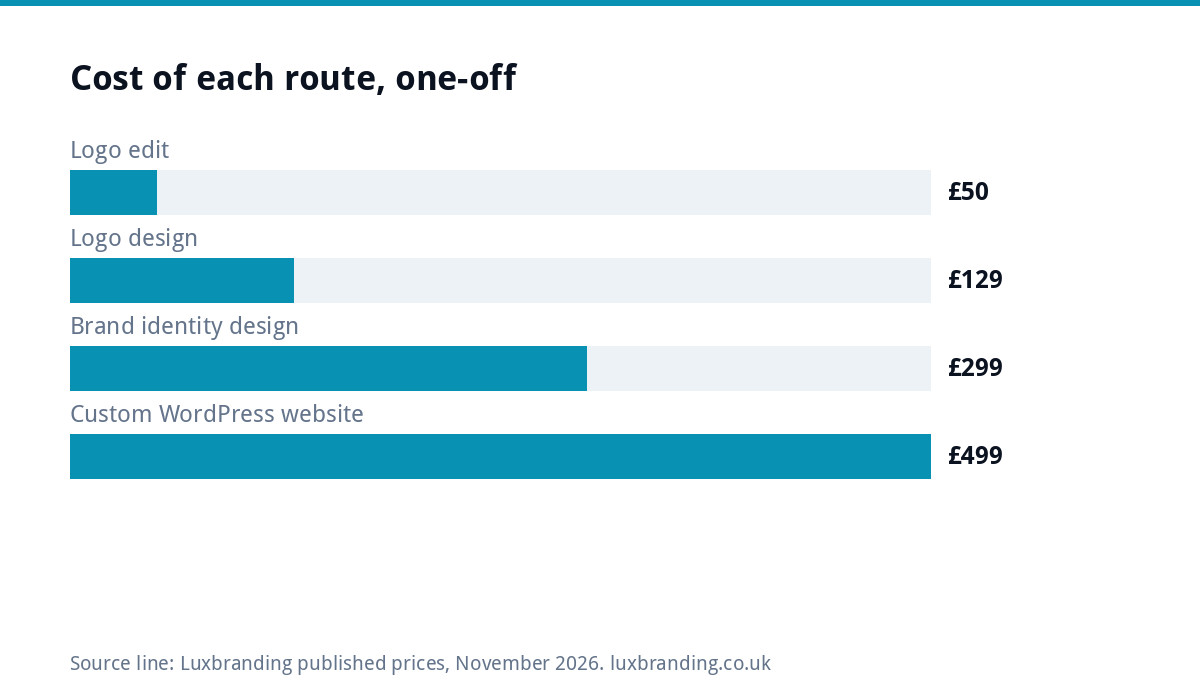
| Logo edit | Changes to a logo you own: colour, font, spacing, layout | £50 one-off |
| Logo design | New logo, unlimited concepts, all layouts and file formats | £129 one-off |
| Brand identity design | Logo, colours, typography, imagery, brand guidelines | £299 one-off |
| Custom WordPress website | Up to 8 pages, custom design, mobile-first, SEO foundation | £499 one-off |
| Rebrand package | A full rebrand bundle | £1,999 |
A logo edit keeps the mark recognisable and returns the edited vector in every format. Logo design at £129 includes stacked, horizontal and icon-only layouts. Brand identity design at £299 adds the colours, fonts and guidelines a website is built from. Our custom WordPress websites are hand-coded, take 2 to 4 weeks and you own the code. For a complete change, see the rebrand package.
Doing both on a tight budget
If both need work but the money is not there for everything this month, phase it rather than doing a cheap version of each.
- Month one: the brand. Get the logo right, with every layout and file format, ideally with colours and fonts written down. Brand identity followed by a custom website comes to £798 in total, but the logo alone at £129 is enough to start.
- Straight away: the free fixes. Swap the new logo onto your Google Business Profile, social profiles, email signature and invoices. These cost nothing and make the change visible immediately.
- Month two or three: the website. Build it around the finished brand, so the design is done once.
- When budget allows: vehicles and signs. These are the most expensive items to redo, so do them last, when the brand is settled and tested.
What to avoid is the halfway house: a new website designed around an old logo you already plan to replace. It feels like progress but usually means paying for parts of the site twice. If cash flow is the main barrier, our pay monthly website at £79 a month, on a 12-month minimum term with hosting included, spreads the cost of the build instead.
Before you start either
Whichever you choose, write down what is going wrong and what success looks like: more quote requests, higher-value jobs, looking credible to commercial buyers. A website judged on enquiries and a logo judged on recognition are easier to brief and easier to measure. If the site has technical problems, Google’s Core Web Vitals guidance sets good thresholds, such as the largest content appearing within 2.5 seconds, which is a useful benchmark for any rebuild. For a fuller look at timing, our guide on when to rebrand helps, and every price is on our pricing page.
Get the UK Branding Budget Worksheet (free)
A printable worksheet: decide what your brand needs now and price it against fixed published prices and the IPO trademark fee.
No spam. UK GDPR compliant. We only use your email to send this resource, unless you tick the box to hear from us.
Frequently asked questions
Should I redesign my logo or my website first? +
Fix whichever is losing you work. If people find you but do not enquire, start with the website. If the business looks amateur everywhere, start with the logo. When both need doing, do the logo first and build the website around it, so the site is only designed once.
Can I refresh my logo without a full redesign? +
Often, yes. Many logos look dated because they are badly used: stretched, pixelated or in the wrong colours. Rebuilding the file as vector or a logo edit to modernise the font, spacing or layout may be enough. Our logo edit is £50 one-off and keeps the mark recognisable.
Will a new logo improve my website's enquiries? +
Not on its own. A logo builds recognition and credibility, but enquiries depend on the website answering questions quickly, loading fast on phones and making it easy to get in touch. If visitors arrive and leave without enquiring, the website is the bottleneck, whatever the logo looks like.
What happens to my trade mark if I change my logo? +
Under section 44 of the Trade Marks Act 1994, a registered trade mark cannot be altered in the register, except limited changes to a name or address in the mark that do not substantially affect it. A new logo usually needs a new application if you want it protected.
How much does it cost to do both? +
A new logo is £129 one-off, or £299 for full brand identity with colours, typography and guidelines. A custom WordPress website is £499 one-off for up to 8 pages. Doing the brand identity then the website costs £798 in total. A rebrand package is £1,999.