Quick answer
A web designer plans how a site looks and works for visitors; a web developer writes the code that makes it run, from page templates to databases and integrations. Most small business websites need someone who does both, which a £499 custom WordPress website covers. Bring in a specialist developer for booking systems, portals or custom apps.
The two titles get used interchangeably, and plenty of freelancers and agencies call themselves both, which makes it hard to know who to hire. The difference matters most when you are comparing quotes or planning something beyond a standard business website. This guide explains what each role does, where they overlap, and five common situations with the right person for each.
What a web designer does
A designer works out what the site should look like and how visitors move through it: the layout, typography, colours, imagery and the journey from landing on a page to making an enquiry. The National Careers Service web designer profile lists tasks such as speaking with clients to find out what they want the site to do, creating prototypes using both code and design software, making sure websites meet accessibility standards and design principles, and using content management systems to manage and maintain sites.
In other words, a good web designer is not just making things pretty. They are deciding what goes on each page, in what order, and how it works on a phone.
What a web developer does
A developer builds it. The National Careers Service web developer profile lists tasks such as working out how the website or application will fit together, writing code in different programming languages, building databases and transferring information between them using APIs, and working with testers to find and fix bugs.
Developers are often split into front-end, building what you see in the browser, and back-end, building the server, database and logic behind it. On a simple business website the line blurs; on a booking system or customer portal it becomes very clear.
Designer and developer side by side
| Web designer | Web developer | |
|---|---|---|
| Main question | What should visitors see and do? | How do we make it work reliably? |
| Typical output | Layouts, page designs, prototypes, style choices | Working code, templates, databases, integrations |
| Tools | Design software, prototyping tools, a CMS | Code editors, programming languages, version control, servers |
| Cares most about | Clarity, brand, usability, accessibility, conversion | Performance, security, data, maintainability |
| You notice them when | The site looks dated or confusing | The site is slow, breaks or cannot do what you need |
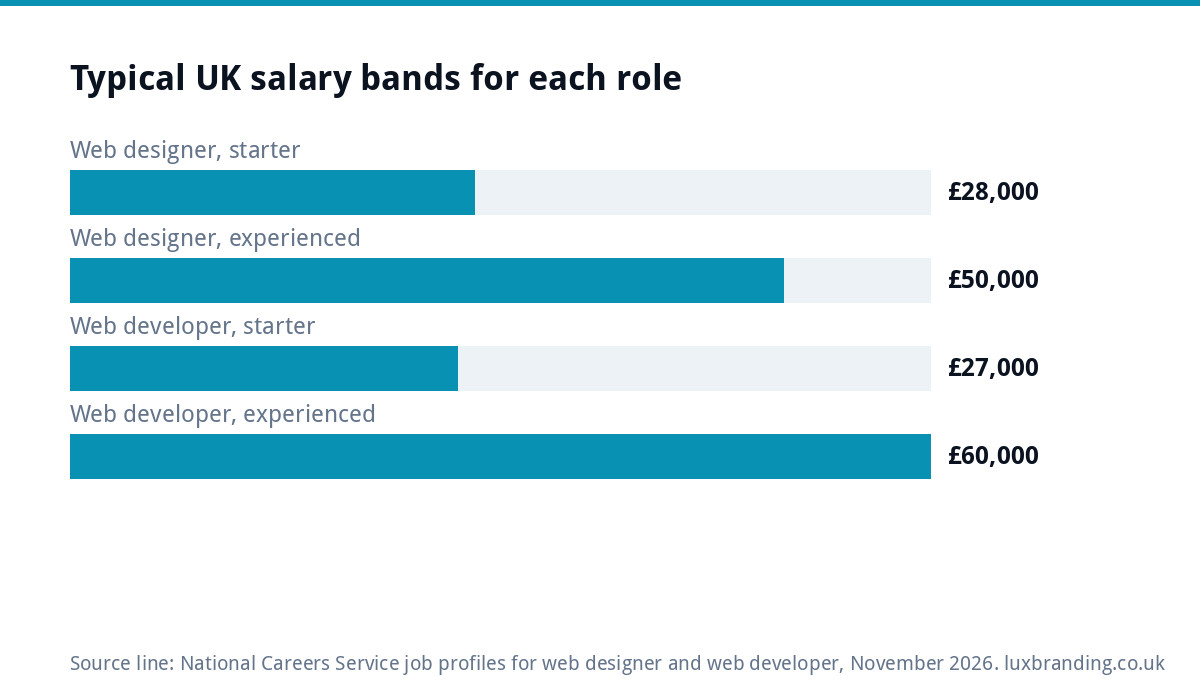
| Typical UK salary band | £28,000 starter to £50,000 experienced | £27,000 starter to £60,000 experienced |
The salary bands are from the National Careers Service profiles at the time of writing, November 2026, and give a sense of how the market values each role; they are not what you would pay for a project.
Where the roles overlap
On most small business websites, one person or one small team does both. A designer who builds in WordPress is doing development work; a developer who chooses the layout is doing design work. That is fine, as long as both jobs actually get done. The risks come at the extremes:
- Design without development: a beautiful mockup that is slow, breaks on phones or cannot be updated by you.
- Development without design: a technically solid site that is confusing to use and does not turn visitors into enquiries.
Ask anyone quoting for your website who is doing each part, and to show you live sites they have built, not just images.
Other job titles you will come across
Quotes and profiles use plenty of other titles. Here is what they usually mean in practice:
- UX designer: focuses on user experience, meaning how easy the site is to use, often through research, user journeys and testing. On a small site, a good web designer covers this.
- UI designer: focuses on the interface itself, such as buttons, forms, menus and the visual details of each screen.
- Front-end developer: builds what you see in the browser from the designs, using HTML, CSS and JavaScript.
- Back-end developer: builds the server side: databases, logins, payments and connections to other systems.
- Full-stack developer: works on both front end and back end.
- WordPress developer: specialises in building themes and plugins for WordPress, the most common platform for small business sites.
- SEO specialist and copywriter: not designers or developers, but often needed alongside them. Words and search visibility make or break a site as much as its looks or code.
The title matters less than the evidence. Ask to see live work and to speak about how they would handle your specific project.
Signs your current site needs a developer, not a designer
- Pages take several seconds to appear on a phone.
- Forms stop sending, or the site shows security warnings.
- An update broke something and nobody knows how to fix it.
- You need it to connect to a booking, stock or accounts system.
If the complaint is that the site looks old, reads poorly or does not persuade people to get in touch, that is a design problem first. If speed is the only issue, a focused fix can be enough: our website speed optimisation is £99, and it is worth trying before paying for a full rebuild.
Five situations and who you need
| Situation | Who you need | Why |
|---|---|---|
| New brochure website for a trade or local service | A designer who builds, or an agency doing both | Mostly design and content, standard build |
| Existing site looks dated but works | Designer first | The structure is fine; the presentation is not |
| Site is slow, insecure or keeps breaking | Developer first | Technical problems need technical fixes |
| Online shop with up to 20 products | Design and build together | Standard e-commerce, careful checkout design |
| Booking system, customer portal or custom app | Specialist developer, with design input | Databases, logins and integrations |
What the technical side should achieve
Whoever builds your site, the development quality shows up in speed and stability. Google’s Core Web Vitals guidance sets good thresholds: the largest content element appearing within 2.5 seconds, responses to interaction in 200 milliseconds or less, and a layout shift score of 0.1 or less, measured at the 75th percentile of page loads. You do not need to understand the details; ask your developer whether the site meets them on mobile, and check with Google’s PageSpeed Insights.
Questions to ask before you hire
- Who designs the site and who builds it? Is it the same person or team?
- Is it built with a page builder or theme, or hand-coded?
- Can I update text and images myself, and will you show me how?
- Who owns the code and design once it is paid for?
- Where will it be hosted, and can I move it?
- How fast does it load on a phone, and how will you check?
- What support is included after launch?
Vague answers to the ownership and hosting questions are the biggest warning signs. If you are already stuck with a site you cannot change, our guide for owners who cannot update their own website explains the way out.
Costs: who costs what
Day rates vary widely across the UK, so the clearer comparison for a small business is the cost of the finished result. Our website cost guide covers the wider market. For reference, our own fixed prices:
- Custom WordPress website: £499 one-off for up to 8 pages, designed and hand-built, no page builders, 2 to 4 weeks.
- Premium custom WordPress: £1,499 for up to 14 pages.
- Web applications: from £1,999 for custom apps, dashboards, portals and booking systems.
- Website management and hosting: £20 a month for the ongoing technical care.
For bespoke software, the web app development cost guide explains what drives the price. Bigger sites, lead-generation tools and member areas are quoted in writing before any work starts.
Builders, agencies and freelancers
If you are weighing a DIY builder against hiring anyone at all, our comparison of Wix and a custom website covers the trade-offs. A freelancer can be excellent value if they are strong at both design and build; an agency gives you both skills under one roof and someone to contact if a person is off. Whichever you choose, the deciding factor is the same: can they show you live sites, built for businesses like yours, that load quickly and bring in enquiries? See every price on our pricing page.
Get the UK Website Project Brief Template (free)
A two-page template for briefing any UK web designer: sitemap, integrations, audience and deliverables. Cuts revision rounds in half.
No spam. UK GDPR compliant. We only use your email to send this resource, unless you tick the box to hear from us.
Frequently asked questions
What is the difference between a web designer and a web developer? +
A web designer plans how the site looks and how visitors use it: layout, typography, colours, imagery and the route to an enquiry. A web developer writes the code that makes it work, from page templates to databases and integrations. On many small business sites, one person or team does both.
Do I need a web designer or a developer for a small business website? +
Usually someone who does both. A brochure site for a trade or local service is mostly design and content on a standard build, so a designer who builds, or an agency covering both, fits well. A specialist developer becomes important for booking systems, customer portals, custom apps or a site with technical faults.
Is a web developer more expensive than a web designer? +
Rates vary widely, so compare the cost of the finished result rather than job titles. As a guide to how the market values each role, the National Careers Service lists web designers at £28,000 to £50,000 a year and web developers at £27,000 to £60,000, at the time of writing.
Can a web designer fix a slow or broken website? +
Some can, if they also build sites. Slowness, security warnings and errors are technical problems, so you need someone with development skills, whatever their title. Ask whether they will measure speed on mobile against Google's Core Web Vitals thresholds and what they will change to improve it.
What does a custom website cost with Luxbranding? +
A custom WordPress website is £499 one-off for up to 8 pages, designed and hand-built without page builders, and you own the code. Premium custom WordPress is £1,499 for up to 14 pages. Web applications such as portals and booking systems start from £1,999. All prices are listed on our pricing page.