Quick answer
A deposit of 30 to 50% before work starts is normal for UK web design, with the balance due at sign-off or before the site goes live. Bigger builds usually split into three or four milestone payments. Pay against named stages, never 100% upfront on a large custom project, and get the schedule in writing.
Payment terms are one of the least discussed parts of hiring a web designer, yet they decide how much risk you carry if the project stalls. This guide sets out the schedules you will meet, what is fair at each budget, what to check before you hand over money and what to do if things go quiet. It is written for trades and small businesses buying a website for the first time or the second time after a bad experience.
The three payment schedules you will see
Most quotes use one of three models. Each shifts risk between you and the designer in a different way.
| Schedule | How it works | Typical for | Your risk |
|---|---|---|---|
| Paid in full upfront | One payment when you order | Small fixed-scope products with a published price | Higher if the supplier is unknown; low with an established business and clear inclusions |
| Deposit and balance | 30 to 50% to start, the rest at sign-off or launch | Most small business websites | Moderate: you have paid for work not yet seen |
| Milestone payments | Three or four payments tied to stages such as design approval, build complete and launch | Larger custom sites, online shops, web apps | Lowest: each payment follows visible progress |
| Monthly plan | A fixed monthly fee over a minimum term | Pay-monthly websites that include hosting | Low upfront, but you pay for longer and must read the exit terms |
Why designers ask for a deposit at all
A deposit is not a sign of distrust. It books time in a schedule, covers early work such as wireframes and design concepts, and filters out people who are not ready to start. A designer who turns down other work to fit your project in has a real cost if you vanish after the first draft.
From your side, the deposit also proves commitment. Once money has changed hands, both parties tend to take deadlines seriously. The problem is not deposits themselves; it is a deposit that is too large for the risk, or a schedule that leaves nothing owing at the point where you most need leverage, which is just before launch.
What is fair at each budget
The right split depends on the size of the job. Here is a sensible guide, using our own published prices as reference points so the figures are real rather than invented averages. Prices are on our pricing page and in the UK website cost guide.
| Project | Example price | Sensible schedule |
|---|---|---|
| Landing page | £199 | Full payment upfront is common at this size |
| One-page website | £299 | Full upfront or 50/50 |
| Custom WordPress site, up to 8 pages | £499 | 50/50, or full upfront from an established supplier |
| Premium custom site, up to 14 pages | £1,499 | 40% deposit, 30% at design approval, 30% at launch |
| Web application | From £1,999 | Three or four milestones against a written scope |
Under a few hundred pounds, splitting payments adds admin for both sides and protects very little. Above roughly £1,000, you should expect milestones, and you are entitled to ask for them.
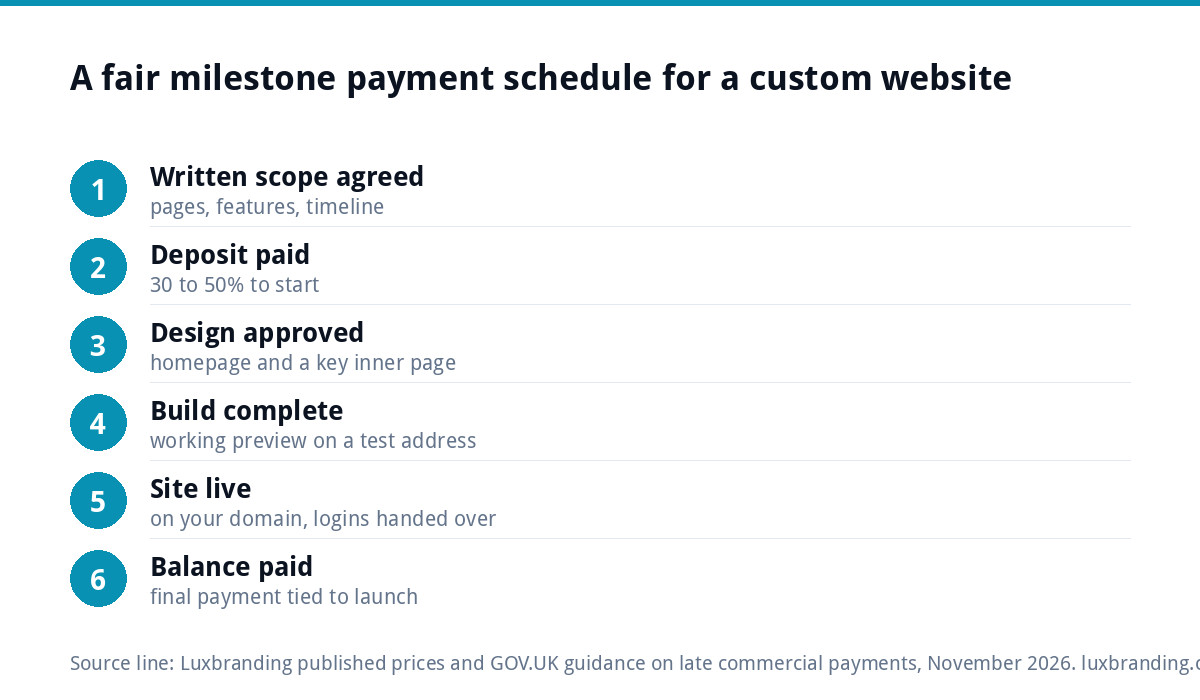
Milestones that should trigger each payment
A milestone should be something you can see and approve, not a date on a calendar. Good triggers include:
- Project start: the deposit, once you have a written scope, page list and timeline.
- Design approval: you have seen the homepage and a key inner page as a design or a working preview.
- Build complete on a test address: every page exists, forms work and you can click through on your phone.
- Launch: the site is live on your domain and the handover items are delivered.
Avoid schedules where the final payment is due “on completion of the build” but before launch, with launch then delayed for reasons you cannot see. Tie the last payment to the site being live and the login details being in your hands. Our website launch checklist lists what should be working by that point.
Checks before you pay a deposit
Five minutes of checking saves a lot of grief. Before transferring anything:
- Look the business up. If it is a limited company, Companies House lets you get information about a company for free, including the registered address, incorporation date, current and former officers and insolvency information.
- Get a written quote that names the pages, features and number of revision rounds, and says what is not included.
- Check who owns what. The domain should be registered in your name and the finished site should be yours, with no platform lock-in.
- Pay a business, by a traceable method, and get an invoice for the deposit.
- Read the cancellation clause. What happens to the deposit if you cancel, or if they do?
Red flags in a payment schedule
Most designers are honest, but some patterns should make you pause. Our guide to spotting web designer overcharging goes deeper on pricing tricks; these are the payment-specific ones:
- 100% upfront on a large bespoke project from someone with no track record you can check.
- No written scope, so the deposit buys an undefined amount of work.
- A final payment that is required before you receive admin access, the domain or the files.
- Pressure to pay quickly to “lock in” a discount that expires today.
- Payment requested to a personal account that does not match the business name on the quote.
- Extra charges for every round of changes that were not mentioned at the start.
If the project stalls after you have paid
Projects stall on both sides. Often the delay is the customer: content not supplied, feedback slow, decisions put off. Check your own list before chasing. If the delay is the designer’s, put your concerns in writing with a reasonable deadline, and refer to the timeline in the quote.
If you are the one who owes money, remember the law applies to you too. Under UK rules on late commercial payments, if no payment date is agreed, a payment is late 30 days after the customer gets the invoice or the service is provided, whichever is later. The supplier can then charge statutory interest of 8% plus the Bank of England base rate on business-to-business debts, unless the contract sets a different rate. Paying the balance promptly at launch keeps the relationship clean.
Monthly plans: a different trade-off
Some businesses would rather not pay a lump sum at all. A pay-monthly website spreads the cost: ours is £79 a month on a 12-month minimum term with hosting included, set out on the pay monthly website page. The upfront risk is low, but over two or three years you pay more than a one-off build, and the exit terms matter. Before signing any monthly plan, ask what you keep if you leave: the domain, the content, and whether the site itself transfers.
A one-off build with separate hosting is usually cheaper over time. Use the website cost calculator to compare the two over the period you expect to keep the site.
How to agree terms without awkwardness
You can raise payment terms without sounding suspicious. Try asking: “What is your payment schedule, and what do I see before each payment?” A professional will have a clear answer. If you want a different split, propose one tied to visible stages rather than simply asking to pay less upfront; most designers accept milestones that match work delivered.
Write the agreed schedule into the quote or a short email both sides confirm. That single paragraph prevents most disputes.
It also helps to agree what counts as approval. A short line such as “design is approved when you reply to confirm it, or after five working days with no changes requested” stops a milestone payment hanging in limbo while a decision waits. Keep every invoice, receipt and approval email in one folder, so if there is ever a disagreement you can show exactly what was paid, when, and for which stage.
How our website pricing works
We publish flat fees rather than quoting each website from scratch. A custom WordPress website is £499 one-off for up to 8 pages, typically built in 2 to 4 weeks, hand-coded with no page builders, and you own the code and can host anywhere. It includes custom design, a mobile-first build, an SEO foundation, contact forms connected to your inbox, Google Analytics, a written CMS walkthrough and 30 days of support. Bigger sites, lead-generation tools and member areas are quoted in writing before any work starts, so you know the full figure before you commit.
Whoever you hire, the principle is the same: know the total, know what triggers each payment, and keep the final payment linked to a live site you control.
Get the UK Website Project Brief Template (free)
A two-page template for briefing any UK web designer: sitemap, integrations, audience and deliverables. Cuts revision rounds in half.
No spam. UK GDPR compliant. We only use your email to send this resource, unless you tick the box to hear from us.
Frequently asked questions
How much deposit should a web designer ask for? +
For a small business website in the UK, 30 to 50% before work starts is the usual range, with the balance at sign-off or launch. Very small fixed-price jobs are often paid in full upfront. Larger custom projects should be split into three or four milestone payments tied to stages you can see and approve.
Is it normal to pay 100% upfront for a website? +
It is common for small products with a published price and clear inclusions, such as a landing page or a one-page site from an established business. It is risky for a large bespoke project from someone you cannot check. On bigger builds, ask for milestones and keep the final payment tied to launch.
Is a web design deposit refundable? +
It depends on the contract, so read the cancellation clause before paying. Many designers keep the deposit to cover time booked and early work such as concepts. A fair contract explains what happens to it if you cancel, if the designer cancels, or if the project cannot go ahead for reasons on either side.
When should the final payment for a website be made? +
Tie the final payment to the site being live on your domain, with the admin logins, domain control and handover items in your hands. Avoid schedules where the last payment falls due at build completion but launch can then be delayed indefinitely, or where access is only released after payment and on the designer's terms.
What should I check before paying a web designer? +
Look the business up on Companies House if it is a limited company, get a written quote naming pages, features and revision rounds, confirm the domain will be in your name, pay a business account by a traceable method and get an invoice. Then read what happens to your money if the project is cancelled.