Quick answer
Usually not from day one. When we manage Meta ads we recommend at least £500 a month of ad spend, and ads work better once there is something to send people to. Spend the first four weeks building complete profiles, posting real work and gathering reviews. Then test ads with a fixed budget aimed at enquiries.
New business owners often hear two opposite pieces of advice: “organic social is dead, you have to pay” and “never pay for ads until you have an audience”. Both are half right. This guide explains what each does well, why the order matters, and gives a simple 90-day plan for a new business with a modest budget.
What organic and paid social each do
Organic social is everything you post for free: photos of work, short videos, updates and replies. It builds trust with people who already know you and gives anyone who finds you something to judge you by. Its reach is limited, because platforms decide who sees each post.
Paid social is advertising: you pay Meta, TikTok or another platform to show a post or advert to people you choose, by area, age or interest. It reaches people who have never heard of you, on your timetable, but it stops the moment you stop paying.
The two do different jobs. Organic social is your shop window. Paid social is the leaflet that brings people to look in it.
Organic vs paid at a glance
| Organic | Paid | |
|---|---|---|
| Cost | Your time, or a manager’s fee | Ad spend plus your time or a management fee |
| Reach | Mostly existing followers and their friends | Anyone you target in your area |
| Speed | Slow to build | Results can start within days |
| Lasts | Posts and reviews keep working as proof | Stops when the budget stops |
| Best at | Trust, proof and staying remembered | Reaching new people and testing offers |
| Main risk | Posting into silence for months | Paying to send people to an empty profile |
Why the order matters for a new business
When someone sees your ad, they rarely act straight away. Most tap through to your profile or website to check you out first. If they find three posts, no reviews and a profile picture that does not match the ad, they leave, and you paid for that visit.
A few weeks of groundwork changes that. A complete profile, a dozen posts of real work and a handful of reviews mean the people your ads reach find a business that looks established. The same ad budget then turns into more enquiries.
The exception is a business with an urgent, time-limited reason to advertise, such as a grand opening or a seasonal service. Then run ads from the start, but still get the basics in place in the first week.
Which comes first, by situation
| Situation | Start with | Why |
|---|---|---|
| New local trade, no reviews yet | Organic for four weeks, then paid | Ads need a credible profile to land on |
| Grand opening or launch date | Both at once | The date will not wait; set up basics in week one |
| Seasonal service, such as gutter clearing | Paid just before the season | Demand is short; organic alone is too slow |
| New online shop with good photos | Organic and a small paid test together | Products can be judged from the ad itself |
| Business-to-business service | Organic on LinkedIn, then targeted ads | Buyers check credibility before replying |
| Established business, new to social | Paid sooner | Existing reviews and website already provide proof |
A worked example: a new mobile dog groomer
A groomer launches in March with a van, a Facebook page and an Instagram profile. For the first month she posts three times a week: before-and-after photos, a short clip of a nervous spaniel settling in, and her price list. Her first dozen customers leave reviews. In April she runs one Facebook campaign to dog owners in her postcodes, sending people to a simple booking page. Because the profile already shows real dogs, real owners and real prices, people who click through can see she is genuine. She keeps posting while the ads run, and the posts become the proof that turns ad clicks into bookings. These are example details to show the method, not a promise of results.
What “organic reach” really means now
Platforms decide who sees each post. Instagram explains in its post on how Instagram ranking works that it does not have one single algorithm: Feed, Stories, Explore and Reels each rank content in their own way, using signals such as a person’s activity and the posts they have liked, shared, saved or commented on.
For a new account with few followers, that means organic posts will not reach many people at first. That is fine. In the early weeks, organic posting is not about reach. It is about having proof on the profile for when people arrive from ads, Google or word of mouth.
A 90-day plan for a new business
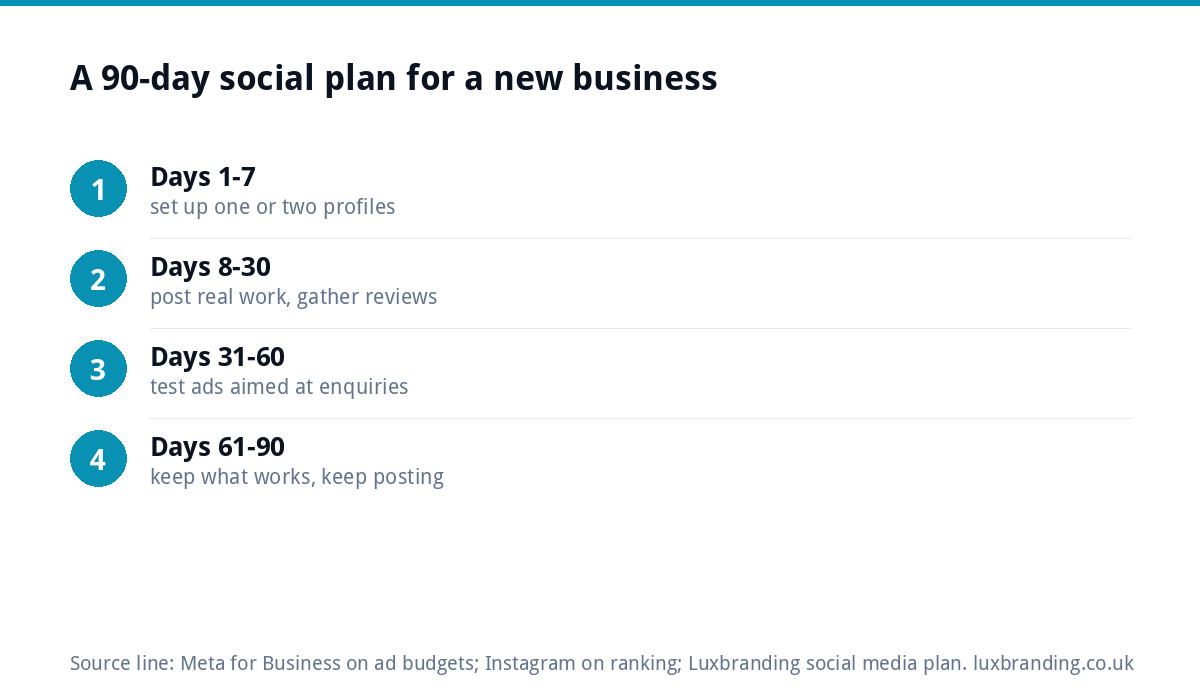
- Days 1 to 7: set up properly. Business profiles on the one or two platforms your customers use, with your branding, a clear bio, service area, phone number and website link.
- Days 8 to 30: build proof. Post two or three times a week: finished work, before-and-afters, the team, short tips. Ask your first customers for reviews.
- Days 31 to 60: test paid ads. Run one campaign aimed at enquiries, with two or three versions of the ad, sent to a page built for that offer.
- Days 61 to 90: keep what works. Pause the weakest ad, try one new idea, and keep posting so the profile stays fresh.
Two platforms done well beat five done badly. For most local service businesses, Facebook and Instagram are the place to start; for business-to-business services, LinkedIn may matter more.
Setting a paid budget you can judge
Meta’s guide to how much Facebook ads cost recommends setting a budget that runs for at least seven days and says Meta may spend up to 75% over your daily budget on some days to make the most of opportunities, averaging out across the week. It also recommends a starting budget of at least US$5, but a few pounds a day is a test of the platform, not of your business.
To judge whether ads bring enquiries, you need enough budget for long enough to see a pattern. That is why, when we manage campaigns, our Meta ads management page recommends at least £500 a month of ad spend: below that, there are rarely enough results to learn from.
What to measure
- Cost per enquiry, not cost per click or likes.
- Quality of enquiries: are they in your area and after work you do?
- Jobs won from those enquiries, over a couple of months.
Where to send people from an ad
An ad that sends people to your homepage makes them search for the thing they clicked. A page built for that one offer, with the price, proof and a short form, usually converts far better. A focused landing page is £199 with us, and it can be reused across Facebook, Instagram and Google ads for the same offer.
If you do not have a website yet, your profile has to do the job. Make sure the call and message buttons work and that someone replies quickly.
Branding makes both work harder
Ads and posts that look the same become recognisable. When the colours, typeface and photo style match across your profile, posts, ads and van, people start to remember you after a few sightings rather than a few dozen. For trades, our guide to branding for trades businesses shows how that consistency works across vans, uniforms and social profiles.
Keep paid posts clearly labelled
If you pay or reward anyone to post about you, such as a local influencer or a customer given a discount, the post must be clearly identifiable as an advert. The ASA’s guidance on recognising ads on social media sets out how to label them. Ads you run through Meta’s own tools are labelled automatically.
Mistakes new businesses make
- Boosting random posts with no goal, then deciding ads do not work.
- Running ads to a profile with no posts or reviews.
- Judging ads after three days and £20.
- Posting every day for a month, burning out, then stopping completely.
- Trying to be on every platform at once.
Getting help with both
Our Social Media Management is £249 a month for 12+ posts a month with full management, run by a real person. Paid campaigns are a separate service: our Meta ads management is £199 a month for up to £5,000 of monthly ad spend, with Pixel and Conversions API setup and no markup on your budget. Every fixed price is on our pricing page, and if your profile still needs a proper look first, our Brand Identity Design is £299.
Get the UK SEO DIY Audit Checklist (free)
A 32-point checklist UK SMEs can run against their own website in an afternoon. Surfaces the quick wins before paying for a paid audit.
No spam. UK GDPR compliant. We only use your email to send this resource, unless you tick the box to hear from us.
Frequently asked questions
Should a new business start with paid or organic social media? +
Usually organic first, for a few weeks. People who see an ad tend to check your profile before getting in touch, so complete profiles, posts of real work and a few reviews make every pound of ad spend work harder. The exception is a time-limited reason to advertise, such as an opening, when ads can start immediately.
How much should a new business spend on social media ads? +
Enough to see a pattern. Meta recommends a budget that runs for at least seven days, but a few pounds a day only tests the platform. When we manage Meta campaigns, we recommend at least £500 a month of ad spend, because below that there are rarely enough results to judge what works.
Is organic social media still worth it? +
Yes, but for proof more than reach. A new account will not reach many people at first, because platforms rank posts using signals such as each person's activity. A complete, active profile with real work and reviews reassures people who arrive from ads, Google or word of mouth, and that is where it earns its keep.
Which social platforms should a new local business use? +
Pick one or two where your customers already are, rather than all of them. For most local service businesses, Facebook and Instagram are the place to start. For business-to-business services, LinkedIn may matter more. Two platforms done well, with regular posts and quick replies, beat five that are left half-finished.
Can you manage our organic posting and our ads? +
Yes, as two services. Our Social Media Management is £249 a month for 12+ posts a month with full management. Our Meta ads management is £199 a month for up to £5,000 of monthly ad spend, with Pixel and Conversions API setup and no markup on your budget. Every fixed price is on our pricing page.