Quick answer
Influencer marketing works for small UK businesses when you pick local creators whose followers match your customers, agree the deal in writing and make sure every paid, gifted or affiliate post is clearly labelled “Ad” upfront. Under ASA and CMA rules the brand shares responsibility, so check posts before they go live.
You do not need a celebrity to benefit from influencer marketing. For a café, salon, gym, independent shop or home improvement business, a few local creators with engaged followers can do more than one big name. The catch is that advertising rules apply from the first free sample. This guide covers how to choose creators, what to pay or offer, how to brief them, how to stay within UK rules and how to measure whether it worked.
What counts as influencer marketing
Any time a creator posts about your business because you gave them something, it is influencer marketing. That includes:
- Paying for a post, story, reel or video.
- Giving free products, services or meals.
- Offering a discount or commission through an affiliate link or code.
- Any ongoing ambassador or partnership arrangement.
The Competition and Markets Authority’s guidance for content creators says the rules apply if someone has received a product for free or at a discounted rate, no matter how many followers they have. A creator with 800 local followers is covered in exactly the same way as one with 800,000.
Types of creator and what they suit
| Creator size | Typical reach | Best for | Usual arrangement |
|---|---|---|---|
| Local micro-creators | A few thousand followers, mostly nearby | Cafés, salons, gyms, shops, local services | Free product or experience, sometimes a small fee |
| Niche specialists | Tens of thousands in one interest | Products for a hobby or trade audience | Fee, product, or affiliate commission |
| Regional names | Large following across a city or region | Launches and events | Paid fee, often through an agent |
| National creators | Hundreds of thousands or more | National e-commerce brands | Paid campaign with contract |
For most small businesses, local micro-creators and niche specialists give the best return, because their followers are more likely to be real potential customers. They are also usually easier to reach directly, quicker to agree terms with and more willing to visit in person, which makes the content feel genuine.
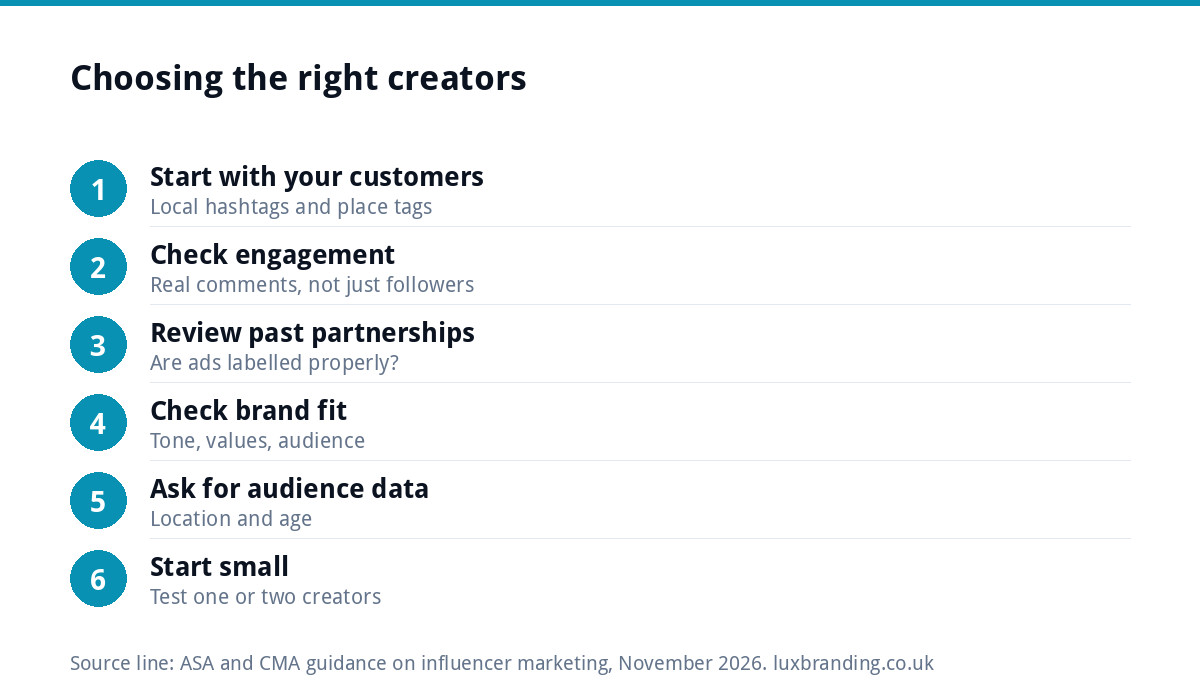
How to choose the right creators
- Start with your customers. Who buys from you, where do they live and what do they follow? Search local hashtags and place tags.
- Check engagement, not just followers. Read the comments. Real conversations beat thousands of emoji replies.
- Look at past partnerships. Are they labelled properly? A creator who hides ads puts you at risk too.
- Check fit with your brand. Tone, values and audience should sit comfortably with yours.
- Ask for audience insights. Most platforms let creators see where their followers are; ask for a screenshot of location and age data.
- Start small. Test one or two creators before committing to a bigger campaign.
The rules: making clear ads are ads
The Advertising Standards Authority’s advice on recognising ads on social media sets out the key points. The CAP Code requires marketing to be obviously identifiable as such, and when influencers and brands blend editorial and advertising, the onus is not on the consumer to work it out; that is the responsibility of brands and influencers.
In practice:
- Use a clear label upfront. “Ad” or “#ad” at the start of the caption or on the video itself, visible before anyone clicks “more”.
- Avoid vague labels. The ASA advises against “sponsored”, and says labels such as “Supported by”, “Gifted”, “In association with” and “#BrandAmbassador” are unlikely to be clear enough on their own.
- Label gifted content too. The ASA’s advice applies to everything from a post about a gifted product to a full brand collaboration.
- Affiliate links count. Content with an affiliate link or code counts as advertising, and the ASA typically considers the brand at least jointly responsible, whether or not it controlled the specific content.
The ASA and CMA also publish a joint influencers’ guide to making clear that ads are ads, which covers what counts as payment, affiliate marketing and how to label clearly. It is worth sending to every creator you work with.
Your responsibilities as the business
Because you share responsibility, build compliance into the deal rather than hoping for the best:
- Put the labelling requirement in writing in every agreement.
- Ask to see captions before posting, or at least check them within an hour of going live.
- Never ask a creator to hide the relationship or make it look unprompted.
- Make sure product claims are accurate; a creator repeating your exaggerated claim is still your ad.
- Keep records of what was given or paid, and the posts that resulted.
This is general guidance rather than legal advice. If your product makes health, beauty or financial claims, take extra care, as those areas carry stricter rules.
What to offer creators
Small businesses usually start with what they already have: a meal, a treatment, a class pass, a product bundle or a service visit. As you work with creators more, you may add a fee or a commission. Whatever you offer, agree it clearly in advance, including:
- What they receive, and its value.
- What they will post, on which platforms, and roughly when.
- Whether you can reuse the content on your own channels, for how long, and with credit.
- How the post will be labelled.
- What happens if they cannot post as agreed.
Briefing a creator well
A good brief gives creators freedom to sound like themselves while protecting your brand. Include one key message, any facts that must be accurate (prices, opening hours, locations), your tag and handle, the labelling requirement, and a few examples of your brand’s look and tone. Clear brand assets make that easier; if your logo, colours and photography are inconsistent across channels, our guide to a brand that looks inconsistent everywhere explains how to fix it before you invite others to represent you.
A worked example
Picture a hypothetical independent bakery in Harrogate launching a weekend brunch menu. It invites three local food creators, each with a few thousand followers in the town, to a free brunch for two on different Saturdays. The written agreement, sent by email and confirmed by each creator, covers one feed post and three stories within a week, an “Ad” label at the start of each caption, permission for the bakery to reshare the photos with credit for six months, and a unique code giving followers a free coffee with brunch. The bakery checks each post on the day it goes live. Three weeks later it can see which creator’s code was used most, and invites that creator back for the Christmas menu.
When influencer marketing is not the right tool
It suits businesses whose products or experiences look good and are bought on impulse or by recommendation: food, beauty, fitness, gifts, interiors and local leisure. It is a weaker fit for emergency trades, B2B services and anything bought through a formal quote. A plumber or an accountant will usually get more from a strong Google Business Profile, reviews and a clear website than from a creator post.
Measuring whether it worked
| What to track | How |
|---|---|
| Sales or bookings | A unique discount code or booking link per creator |
| Website visits | Tagged links so your analytics shows each creator separately |
| New followers | Follower change in the days after each post |
| Content value | Photos and videos you are allowed to reuse |
| Cost per result | Value given divided by sales or bookings |
Give each campaign a fair test, then compare creators against each other and against your paid ads. Our Facebook and Instagram ads service can amplify the best creator content to a wider local audience, labelled as an ad in the usual way.
Common mistakes to avoid
- Choosing creators by follower count alone.
- Agreeing everything in direct messages with nothing written down.
- Letting posts go live without a clear “Ad” label.
- Sending a product without saying what you hope for in return, then feeling let down.
- Reusing a creator’s photos on your website without permission.
Get help with your social media
Influencer content works best alongside a consistent presence of your own. Our social media marketing and management service plans and runs your channels, and our social media design service gives your posts a consistent, recognisable look. If your brand itself needs work first, our Brand Identity Design is £299 for a logo, colours, typography, imagery and brand guidelines. Every service price is on our pricing page.
Get the UK SEO DIY Audit Checklist (free)
A 32-point checklist UK SMEs can run against their own website in an afternoon. Surfaces the quick wins before paying for a paid audit.
No spam. UK GDPR compliant. We only use your email to send this resource, unless you tick the box to hear from us.
Frequently asked questions
Do influencers have to label gifted posts as ads in the UK? +
Generally, yes. The ASA's advice says a clear "Ad" label applies to all types of marketing content, from a post about a gifted product to a full brand collaboration. The CMA's guidance applies when a creator receives something free or discounted, whatever their follower count. Labels such as "gifted" or "sponsored" on their own are unlikely to be clear enough.
Is my business responsible if an influencer does not label a post? +
You can be. The ASA says making ads recognisable is the responsibility of brands and influencers, and it typically treats the brand as at least jointly responsible for affiliate content. Put the labelling requirement in writing, check posts when they go live and ask for changes immediately if a label is missing or unclear.
How much should a small business pay an influencer? +
Many small businesses start by offering a product, meal, treatment or service rather than a fee, especially with local micro-creators. Larger creators often charge a fee or take affiliate commission. Whatever you agree, write down what each side gives and gets, including content reuse rights, and judge the value by the sales or bookings it brings.
Are micro-influencers worth it for a local business? +
Often, yes. Local creators with a few thousand engaged followers in your area can reach more genuine potential customers than a bigger account with a scattered audience. Check comments for real conversation, ask for audience location data and test with one or two creators before committing to a wider campaign.
How do I track sales from influencer posts? +
Give each creator a unique discount code or tagged booking link so results show separately in your till, booking system or website analytics. Track follower changes after each post and note any content you can reuse. Divide the value you gave by the sales or bookings that followed to compare creators fairly.