
Quick answer
A small business Christmas email plan needs four or five sends, not daily blasts: an early gift guide in mid-November, a Black Friday offer if you run one, a last-order or booking deadline reminder, a thank-you before Christmas and a January follow-up. Email only people who opted in or recently bought, and keep every offer honest.
December is when inboxes are fullest and patience is shortest. The businesses that do well are not the ones that send most; they are the ones whose emails are useful, well timed and easy to act on. This guide gives you a simple seasonal calendar, ideas for each send, the UK rules that apply, and the checks that keep your emails out of spam folders when the big senders are at full volume.
Before you write anything: who can you email?
UK marketing email is governed by the Privacy and Electronic Communications Regulations (PECR). The Information Commissioner’s Office summarises the position in its guidance on electronic mail marketing: you must not send marketing emails or texts to individuals without specific consent, with a limited exception for your own previous customers, often called the “soft opt-in”. You can send marketing emails to companies, and the ICO says it is good practice to keep a “do not email” list of any that object.
| Who | Can you send them Christmas marketing? |
|---|---|
| People who signed up to your newsletter | Yes |
| Recent customers who did not opt out (soft opt-in) | Yes, about similar products or services, with an easy opt-out |
| Business contacts at their work addresses | Generally yes, but stop if they object |
| People who only enquired and never bought | Only if they consented to marketing |
| Bought or scraped lists of individuals | No |
The festive season is not an exception. A “Merry Christmas” email that promotes your business is still marketing.
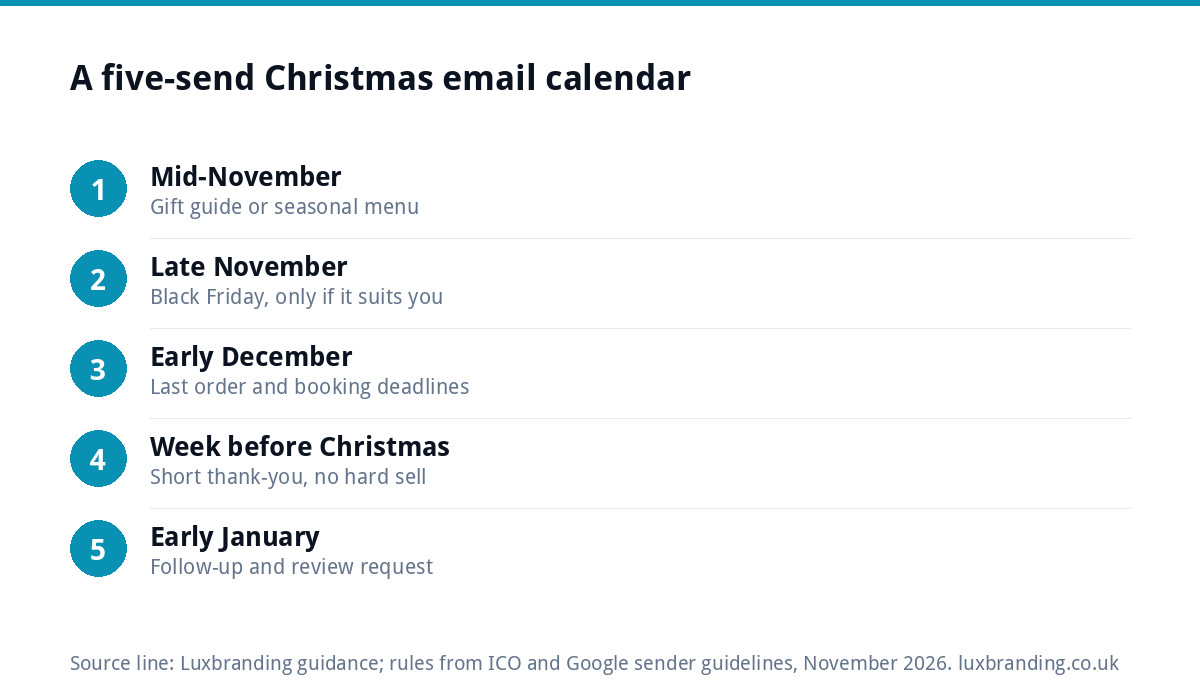
A five-send Christmas calendar
- Mid-November: gift guide or seasonal menu. Your best gifts, vouchers, festive bookings or winter services, with prices.
- Late November: Black Friday, only if it suits you. In 2026 Black Friday falls on 27 November and Cyber Monday on 30 November. Skip it if discounting does not fit your brand.
- Early December: deadlines. Last order dates for delivery, last booking slots, holiday opening hours.
- A week before Christmas: thank-you. A short, warm note with no hard sell, perhaps with a voucher reminder for last-minute buyers.
- Early January: follow-up. New-year services, January booking availability, or a request for a review from December customers.
Ideas for each send, by type of business
| Business | November | December | January |
|---|---|---|---|
| Online shop | Gift guide by budget | Last order dates, then e-vouchers | New stock and returns reminder |
| Café or restaurant | Christmas menu and party bookings | Opening hours and last tables | January offers for quiet weeks |
| Salon or gym | Gift vouchers | Last appointments before Christmas | New-year packages |
| Trades and home services | “Get it done before Christmas” slots | Holiday emergency cover and hours | Early-year booking for spring jobs |
| B2B services | Year-end planning help | Office closure dates and thank-you | Planning for the year ahead |
Write emails people actually read
- One message per email. A gift guide or a deadline, not both.
- A subject line that says what is inside. “Order by Thursday for Christmas delivery” beats “Ho ho ho!” every time.
- The key fact near the top. Price, date or offer in the first two lines.
- One clear button that goes to a page built for that email, not just your homepage.
- Short and mobile-friendly. Most people will read it on a phone between other things.
- Consistent branding. Your logo, colours and tone, so readers recognise you instantly in a crowded inbox.
A dedicated page for each campaign makes a measurable difference. Our Landing Page design is £199 if your website has nowhere sensible to send seasonal traffic.
A gift guide email, line by line
If you only write one seasonal email, make it the gift guide or seasonal menu. A structure that works for most small businesses:
- Subject line: what it is and who it helps, such as “Stocking fillers and gifts from our workshop”.
- Preview text: the key date or detail, such as your last order date for Christmas delivery.
- Opening line: one friendly sentence, not a paragraph about how busy the year has been.
- Three to six products or services, each with a photo, a one-line description and a price.
- Gift vouchers for people who cannot decide or have left it late.
- Deadlines and hours in a short box: last order dates, collection times, closure days.
- One button to the campaign page, and your phone number for people who prefer to call.
A worked example
Picture a hypothetical garden centre café near Shrewsbury with a list of past customers who opted in through its loyalty sign-up. Its mid-November email leads with the Christmas lunch menu and price per head, links to a booking page with available dates, and mentions gift vouchers at the bottom. The early December email is purely practical: remaining lunch slots, holiday opening hours and the last day for wreath orders. The January email offers quiet-week afternoon tea for two and asks December diners for a review. Three useful emails, no pressure, and each one tied to something the café needs to fill.
Segment simply
You do not need advanced software to send the right message to the right people. Even splitting your list into “bought in the last year” and “signed up but never bought” lets you thank customers differently from prospects. If you take bookings and sell products, a second split by what people bought last time makes each email feel more relevant.
Keep offers honest
Seasonal pressure is when businesses are most tempted by fake urgency and inflated “was” prices. Consumer protection law in this area now sits under the Digital Markets, Competition and Consumers Act 2024, and the Competition and Markets Authority’s examples of unfair commercial practices make the point that just one unfair practice is enough to break the rules. As general guidance:
- Only call it a discount if the previous price was genuinely charged.
- If an offer ends on a date, end it on that date.
- Do not claim limited stock unless stock really is limited.
- State delivery dates you can actually meet.
This is not legal advice; if you run complex promotions, check the CMA’s guidance in full.
Stay out of the spam folder in December
Inbox providers are at their strictest when volume peaks. Google’s email sender guidelines require marketing and subscribed messages to support one-click unsubscribe and include a clearly visible unsubscribe link, and ask senders to keep spam rates reported in Postmaster Tools below 0.3%. The strictest requirements apply to senders of more than 5,000 messages a day, but the same habits help small senders too.
- Send from your own domain, with SPF, DKIM and DMARC set up.
- Remove addresses that have bounced or not opened anything in a year.
- Do not suddenly email your whole old list after months of silence.
- Make unsubscribing easy; a complaint does more harm than a lost subscriber.
If your messages are already landing in junk, our guide to business emails going to spam walks through the fixes.
Measure what matters
Before each send, email a test to yourself and one colleague. Check it on a phone, click every link, read the dates aloud and make sure the unsubscribe link works. Most seasonal email mistakes, such as a wrong date or a broken button, are caught in that two-minute check.
Open rates are increasingly unreliable because some email apps load images automatically. Judge each send on clicks, bookings, orders and replies. Keep a simple note of what you sent, when, and what happened, so next November starts from evidence rather than memory. If seasonal emails get clicks but no orders, the problem may be the website rather than the email; our guide to an online store with no sales covers the common causes.
Plan it now, send it calmly
The best Christmas campaigns are written in early November, before the rush. Draft all five emails in one sitting, schedule them, and leave December for serving customers. If you sell online and your shop is not ready for seasonal traffic, our guide to e-commerce website costs shows the options.
Want it done for you?
Our email marketing and automation service sets up branded templates, consent-friendly sign-up forms and scheduled seasonal campaigns, and our social media design service can match your Christmas posts to your emails. Every service price is listed on our pricing page.
Get the UK SEO DIY Audit Checklist (free)
A 32-point checklist UK SMEs can run against their own website in an afternoon. Surfaces the quick wins before paying for a paid audit.
No spam. UK GDPR compliant. We only use your email to send this resource, unless you tick the box to hear from us.
Frequently asked questions
How many Christmas marketing emails should a small business send? +
Four or five is usually enough: a gift guide or seasonal menu in mid-November, a Black Friday email only if discounting suits you, a deadline reminder in early December, a short thank-you before Christmas and a January follow-up. Sending more often tends to raise unsubscribes and spam complaints when inboxes are busiest.
Can I email past customers about Christmas offers? +
Often, yes. The ICO describes a limited exception for your own previous customers, the soft opt-in, where someone bought from you, gave you their details and did not opt out. It covers marketing about similar products or services, and every email must offer an easy way to unsubscribe. People who only enquired need to have consented.
Is a Christmas greeting email counted as marketing? +
If it promotes your business, offers or services, treat it as marketing and send it only to people you are allowed to market to. A purely personal note to a handful of contacts is different, but most business greetings include a logo, a link or an offer, which brings them within the usual email marketing rules.
When is Black Friday in 2026? +
Black Friday falls on Friday 27 November 2026, with Cyber Monday on 30 November. Many retailers start promotions earlier in the week. You do not have to take part; for many service businesses and premium brands, a gift voucher email or an early-booking reminder works better than a discount.
How do I stop my Christmas emails going to spam? +
Send from your own domain with SPF, DKIM and DMARC set up, include a clear one-click unsubscribe, clean out bounced and long-inactive addresses, and avoid suddenly emailing a cold list. Google asks senders to keep reported spam rates below 0.3%, so make unsubscribing easy rather than leaving people to press the spam button.