Quick answer
Branded paper bags with handles work well for boutiques, cafés, bakeries and gift shops: they turn every purchase into a walking advert. Choose bag size and handle type to suit your products, keep the design to your logo plus one or two colours, and supply vector artwork to the printer. Our Packaging Design service is £99.
A printed bag is one of the few pieces of marketing customers carry down the high street for you. Done well, it makes a small shop feel established; done badly, it splits at the handle on the bus. This guide covers bag types and handles, what to print, how to keep costs sensible, the UK rules on carrier bags and packaging, and how to prepare artwork your printer will accept first time.
Why a branded bag is worth it
- Visibility. Shoppers carry your name through town, onto public transport and into their homes.
- Perceived quality. A sturdy, well-printed bag makes the product inside feel more valuable, which matters for gifts.
- Reuse. Good paper bags get reused for lunches, gifts and storage, so the logo keeps working.
- Consistency. Bags that match your signage, labels and website make a small business look joined-up.
Choosing the right bag
| Bag type | Handles | Best for | Notes |
|---|---|---|---|
| Twisted paper handle kraft bag | Twisted paper, glued inside | Cafés, bakeries, delis, everyday retail | Practical and widely available |
| Flat paper handle bag | Flat paper strip | Takeaway food, lighter goods | Usually the most economical |
| Luxury rope handle bag | Cotton or polypropylene rope | Boutiques, jewellery, cosmetics, gifts | Heavier board, often laminated; feels premium |
| Ribbon handle bag | Satin or grosgrain ribbon | High-end gifts and events | Elegant, but adds cost |
| Die-cut handle bag | Handle punched into the bag | Light items, flat goods | No separate handle; clean look |
Think about how the bag will be used after it leaves your counter, too. A bakery bag needs to cope with warmth and a little grease; a boutique bag is more likely to be kept and reused for gifts, so the extra cost of a heavier board can pay for itself in repeat visibility.
Match the bag to your heaviest typical purchase, not your lightest. A bottle of wine or a stack of books needs a stronger bag and handle than a pair of earrings. Ask your supplier for the weight each bag is designed to carry.
Sizing your bags
Most shops need two sizes at most: a small bag for single items and a larger one for bigger purchases. Measure the three or four products you sell most often, including any box they come in, and add a little room so items slide in easily. A bag that is too tight tears; one that is too big looks empty and costs more. Check that the base gusset is wide enough for boxed items to stand upright, especially for cakes, candles and bottles.
What to print, and what to leave off
A bag is seen at a distance and on the move, so simplicity wins.
- Your logo, large and centred, or placed boldly on one corner.
- One or two colours, which keeps print costs down and looks confident on kraft paper.
- Your web address or social handle, small, on the side gusset or lower front.
- Optional short line, such as where you are based, if it adds character.
Leave off phone numbers that may change, long slogans and detailed images that turn muddy on uncoated paper. If your logo has fine detail or gradients, it may need a simpler version for printing on kraft. Our guide to logo file formats explains why the printer will ask for a vector file.
Print methods and finishes
| Option | What it means | Good for |
|---|---|---|
| One or two spot colours | Solid ink colours printed separately | Logos on kraft and plain bags; consistent brand colour |
| Full colour | Photographic or multi-colour designs | Patterned or illustrated bags; usually higher cost |
| Hot foil | Metallic foil pressed onto the bag | Luxury rope-handle bags |
| Lamination | Matt or gloss film over printed board | Premium bags; makes recycling harder |
| Stickers or stamps on plain bags | Your logo applied to stock bags | Very small runs and testing a look |
Minimum order quantities for custom-printed bags vary a lot between suppliers, so compare quotes on the same size, handle, paper and colours. For a very small business, plain stock bags with a well-designed printed sticker or rubber stamp can be a sensible first step.
The UK rules on carrier bags
In England, the government’s guidance on carrier bag charges for retailers says businesses must charge a minimum of 10 pence a bag, including VAT, for single-use carrier bags that are unused, plastic and 70 microns thick or less, and have handles. Only large retailers, those with 250 or more full-time equivalent employees, need to record and report the bags they sell.
Paper bags do not fall within that definition, so in England the 10p charge does not apply to them. Wales, Scotland and Northern Ireland run their own carrier bag rules, so check locally if you trade there. Whatever the rule, many small shops choose to charge a little for premium bags or offer them free with larger purchases; that is a business decision.
Packaging responsibilities for small producers
You may have heard about extended producer responsibility (EPR) for packaging. The government’s guidance on checking whether you must comply with EPR for packaging sets thresholds based on annual turnover and the tonnes of packaging supplied. Businesses with £1 million or less in annual turnover, or supplying less than 25 tonnes of packaging a year, have no obligation under the scheme. Most independent shops and cafés fall well below those thresholds, but check the guidance if you are growing quickly.
Choosing more sustainable bags
Paper is not automatically the greener choice, but you can make it better:
- Choose recycled or responsibly sourced paper. The Forest Stewardship Council explains its FSC 100%, FSC Recycled and FSC Mix labels; only print the FSC mark if your supplier’s certification allows it.
- Skip lamination and plastic rope handles if recyclability matters to you.
- Use water-based inks where your printer offers them.
- Make the bag good enough to reuse, then encourage customers to bring it back.
Preparing artwork your printer will accept
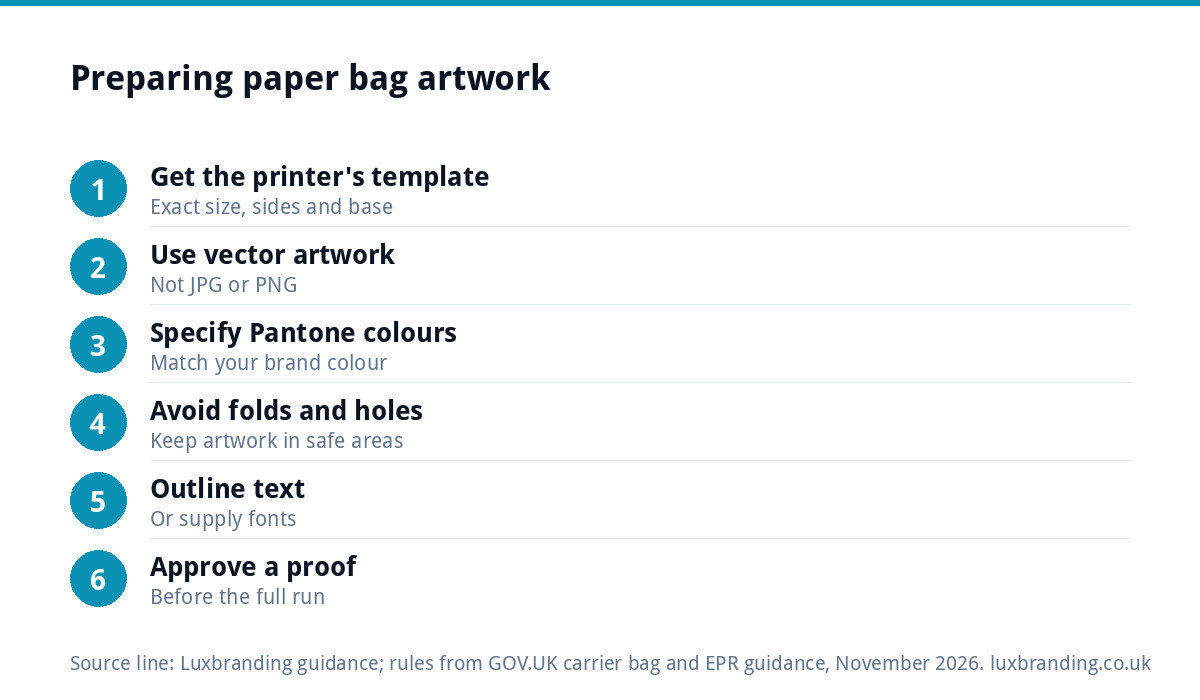
- Get the printer’s template for your exact bag size, showing the front, back, sides, base and handle positions.
- Use vector artwork for your logo and text, not a JPG or PNG.
- Specify colours as Pantone references for spot colours, so your brand colour is matched.
- Keep artwork away from folds, gussets and handle holes unless the template allows it.
- Convert text to outlines or supply fonts, as your printer asks.
- Approve a proof, digital or physical, before the full run.
If you only have your logo as a JPG or PNG, it will need redrawing as vector first; our Recreate and Vectorise service is £79 for one layout. Our guide to print-ready artwork explains bleed, colour and file settings in more detail.
A worked example
Picture a hypothetical independent deli in Harrogate that has been using plain brown bags from a cash-and-carry. The owner wants something that looks like the shop without a large upfront bill. The plan has two stages. First, a round printed sticker with the deli’s logo in its dark green brand colour, applied to the same plain bags, which tests the look at low cost before committing to a custom print run. Then, once the sticker version has proved popular with customers, a custom run of twisted-handle kraft bags in two sizes, printed in that one green, with the logo large on the front and the web address small on the side. One colour keeps the cost down, the green matches the shopfront, and the bags are sturdy enough that regulars bring them back.
Where branded bags pay off most
- Shops where people browse and buy gifts, especially in busy town centres.
- Cafés and bakeries with a strong takeaway trade.
- Markets and events, where your bag travels past every other stall.
- Online orders packed into a branded bag inside the box, as a small unboxing moment.
Part of a joined-up brand
Bags look best when they belong with everything else: labels, boxes, tissue, stickers, signage and your website. Our guide to packaging design for small brands covers planning the pieces together. If your logo itself is not working at bag scale, our Logo Design is £129 with all layouts included, and our Packaging Design service is £99. Every price is on our pricing page.
Get the UK Print-Ready Artwork Checklist (free)
A one-page checklist for any UK designer or printer covering CMYK, bleed, fonts and resolution. Saves you the pre-press fix-up fees.
No spam. UK GDPR compliant. We only use your email to send this resource, unless you tick the box to hear from us.
Frequently asked questions
Do I have to charge for paper bags in England? +
The minimum 10p charge in England applies to single-use carrier bags that are plastic, 70 microns thick or less, unused and have handles. Paper bags do not meet that definition, so the charge does not apply to them in England. Wales, Scotland and Northern Ireland have their own rules, so check locally if you trade there.
What file does a printer need for printed paper bags? +
Usually vector artwork, such as an AI, EPS, SVG or PDF file, placed on the printer's template for your exact bag size, with spot colours specified as Pantone references and text outlined or fonts supplied. A JPG or PNG logo normally needs redrawing as vector before it can be printed cleanly on a bag.
Which paper bag handle is strongest? +
Rope handles on heavier board are typically the sturdiest and feel most premium, while twisted paper handles are practical for everyday retail and food. Flat paper and die-cut handles suit lighter goods. Choose for your heaviest typical purchase and ask your supplier what weight each bag is designed to carry.
Does EPR for packaging apply to my small shop? +
Probably not. The government's EPR guidance says businesses with £1 million or less in annual turnover, or supplying less than 25 tonnes of packaging a year, have no obligation under the scheme. Most independent shops and cafés are well below those thresholds, but check the current guidance if your business is growing quickly.
How can I make branded bags cheaper? +
Keep the design to your logo in one or two spot colours, choose a standard size and handle type, avoid lamination and foil, and compare quotes on identical specifications. For very small runs, plain stock bags with a well-designed printed sticker or stamp can look smart for a fraction of the setup cost.