
Quick answer
PageRank is Google’s own system for judging pages by the links pointing to them, and Google says it is still part of its core ranking. Domain Authority and Domain Rating are scores invented by SEO tool companies to estimate link strength. Google does not use them, so treat them as rough comparisons, never as targets.
If you have ever been sent an SEO report, a cold email offering “DA 50 backlinks” or a free “PageRank checker”, you have met these numbers. They sound official, and that is exactly why they get misused. This guide explains what each one is, which one Google actually uses, how to read third-party scores sensibly, and what genuinely builds authority for a small business website.
The terms at a glance
| Metric | Made by | Scale | Used by Google? |
|---|---|---|---|
| PageRank | Not published | Yes, as one of its core ranking systems | |
| Domain Authority (DA) | Moz | 1 to 100 | No |
| Page Authority (PA) | Moz | 1 to 100 | No |
| Domain Rating (DR) | Ahrefs | 0 to 100 | No |
| Authority Score and similar | Other SEO tool companies | Varies | No |
PageRank: Google’s link system
PageRank was one of the ideas Google was founded on: a link from one page to another acts like a vote, and votes from pages that themselves receive many links count for more. Google’s guide to its ranking systems says PageRank was one of its core ranking systems when Google first launched, that how it works has evolved a lot since, and that it continues to be part of its core ranking systems.
For a small business, the practical point is that links still matter, but not all links are equal. A link from a relevant, trusted page that real people read passes far more value than dozens from pages that exist only to host links.
What Google does not do is publish a PageRank score for your site. Any tool claiming to show your “PageRank” today is showing its own estimate, not Google’s number. That matters, because sellers of links often lean on the name.
Domain Authority: a tool company’s estimate
Domain Authority is a score from 1 to 100 created by the SEO software company Moz. Moz’s own explainer on Domain Authority describes it as a prediction of how likely a website is to rank compared with competitors, and states clearly that it is not a Google ranking factor and has no effect on the search results.
Ahrefs’ Domain Rating is a similar idea built on its own link data. In its article on Domain Rating, Ahrefs describes DR as one of its most prominent metrics. Different tools crawl different parts of the web, so the same site can score quite differently in each.
Why the scores still exist, and when they are useful
These scores are not useless. Used carefully, they help with:
- Comparing like with like. Your site against three local competitors in the same tool gives a rough sense of the link gap.
- Tracking direction. A slow rise over a year usually means you are earning links.
- Sorting outreach ideas. A link from a respected trade body is worth more than a link from a page nobody reads.
They become harmful when they are treated as the goal. A score is a summary of links counted by one company’s crawler. Chasing the number, rather than the customers and relevance behind it, is how small businesses end up paying for links that do nothing or cause problems.
It also helps to remember what the scores cannot see. They do not know whether a linking page is relevant to your trade, whether anyone actually clicks the link, or whether the site behind it is trusted locally. A plumber with a modest score and links from a regional trade body, two builders’ merchants and the local paper is often in a stronger position than the number suggests.
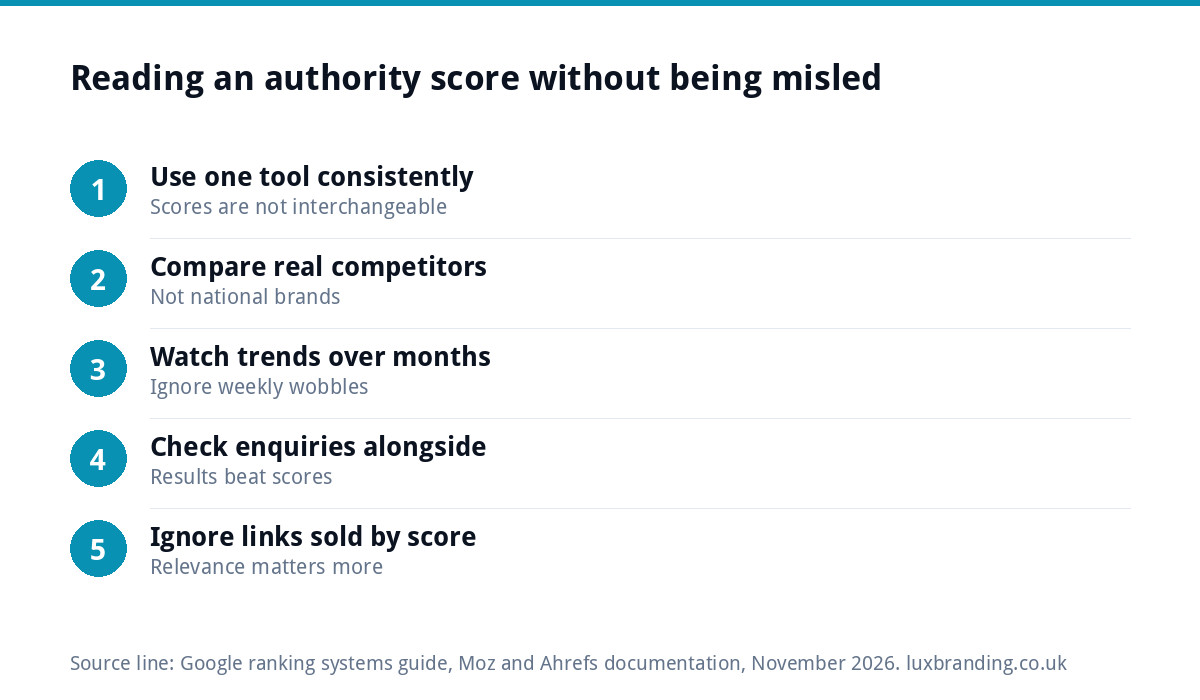
How to read your score without being misled
- Use one tool consistently. Scores from different tools are not interchangeable.
- Compare with real competitors, not with national brands or newspapers.
- Look at trends over months, not week-to-week changes, which often reflect the tool updating its data.
- Check rankings and enquiries alongside it. If enquiries are growing, a flat score does not matter.
- Ignore anyone selling links by score. “DA 50 guest posts” says nothing about relevance or quality.
What actually builds authority for a small business
For local and service businesses, Google’s link systems reward the same things customers reward: being genuinely known and referenced in your area and trade. The most useful links are usually the least glamorous.
| Source of links | Why it helps | Effort |
|---|---|---|
| Trade bodies and accreditation schemes | Relevant, trusted and hard to fake | Low once you are a member |
| Local organisations you support | Clubs, charities and events link to sponsors | Low to medium |
| Suppliers and partners | “Approved installer” or stockist pages | Low; ask |
| Local press and community sites | Stories about real projects or milestones | Medium |
| Genuinely useful guides on your own site | Others cite good answers to common questions | Medium to high |
| Your Google Business Profile and key directories | Consistency and local trust signals | Low |
A strong Google Business Profile often matters more than links for local searches; our Google Business Profile Setup and Optimisation service is £199 if yours needs work.
A six-month plan for earning better links
Authority is built steadily, alongside running the business. A realistic plan for a small firm looks like this:
- Month one: tidy the foundations. Make sure your Google Business Profile, website and main directory listings show the same name, address and phone number.
- Month two: claim the easy links. List every trade body, accreditation scheme, supplier and manufacturer you work with, and ask each whether they keep a member, installer or stockist page.
- Month three: get involved locally. Sponsor a junior team, support a local charity event or offer a talk at a business network. Organisations like these usually thank supporters on their own sites.
- Month four: publish one genuinely useful guide. Answer the question customers ask most often, better than anyone else locally, with photos from real jobs.
- Month five: share real stories. A notable project, a new apprentice or a business anniversary can interest local news sites and community pages.
- Month six: review. Check rankings, enquiries and, if you use one, your tool’s score against the same competitors as before.
None of this needs a link seller, and every step also helps customers find and trust you.
Red flags in link offers
- Packages priced by score: “10 links from DA 40+ sites”.
- Links from sites with no connection to your trade or area.
- Guaranteed score increases within weeks.
- Networks of “blogs” that exist only to sell links.
- Any offer that asks you to keep the arrangement quiet.
Paid links designed to manipulate rankings can harm a site rather than help it. If in doubt, leave it out.
A worked example
Picture a hypothetical roofing firm in Stoke-on-Trent comparing itself with two local competitors in one SEO tool. Its score is lower than both. Looking at where the competitors’ links come from, the gap turns out to be a handful of ordinary sources: a roofing trade association listing, a manufacturer’s approved-installer page, a local rugby club sponsorship page and a write-up in a community news site. None of those needed a link seller. Joining the association, asking the manufacturer for a listing and sponsoring a junior team would close most of the gap within a season, and each would bring real enquiries as well as links.
When your score is fine but rankings are not
Links are only one part of how Google ranks pages. If your score is comparable with competitors and you still do not appear, the cause is more often technical problems, thin service pages, poor local signals or pages that do not match what people search for. Our guide to a website not showing on Google covers the common causes, and our free SEO audit gives a quick technical snapshot.
Content earns links too. A clear, well-researched guide that answers a question customers really ask is the kind of page other sites cite. Our content and blog writing service focuses on exactly that.
Building authority the slow, safe way
There is no shortcut that lasts. Our SEO service is £249 a month and covers rankings, content, technical health, link building and reports, with links earned from relevant sources rather than bought by the score. Our guide to how much SEO costs in the UK explains what to expect from any provider, and every service price is listed on our pricing page.
Get the UK SEO DIY Audit Checklist (free)
A 32-point checklist UK SMEs can run against their own website in an afternoon. Surfaces the quick wins before paying for a paid audit.
No spam. UK GDPR compliant. We only use your email to send this resource, unless you tick the box to hear from us.
Frequently asked questions
Does Google use Domain Authority? +
No. Domain Authority is a score from 1 to 100 created by Moz, and Moz itself states it is not a Google ranking factor and has no effect on search results. It is an estimate based on Moz's own link data. Use it to compare your site with direct competitors in the same tool, not as a target.
Does Google still use PageRank? +
Yes. Google's guide to its ranking systems says PageRank was one of its core ranking systems at launch, that it has evolved a lot since, and that it remains part of its core ranking systems. Google does not publish PageRank scores, so any checker showing your PageRank is showing its own estimate.
What is a good Domain Authority for a small business? +
There is no universal good score. A local trade business does not need to match national brands. What matters is how you compare with the competitors who appear for your searches, measured in the same tool, and whether the trend is rising over months. Enquiries and rankings matter far more than the number itself.
Should I buy backlinks to raise my score? +
No. Links bought to manipulate rankings can harm a site rather than help it, and packages sold by score say nothing about relevance or quality. The safest and most useful links for a small business come from trade bodies, suppliers, local organisations, community news and genuinely helpful content on your own site.
Why is my Domain Rating different from my Domain Authority? +
They are made by different companies using different crawlers and formulas. Ahrefs calculates Domain Rating from its link data and Moz calculates Domain Authority from its own, so the same site can score quite differently in each. Pick one tool, use it consistently and compare against the same competitors over time.