Quick answer
Most UK small businesses need between five and twelve pages: a home page, one page for each main service, an about page, a page of proof such as reviews or past work, a contact page, and a privacy notice. A sole trader offering one service can do well with a single page; a firm with eight distinct services needs more.
The right number comes from what people search for and what they need to see before they get in touch, not from a package limit. This guide shows the core pages, typical counts by type of business, and the pages that are safe to leave out.
The core pages almost every business needs
Strip a small-business website back to what earns enquiries and you are left with the same short list:
- Home. Says what you do, where, and how to get in touch, within the first screen on a phone.
- Service pages. One for each service people search for by name.
- About. Who you are, why customers can trust you, and your credentials.
- Proof. Reviews, case studies or a gallery of real jobs.
- Contact. Phone, email, form and the areas you cover.
- Privacy notice. Required if your site collects personal details through a form, which nearly every site does.
That is six pages before you add a second service. Everything else is optional and should earn its place.
Why each main service deserves its own page
People search for the job, not your trade. Someone with a leaking flat roof types “flat roof repair”, not “roofer”. If all your services sit on one long “Services” page, that page tries to rank for everything and usually ranks for nothing in particular.
A separate page for each main service lets you explain that job properly: what it involves, typical timescales, rough costs, photos of that work and the questions people ask about it. It also gives a clear page to send people to from ads, your Google Business Profile or a quote email.
The test is simple. If customers ask for it by name, and you want more of that work, it gets a page. If it is a small add-on to another job, it becomes a section on that job’s page.
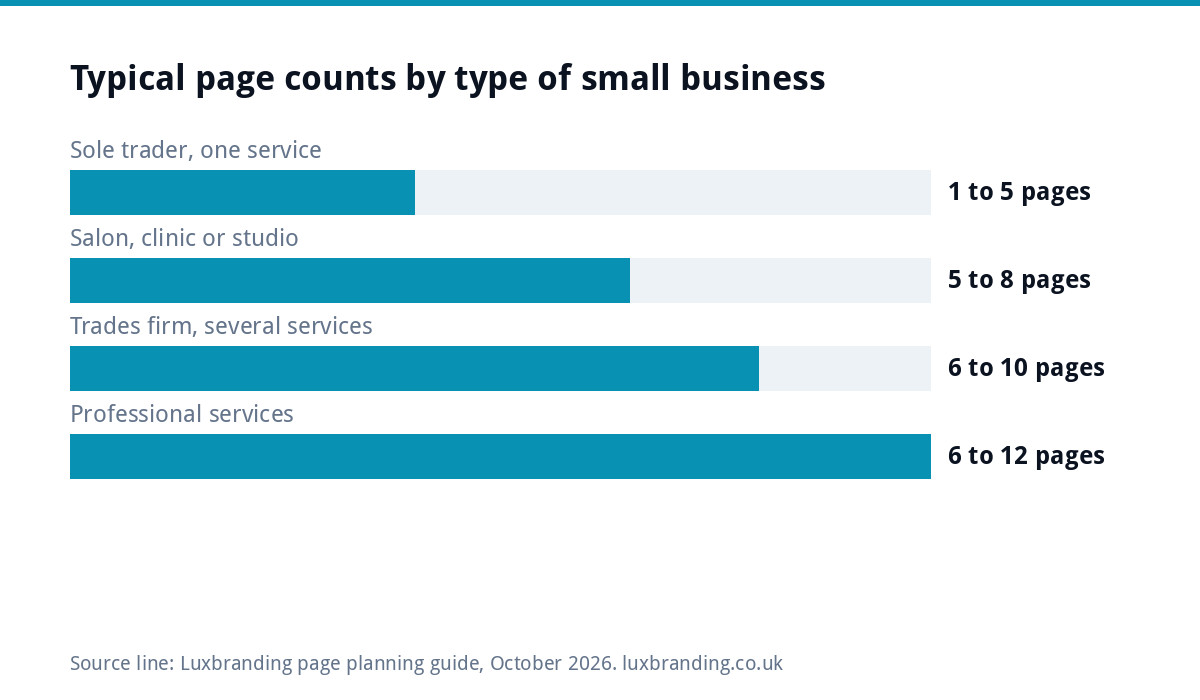
Typical page counts by type of business
These are starting points, not rules. Count your genuine services and adjust.
| Business | Typical pages | What drives the count |
|---|---|---|
| Sole trader, one service (dog walker, window cleaner) | 1 to 5 | One service, one area, simple questions |
| Trades firm with several services (roofing, plumbing, electrical) | 6 to 10 | One page per service people search for |
| Salon, clinic or studio | 5 to 8 | Treatment groups, price list, booking information |
| Professional services (accountant, consultant) | 6 to 12 | Services, sectors served, team, guides |
| Small online shop | Core pages plus product and category pages | Product range, delivery and returns information |
Notice what is missing: there is no row that needs forty pages. Small businesses rarely benefit from size for its own sake. A focused site with ten well-written pages usually does more than a sprawling one with thirty thin ones.
When one page is enough
A single scrolling page works well when you offer one main service, cover one area and get most of your work from referrals, social media or your Google Business Profile. The page acts as a smart business card: what you do, proof, prices if you publish them, and a way to get in touch.
The trade-off is search reach. One page can only be about so many things. If you later want to be found for several different jobs, you will add pages. Our one-page website is £299 and is built so it can grow into a fuller site without starting again.
If you only need a single page to support an advert or a seasonal offer, that is a different job: a landing page built around one action.
Pages you can safely leave out
Plenty of small-business sites carry pages that cost time to write and do nothing. Cut these unless you have a real reason to keep them:
- A “News” page you will update twice and then abandon. An old date on the last post makes the whole site look neglected.
- Separate “Mission” and “Values” pages. Fold them into the about page in two sentences.
- A “Links” or “Partners” page with no clear purpose for the customer.
- Thin location pages that repeat the same text with a different town name swapped in.
- A separate testimonials page if you can place the reviews beside the services they mention instead.
The trap of copy-and-paste town pages
A common piece of advice is to create a page for every town you cover. Done badly, that means twenty near-identical pages with the town name swapped. Google’s spam policies describe “doorway” pages, including pages targeted at specific regions or cities that funnel users to one page, as something it treats as abuse.
A better approach is to name the towns and postcode areas you cover in plain text on your service and contact pages, show real jobs from those places, and keep your Google Business Profile accurate. Only create a separate area page if you have something genuinely different to say there, such as a branch, a team or a body of work in that town.
The pages the law expects
Some content is not optional. If you trade as a limited company, GOV.UK’s guidance on signs, stationery and promotional material says your website must show the company’s registered number, its registered office address, where it is registered, and that it is a limited company. That can sit in the footer or on the contact page rather than a page of its own.
If you collect names, emails or phone numbers, the ICO’s guidance on the right to be informed explains what your privacy information must cover, including why you use the data, how long you keep it and who you share it with. Online shops also need delivery, returns and terms pages.
How page count affects the price
Every page needs planning, writing, designing, building and checking, so page count is one of the main things that moves a website quote. Our fixed prices are set by page limits:
| Option | Pages included | Price |
|---|---|---|
| Landing Page | 1, built around one action | £199 |
| One-Page Website | 1, a full scrolling site | £299 |
| Custom WordPress Website | Up to 8 | £499 |
| Premium Custom WordPress | Up to 14 | £1,499 |
| E-commerce Website | Core pages, up to 20 products | £499 |
The eight-page tier covers the core six plus two more service pages, which suits most trades firms. If you need a wider picture of costs across the market, our guide to how much a website costs in the UK sets out the ranges, and the full list is on our pricing page.
A worked example: a heating engineer in Sheffield
A two-person heating firm wants more boiler installation work and steady servicing contracts. Its page plan looks like this:
- Home
- Boiler installation
- Boiler repair and breakdowns
- Boiler servicing and landlord safety checks
- Underfloor heating
- About, with accreditation details
- Reviews and recent jobs
- Contact, with the areas covered listed in text
That is eight pages, plus a privacy notice and the company details in the footer. Bathroom refits, which the firm does occasionally, become a short section on the about page rather than a page it would struggle to fill. If the firm later adds commercial work, that becomes page nine.
Signs your site needs more pages
Page counts are not fixed for life. A site that was right at launch can fall behind the business. These are the usual signs it is time to add pages rather than squeeze more into the ones you have:
- Customers ring to ask whether you do a job that you do, but your site only mentions it in passing.
- One service page has grown so long that the phone number is buried halfway down.
- You have started a new line of work, such as commercial contracts alongside domestic jobs.
- You run adverts and have nowhere specific to send the clicks.
Add one page at a time, write it properly, and link to it from the home page and any related service pages so visitors and Google can find it.
Plan the list before you get quotes
Write your page list on paper before you speak to any designer. For each page, write one line: who lands there and what they should do next. Pages without a clear answer are candidates to cut. Then use the list to get comparable quotes, because “a website” means very different things to different suppliers.
Our website cost calculator turns a page list into a quick estimate, and the website launch checklist covers the details to check before those pages go live. When you are ready, our custom WordPress website covers up to eight pages for £499; order online or email us at support@luxbranding.co.uk with your list.
Get the UK Website Project Brief Template (free)
A two-page template for briefing any UK web designer: sitemap, integrations, audience and deliverables. Cuts revision rounds in half.
No spam. UK GDPR compliant. We only use your email to send this resource, unless you tick the box to hear from us.
Frequently asked questions
How many pages does a small business website need? +
Most need five to twelve: a home page, one page per main service, an about page, a page of reviews or past work, a contact page and a privacy notice. A sole trader with one service can manage with a single page, while a firm offering many distinct services will sit at the top of that range.
Is a one-page website bad for SEO? +
Not bad, but limited. One page can only target a narrow set of searches, so it suits businesses with one main service and one area. If you want to be found for several different jobs, separate service pages give each one a clear page to rank, which a single scrolling page cannot do as well.
Should I make a page for every town I cover? +
Only if you have something genuinely different to say about each town. Near-identical pages with the town name swapped can fall foul of Google's doorway page policy. It is usually better to list the towns and postcodes you cover in text on your service and contact pages and show real jobs from those areas.
Does a privacy policy count as a website page? +
Yes, and most sites need one. If your site collects names, emails or phone numbers through a form, the ICO's guidance says you must tell people why you use their data, how long you keep it and who you share it with. A short privacy notice page linked from the footer is the usual way to do that.
How many pages does Luxbranding's £499 website include? +
Our custom WordPress website at £499 includes up to eight pages, which covers the core pages plus several service pages for most small businesses. The premium version at £1,499 covers up to fourteen pages, and a one-page website is £299. Bigger sites are quoted in writing before any work starts.