
Quick answer
A good price increase letter states the new price, the date it starts, one honest reason and what stays the same, then thanks the customer. For example: your rate moves from £45 to £50 an hour from 1 February. Give at least 30 days’ notice, send it in writing, and keep it under 150 words.
Below are six templates you can copy straight into an email, a letter or a text, one for each situation UK small businesses and trades actually face, plus a notice table and a checklist for the jobs that come after the letter goes out.
Before you send: the five facts every letter needs
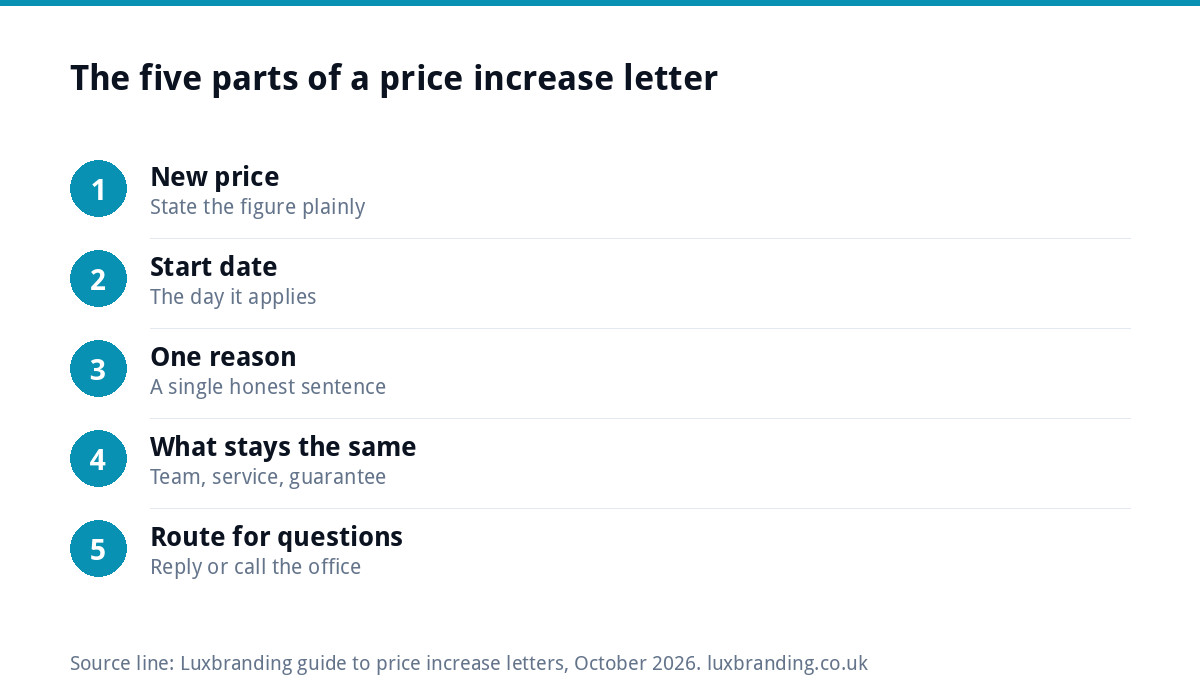
Every template on this page is built from the same five parts. If you write your own, check it against this table before it leaves your outbox.
| Part | Example wording | Why it matters |
|---|---|---|
| The new price | “Our hourly rate will be £50” | Vague phrases such as “a small adjustment” read as evasive and invite questions |
| The start date | “from 1 February 2027” | Customers plan around dates; a missing date makes every invoice an argument |
| One reason | “materials and wage costs have risen” | One clear reason sounds confident; five reasons sound like an apology |
| What stays the same | “same team, same guarantee, same response times” | Reassures the customer that only the number has changed |
| A route for questions | “reply to this email or call the office” | Gives the worried customer somewhere to go other than a competitor |
Leave out the old price unless the customer is on a written contract that names it. Showing both figures side by side invites a percentage calculation and turns a short note into a debate.
Template 1: regular domestic customers
Use this for homeowners and repeat customers who book you a few times a year: window cleaners, gardeners, cleaners, dog groomers, mobile mechanics.
Dear [first name],
Thank you for using [business name] this year. From [date], our price for [service] will be [new price]. Costs for fuel, materials and wages have all risen over the past year, and this change lets us keep the same standard of work you are used to.
Nothing else changes: the same team, the same days, and the same [guarantee or promise]. Any work booked before [date] stays at the current price.
If you have any questions, just reply to this message.
Kind regards,
[your name], [business name]
The line “any work booked before [date] stays at the current price” does a lot of quiet work. It rewards customers who book early and it takes the sting out of the change.
Template 2: business clients on account
Commercial clients care about budgets and purchase orders, so this version is shorter and more formal. It suits contractors, cleaning companies, suppliers and anyone invoicing on 30-day terms.
Dear [contact name],
I am writing to confirm our rates for [year]. From [date], [service or day rate] will be charged at [new price] plus VAT where applicable. All other terms, including payment terms and response times, remain unchanged.
Orders and purchase orders received before [date] will be invoiced at current rates. A revised rate card is attached for your records and for any budget planning on your side.
Thank you for your continued business. If it would help to talk this through before your next order, reply and we will arrange a call.
Yours sincerely,
[name], [job title], [business name]
If you only bid on commercial work occasionally, our guide to winning commercial contracts as a trade covers how rate cards and tender prices fit together.
Template 3: customers on a contract or retainer
If the customer signed terms, check them before you write anything. A price change mid-contract usually needs a clause that allows it. For consumer contracts, the Competition and Markets Authority’s unfair contract terms guidance (CMA37) explains that terms must be fair and transparent, and a vague “we can change prices at any time” clause is the kind of wording it warns about.
Dear [name],
Under clause [number] of our agreement dated [date], we are giving you [notice period] notice that the monthly fee for [service] will change to [new price] from [date].
The scope of the service stays exactly as agreed. If you would prefer not to continue at the new rate, you can end the agreement before [date] as set out in clause [number], with no charge for doing so.
We hope you will stay with us, and thank you for your trust so far.
Kind regards,
[name], [business name]
Naming the clause and offering a clean exit is what makes this letter fair. If your contracts have no review clause, add one at the next renewal rather than forcing a change now.
Template 4: the short email or text version
Some customers only ever hear from you by text or WhatsApp. A letter would feel odd, so send this instead and keep the full letter for anyone who asks.
Hi [name], a quick heads-up from [business name]. From [date] our [service] price will be [new price], due to higher fuel and material costs. Anything booked before then stays at today’s price. Any questions, just reply here. Thanks, [your name]
Text messages are easy to miss, so repeat the date on the next invoice or booking confirmation. If you send the change by email to a big list, make sure it actually lands: our guide to business emails going to spam covers the setup checks.
Template 5: a quote that is still open
A quote with a validity date is a promise until that date. Honour it, and use the deadline as a reason to decide.
Hi [name], just a note on the quote we sent on [date] for [job]. That price is held until [expiry date]. From [date], our rates change, so if you would like to go ahead at the quoted price, confirming before [expiry date] locks it in. Happy to answer any questions in the meantime.
This is the one situation where a price rise can help you win work. It is not pressure; it is information the customer needs.
Template 6: when the rise comes with something new
If you have added something customers value, such as online booking, a longer guarantee or a new certification, say so. Do not invent improvements to justify the number.
Dear [name],
Two updates from [business name]. First, you can now [new benefit, for example book and pay online, or get a written report after every visit]. Second, from [date], our price for [service] will be [new price].
Your bookings, contacts and preferences carry over automatically. Thank you for being a customer.
Kind regards,
[name]
How much notice to give, by situation
There is no single legal notice period for a price change outside a contract, so the right answer depends on the relationship and the paperwork. These are sensible defaults.
| Customer type | Suggested notice | Best channel |
|---|---|---|
| One-off or occasional domestic customers | None needed; new quotes show new prices | Price list, website, quotes |
| Regular domestic customers | 30 days | Email or letter, then a text reminder |
| Business clients on account | 30 to 60 days, ideally before their budget year | Email with a rate card attached |
| Contract or retainer clients | Whatever the contract says, never less | Email or letter that names the clause |
| Open quotes | Honour until the validity date | Reply on the original quote thread |
The reasons you can honestly give in 2026
Customers accept a rise far more easily when the reason is concrete. Two public figures are worth knowing. The National Living Wage for workers aged 21 and over went up to £12.71 an hour on 1 April 2026, from £12.21, according to GOV.UK’s minimum wage rates page. And the Office for National Statistics reports that the Consumer Prices Index rose by 3.5% in the 12 months to September 2026.
Only use the reason that applies to you. If you employ nobody, the wage rise is not your reason; your materials, fuel, insurance or software costs probably are. If you want help with the pricing decision itself rather than the letter, that strategy is a separate question from the wording here.
Wording that works, and wording that backfires
- Say “will be”, not “we are considering”. A firm statement is business; a tentative one is an invitation to haggle with every recipient.
- Do not apologise. “We are sorry to tell you” frames the rise as bad news you feel guilty about.
- One reason, one sentence. A paragraph of justification reads as defensive.
- Thank them once. At the end, not three times through the letter.
- Keep your branding consistent. A letter on a scruffy template undermines the message that your work is worth more. Our guide to branding for trades businesses covers the basics, from quote templates to vans.
After the letter: update every place your prices live
The letter is the easy part. The common failure is a customer who receives the letter, then sees the old price on your website or a quote template that nobody updated. Work through this list on the day the change starts:
- Website price list, service pages and any booking system.
- Quote and invoice templates, including the ones on your phone.
- Google Business Profile services and any directory listings that show prices.
- Printed price lists, leaflets and van or shop signage.
- Recurring invoices and direct debits in your accounting software.
If editing your own website prices means emailing a developer and waiting, read what to do when you cannot update your own website. And if your prices live in five disconnected systems, our custom business software service builds tools that can bring quotes, invoices and price lists together, so a price change is made once rather than five times. For sending the letter itself to a whole customer list on schedule, see our email marketing automation service, and you can compare everything we offer on our pricing page.
Get the UK SEO DIY Audit Checklist (free)
A 32-point checklist UK SMEs can run against their own website in an afternoon. Surfaces the quick wins before paying for a paid audit.
No spam. UK GDPR compliant. We only use your email to send this resource, unless you tick the box to hear from us.
Frequently asked questions
How much notice should I give customers of a price increase? +
For regular domestic customers, 30 days is a sensible default. Business clients on account deserve 30 to 60 days, ideally before their budget year starts. If the customer has a written contract, give whatever notice it sets out and never less. Open quotes should be honoured until their validity date, whatever your new prices are.
Do I have to give a reason for raising my prices? +
You are not usually obliged to, but one honest reason makes the change easier to accept. Keep it to a sentence, such as higher fuel, materials or wage costs. Avoid listing five reasons, because a long justification reads as an apology and invites customers to argue with each point.
Should I show the old price and the new price? +
Usually not. Showing both side by side invites customers to work out the percentage and compare it with inflation. State the new price and the date it starts. The exception is a customer on a written contract that names the current fee, where showing both figures keeps the notice clear and fair.
Can I raise prices in the middle of a contract? +
Only if the contract allows it, usually through a price review clause, and the clause must be fair and transparent. For consumer contracts, the CMA's unfair contract terms guidance explains what that means. If your contract has no review clause, wait until renewal and add one, rather than forcing a change now.
Is it fine to tell customers about a price rise by text? +
Yes, for customers who normally hear from you by text or WhatsApp. Keep it short: the new price, the start date, one reason and what stays the same. Because texts are easy to miss, repeat the date on the next invoice or booking confirmation, and keep the full letter ready for anyone who asks.