Quick answer
Trust reviews that are specific, spread over time and mixed in tone, from reviewers with their own history. Be wary of bursts of five-star reviews in a short window, vague praise, identical phrasing and no replies to complaints. Then check beyond reviews: real portfolio work, a registered company, published prices and who owns the finished files.
This guide gives you a checklist for reading reviews of design agencies, freelancers and web designers, explains what UK law now says about fake reviews, and shows what to check alongside the stars before you pay a deposit.
Why agency reviews need a careful read
Choosing a designer is harder than choosing a plumber. You cannot see the finished logo or website before you pay, and most people only buy branding once every few years. That makes reviews unusually important, which is exactly why some businesses are tempted to game them.
Most agencies and freelancers have honest reviews. But a few minutes of careful reading will tell you far more than the headline star rating, and will help you spot the rare profile that is not what it seems.
What UK law says about fake reviews
Since April 2025, fake reviews have been banned outright in the UK. Schedule 20 of the Digital Markets, Competition and Consumers Act 2024 lists commercial practices that are always unfair, including submitting or commissioning a fake consumer review, publishing a review that conceals it was incentivised, and presenting reviews in a misleading way, such as hiding negative ones while showing positive ones.
The Competition and Markets Authority has published guidance for businesses on fake reviews explaining what is prohibited. Platforms have their own rules too. Google’s policy for Maps reviews bans paid or incentivised reviews and content based on a conflict of interest, such as reviews from current or former employees.
None of that makes every review trustworthy. It does mean that a business caught faking reviews is taking a serious legal risk, and that you have every right to be sceptical.
Signs of genuine and suspicious reviews
| Look at | Usually genuine | Worth a closer look |
|---|---|---|
| Detail | Names the service, the problem and what happened | “Great service, highly recommend” and nothing else |
| Timing | Spread steadily over months and years | A large burst in a few days, then silence |
| Language | Different voices, spelling and lengths | Repeated phrases or the same structure in many reviews |
| Reviewer history | Has reviewed other local businesses | One review ever, or reviews for unrelated firms on the same day |
| Mix of ratings | Mostly positive with the odd honest complaint | A perfect score with no criticism at all |
| Business replies | Calm, specific responses to problems | No replies, or defensive attacks on reviewers |
| Match with the work | Reviews mention projects you can see in the portfolio | Praise for services the business does not show |
One suspicious sign on its own proves little. Several together are a reason to slow down and ask questions.
Read the negative reviews first
The most useful reviews are often the critical ones, and the reply underneath them.
- What went wrong? Missed deadlines, poor communication and surprise extra charges are the complaints that matter most for design work.
- Is there a pattern? One unhappy customer is normal. The same complaint from several people over a year is a warning.
- How did the business respond? A reply that explains, apologises where needed and offers a fix tells you how they will treat you if something goes wrong.
- Is the complaint about something you care about? A review saying “they would not do unlimited free changes after sign-off” may tell you more about the reviewer than the agency.
A five-step check in fifteen minutes
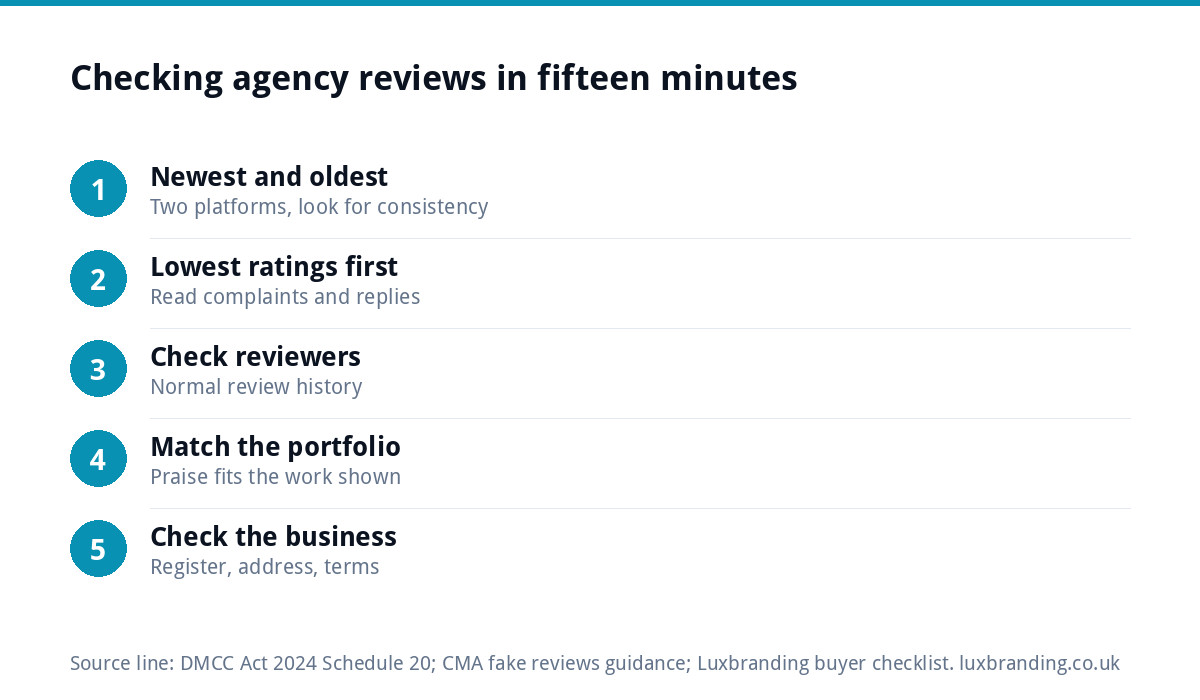
- Read the newest ten reviews and the oldest five on at least two platforms. Look for consistency over time.
- Sort by lowest rating and read every critical review and reply.
- Click on three or four reviewers to see whether they have a normal review history.
- Match reviews to the portfolio. If people praise logo work, the portfolio should show logos of a similar standard.
- Check the business itself: a registered company on the Companies House register if it trades as a limited company, a real contact address and clear terms.
Testimonials on the agency’s own website
Testimonials on a designer’s own site are chosen by the designer, so they will always be the best ones. That does not make them worthless, but read them differently from independent reviews.
- Look for names you can check. A first name, a business name and a town let you look up the business and see the logo or website in real use.
- Prefer case studies to quotes. A short write-up showing the brief, the options and the final result tells you more than a line of praise.
- Check the work is live. If a testimonial praises a new website, visit it. If it praises a logo, see whether the business actually uses it on its van, shopfront or social profiles.
- Be wary of anonymous praise. “J, London” could be anyone.
Reviews on freelance marketplaces
Freelancer platforms show reviews per seller, often alongside the number of jobs completed and repeat buyers. They are useful, but remember that reviews there are usually left at the moment of delivery, before you have tried to print the logo or hand the files to a sign maker. Look for reviewers who mention file formats, print and long-term use, not just speed and friendliness.
What to check beyond the stars
Reviews tell you how past customers felt. They do not tell you everything about what you are buying. Before paying for branding or a website, look for:
| Check | What good looks like |
|---|---|
| Published prices | Clear prices or a written quote with inclusions before work starts |
| Portfolio | Varied, recent work in a range of styles, not one look applied to every client |
| Revisions | A clear statement of how many rounds or what “unlimited” covers |
| Files and ownership | Every file format handed over, with ownership of the final artwork transferred to you |
| Website ownership | You own the domain, hosting account and code, with no lock-in |
| Contact routes | A business email address and a reply time you can rely on |
Ownership is where many disputes start. Our guide to logo copyright and trademarks explains what you should own once you have paid, and our article on signs a web designer is overcharging covers the warning signs on the web side.
Use reviews to ask better questions
The real value of reviews is the questions they prompt. If several reviewers praise fast concepts, ask how quickly the first designs arrive. If one complains about extra charges, ask exactly what is and is not included. If nobody mentions brand guidelines, ask whether they are part of the package.
Comparing what is included matters as much as comparing stars. Our guides to what branding costs in the UK and brand identity vs logo design explain the usual inclusions, so you can tell a cheap quote from a thin one.
Red flags that matter more than reviews
- Pressure to pay in full immediately, with a “today only” price.
- No written terms, or terms that keep ownership of your files with the designer.
- A portfolio that looks like templates or stock graphics.
- Refusal to say who will actually do the work.
- Reviews that mention services the business does not seem to offer.
Any one of these is a reason to walk away, however good the stars look.
After you hire: leave an honest review
When your project finishes, write the review you would have wanted to read: what you bought, how long it took, how changes were handled and whether you would use them again. Specific, honest reviews help the next business owner, and good agencies value them, criticism included.
If something went wrong and was put right, say that too. A review that describes a problem and how it was fixed is often more persuasive to the next reader than unbroken praise, and it rewards the businesses that handle problems well.
How we work
Our prices are published on our pricing page before you order. Our Logo Design is £129 with unlimited concepts, unlimited revisions within your brief, every file format and full layouts included. Our Brand Identity Design is £299 and covers your logo, colours, typography, imagery and brand guidelines. We are rated 4.8/5 (Excellent) and have delivered 4,500+ projects, and we would encourage you to read our reviews with the same checklist as anyone else’s.
Get the UK Branding Budget Worksheet (free)
A printable worksheet: decide what your brand needs now and price it against fixed published prices and the IPO trademark fee.
No spam. UK GDPR compliant. We only use your email to send this resource, unless you tick the box to hear from us.
Frequently asked questions
How can I tell if a business's reviews are fake? +
Look for warning signs together: a burst of five-star reviews in a few days, vague praise with no detail, repeated phrases, reviewers with no other review history and no critical reviews at all. One sign proves little, but several suggest caution. Genuine reviews are specific, spread over time and mixed in tone.
Are fake reviews illegal in the UK? +
Yes. Since April 2025, the Digital Markets, Competition and Consumers Act 2024 treats submitting or commissioning fake consumer reviews, concealing that a review was incentivised and presenting reviews misleadingly as always unfair. The Competition and Markets Authority has published guidance for businesses on what is prohibited.
Should I trust Google or Trustpilot reviews more? +
Neither is automatically more trustworthy. Read reviews on at least two platforms and look for the same patterns on both: detail, steady timing, a natural mix of ratings and sensible replies to complaints. Consistency across platforms is a better signal than the rating on any single site.
What should I check besides reviews when hiring a designer? +
Check for published prices or a written quote with inclusions, a varied and recent portfolio, clear revision terms, and confirmation that you will own the final files, domain and website code. If the business is a limited company, check it on the Companies House register, and read its terms before paying.
What does Luxbranding include in a logo or brand package? +
Our Logo Design is £129 with unlimited concepts, unlimited revisions within your brief, every file format and stacked, horizontal and icon-only layouts. Brand Identity Design is £299 and adds colours, typography, imagery and brand guidelines. Prices are published on our pricing page before you order.