
Quick answer
Add a shop to a service website only if the products follow naturally from your service, such as aftercare products, gift vouchers, kits or spare parts, and you can handle stock, delivery and returns. Start small with vouchers or a handful of products on your existing site, and keep booking or enquiring as the main action.
Plenty of service businesses sell products on the side: a salon selling the shampoo it uses, a dog groomer selling brushes, a personal trainer selling programmes, a garden designer selling planters, a heating engineer selling replacement filters. Done well, a shop adds income and keeps customers coming back between appointments. Done badly, it becomes a cluttered website, a garage full of stock and a new set of customer service problems. This guide helps you decide, then shows how to start without overcommitting.
What service businesses sell successfully
The products that work best share one feature: customers already ask you about them.
- Aftercare: hair, skin and beauty products; paint touch-up kits; cleaning products for a newly fitted surface.
- Gift vouchers: for treatments, sessions, lessons or services.
- Consumables and parts: filters, bulbs, replacement heads, care kits.
- Packaged expertise: training plans, guides or templates.
- Branded merchandise: only where your brand has a following, such as a gym or a café.
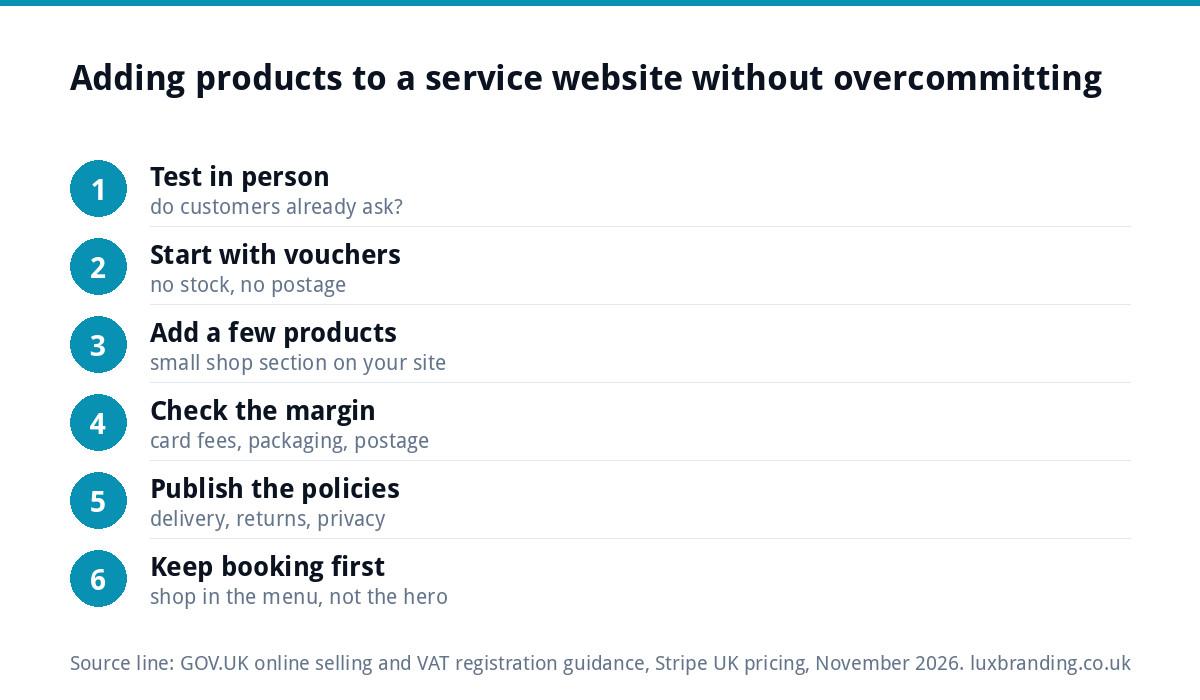
If you are guessing whether customers would buy something, test it in person first. Put five on the counter or mention it after a job. If nobody buys face to face, they are unlikely to buy online.
Questions to answer before you add a shop
- Who supplies the stock, at what margin, and with what minimum order?
- Where will stock live, and who packs orders on a busy week?
- How will you deliver: post, local delivery, collection, or included with a service visit?
- How will you handle returns and faulty items?
- Does the shop fit your brand, or does it make you look less specialist?
- Is there enough margin after card fees, packaging, postage and your time?
If several of these answers are “not sure”, start with gift vouchers or click-and-collect, which avoid most of the hard parts.
Four ways to start selling
| Option | How it works | Good for | Limits |
|---|---|---|---|
| Payment links or buy buttons | A link from your payment provider placed on a page | One to three products or vouchers | No basket, little stock control |
| Small shop section on your site | WooCommerce or similar added to your website | A focused range alongside your service | Needs setup, updates and testing |
| Separate online shop | A dedicated shop, often on Shopify | A product range that may outgrow the service | Two sites to run |
| Marketplace listing | Selling through an existing marketplace | Testing demand with little setup | Fees per sale; the customer relationship sits with the marketplace |
For most service businesses, the second option is the sweet spot: one website, one brand, with a small shop section linked from the menu. Our Shopify vs WooCommerce comparison helps if you are choosing a platform.
What it really costs to run
The build is only part of the bill. Use this list to check the margin on each product before you add it:
| Cost line | What to allow for |
|---|---|
| Stock | Wholesale price and minimum order from your supplier |
| Card fees | For example, Stripe’s UK pricing at the time of writing, November 2026, lists 1.5% + 20p for standard UK cards |
| Packaging | Boxes, padding, labels and any branded inserts |
| Postage | Carrier rates by size and weight; free delivery is paid by you |
| Returns | Refunds, return postage and stock you cannot resell |
| Time | Packing, answering questions and updating stock |
| Website | Build, hosting and updates |
Stripe’s current card fees are on its UK pricing page; fees for international cards are higher, and prices change. On a low-priced product, the fixed part of the fee and the postage can wipe out the margin, which is why many small shops set a minimum order or sell in bundles.
Gift vouchers: the easiest place to start
For salons, trainers, driving instructors, restaurants and many trades, gift vouchers are the ideal first product. There is no stock, no postage if you send a printable or emailed voucher, and the customer has to come back to you to redeem it. They also sell most when your service is booked up, around Christmas and birthdays.
Set clear terms: expiry date, whether vouchers can be part-redeemed, and what happens if the price of the service changes. Give each voucher a unique code and keep a simple record of codes issued and redeemed, so a voucher cannot be used twice and you can see how much unredeemed value is outstanding at any time.
A worked example: a salon adds aftercare
Picture a salon that already recommends the same three hair products to most clients at the end of an appointment. Clients often say they will “pick some up online”, and then buy them from a big retailer instead.
The salon adds a small shop section with those three products, plus gift vouchers in three values. Each treatment page gets a short “what we use” panel linking to the matching product. Orders are collected at the next appointment or posted to clients further away, with a minimum order so postage does not eat the margin. Stock is counted every Friday.
Nothing about the booking process changes. The shop simply captures sales the salon was already creating with its recommendations, and the vouchers bring in new clients as gifts. That is the pattern to copy: sell what you already recommend, to people who already trust you.
Keep the shop from distracting from your service
Your service is still the main business, so the website should keep it front and centre. Leave “Book now” or “Get a quote” as the main button on every page, put the shop in the menu rather than the hero area, and show products on relevant service pages instead of on the homepage. A customer who came to book a boiler service should not have to scroll past a product grid to find the phone number.
Check the mobile view in particular. Shop features such as basket icons and product carousels take up a lot of space on a small screen, and the booking button can easily slip out of sight. Test the most common journey, from a search to a booking, on a phone after the shop goes live.
The legal basics of selling online
Selling goods online brings in consumer rules that a service enquiry form does not. GOV.UK’s guidance on online and distance selling sets out the information you must give before an order, including your business details, a description of the goods, the total price, payment methods, delivery terms and how to cancel. It also says you must tell customers they can cancel up to 14 days after their order is delivered, without giving a reason. You will need clear delivery, returns and privacy information on the site before you take your first order.
Watch the VAT threshold
Product sales count towards your taxable turnover alongside your service income. GOV.UK says you must register for VAT if your total taxable turnover for the last 12 months goes over £90,000. It is a rolling 12 months, not a tax year, so a service business sitting just under the threshold should watch it closely before adding a product range. Talk to your accountant before you launch.
Delivery, stock and returns in practice
- Offer local collection or “delivered at your next appointment” to avoid postage entirely.
- Keep the range small enough that you can count the stock in five minutes.
- Set up stock tracking so items show as sold out instead of taking orders you cannot fill.
- Use consistent, branded packaging; our packaging guide for small brands covers what is worth spending on.
- Decide your returns process before the first return arrives, including who checks the item and how quickly the refund is made.
Getting a shop on your website
If you need a new site with products built in, our e-commerce website is £499 one-off for up to 20 products on WooCommerce or Shopify, with Stripe and PayPal. If you only need a service website for now, a custom WordPress website is also £499 for up to 8 pages. For budgets and running costs, read the e-commerce website cost guide, and if a shop is live but not selling, see why an online store gets visits but no sales. All our prices are on the pricing page.
Get the UK Website Project Brief Template (free)
A two-page template for briefing any UK web designer: sitemap, integrations, audience and deliverables. Cuts revision rounds in half.
No spam. UK GDPR compliant. We only use your email to send this resource, unless you tick the box to hear from us.
Frequently asked questions
Should a service business sell products online? +
Yes, if the products follow naturally from the service and customers already ask about them, such as aftercare products, vouchers, parts or care kits, and you can handle stock, delivery and returns. If you are unsure whether anything would sell, try selling it in person first. Products nobody buys face to face rarely sell online.
What is the easiest product for a service business to sell online? +
Gift vouchers. There is no stock to hold, no postage if the voucher is emailed or printable, and the buyer has to come back to you to redeem it. Set clear terms covering expiry, part-redemption and what happens if your prices change. Vouchers suit salons, trainers, instructors, restaurants and many other services.
Will adding a shop hurt my service enquiries? +
It can if the shop takes over the website. Keep booking or getting a quote as the main button on every page, put the shop in the menu rather than the hero area, and show products on the service pages they relate to. Customers coming to book should never have to scroll past products to reach you.
Do I need returns and delivery policies if I sell a few products? +
Yes. Selling goods online brings in distance selling rules, including giving your business details, the total price, payment and delivery terms and cancellation information before the order. Consumers can usually cancel up to 14 days after delivery. Publish delivery, returns and privacy information before taking your first order, even for a small range.
Do product sales count towards the VAT threshold? +
Yes. Product sales are added to your service income when working out taxable turnover. GOV.UK says you must register if taxable turnover for the last 12 months goes over £90,000, measured on a rolling basis rather than by tax year. If you are close to the threshold, speak to your accountant before adding products.