
Quick answer
For most small businesses, one website with a strong page for each service beats separate sites. Reviews, links and Google trust build in one place, and there is one site to maintain. Near-identical sites aimed at the same searches can count as doorway abuse. Separate sites only make sense for genuinely separate businesses with different customers and brands.
The idea is tempting. A builder who also does roofing and driveways buys three domains, puts up three sites and hopes to rank three times as often. A cleaner offering domestic and commercial cleaning wonders whether offices will take a “home cleaning” website seriously. This guide explains what actually happens when you split a business across several websites, what Google’s rules say, when separate sites do make sense, and how to structure one site so every service gets its own chance to rank.
Why businesses consider separate sites
The reasons usually fall into three groups:
- Search hopes: the belief that a domain containing the service and town, such as one for “roofer” plus a city, ranks more easily.
- Different audiences: domestic customers and commercial clients seem to need different messages.
- Different services: a plumber who also runs a bathroom showroom feels the two do not sit well together.
The second and third are real concerns, but a well-planned single site handles them through clear sections and navigation. The first is mostly a myth that costs time and money, because a new domain starts with no history, no links and no reviews, whatever words it contains.
One website or several: the comparison
| Factor | One site, a page per service | Separate site per service |
|---|---|---|
| Build cost | One build | A build for each site |
| Running cost | One domain, one hosting plan | Domains, hosting and updates multiplied |
| Search authority | Links and history concentrate on one domain | Split thinly across several new domains |
| Reviews and trust | Every review supports every service | Each site starts with less proof |
| Google Business Profile | One profile, one website | Still one profile, so other sites get no map support |
| Brand | One name customers remember | Customers may not realise it is the same firm |
| Content effort | One blog, one set of projects | Several sites to keep fresh |
| Risk | Low | Near-duplicate sites can breach Google’s spam policies |
What Google’s rules say
Google’s spam policies describe doorway abuse as sites or pages created to rank for specific, similar search queries, leading users to intermediate pages that are not as useful as the final destination. One of the examples given is having multiple domain names or pages targeted at specific regions or cities that funnel users to one page.
A network of thin sites, each with a slightly reworded version of the same text and all pointing to the same phone number, is exactly the pattern described. Distinct sites with genuinely different, useful content are not doorways, but most small businesses do not have the time to keep three genuinely different sites full of useful content.
Google’s SEO starter guide points the other way: it suggests grouping similar topics in directories on your site, which helps Google understand how the site is organised. In other words, one well-structured site with a section per service is what Google’s own guidance describes.
Your Google Business Profile does not multiply
For local trades, the map listings often bring more calls than the websites themselves. Google’s Business Profile guidelines say each business should have only one profile, and that multiple profiles can cause display problems on Maps and Search. Separate profiles are only allowed in specific cases, such as distinct departments or genuinely separate businesses.
So a roofing site and a driveway site run by the same builder from the same address still share one profile, which links to one website. The second and third sites get no help from the map at all.
The hidden running costs
Every extra site needs its own domain renewal, hosting, security updates, backups, contact forms that work and content that stays current. Using our own published prices as an illustration, a custom WordPress website is £499 one-off and website management and hosting is £20 a month. Three sites means three builds and three hosting plans, or £60 a month instead of £20, before anyone writes a word of content.
Money spent on a second or third site is usually better spent on making one site excellent: better photography, more project pages, and service pages that answer real questions.
When separate websites do make sense
| Situation | Separate site? | Reason |
|---|---|---|
| Same business, several related services | No | One site with a page per service |
| Domestic and commercial versions of one service | Usually no | Two clear sections on one site work well |
| A separate company with its own name, premises and customers | Yes | It is a different business |
| A product brand sold nationally alongside a local service | Often yes | Different audience, different buying journey |
| A business you plan to sell separately | Often yes | A standalone brand and site are easier to sell |
The test is simple: would a customer think of these as two different businesses? If yes, two brands and two sites can be right. If they are one firm doing several jobs, keep it together.
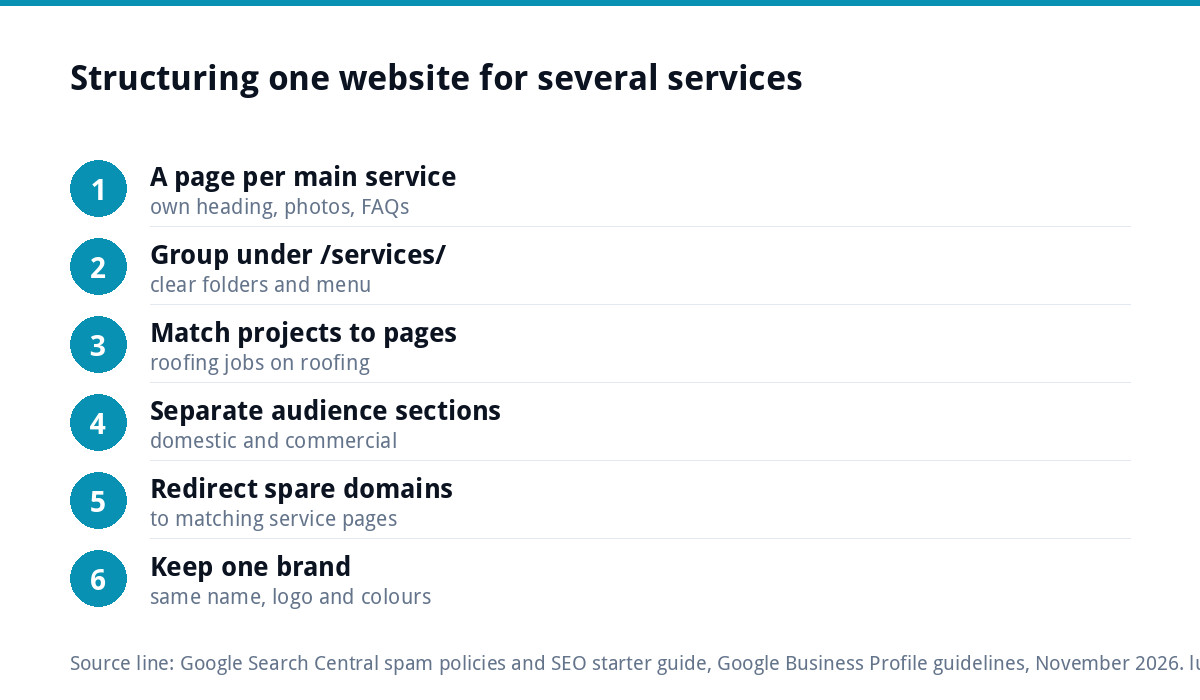
How to structure one site for several services
- Give every main service its own page with its own heading, photos, prices or ranges, and frequently asked questions.
- Group them under a services section, such as /services/roofing/ and /services/driveways/.
- Show the right projects on each page: roofing jobs on the roofing page, not a generic gallery.
- Use clear navigation so a commercial client can reach the commercial section in one click.
- Link related services to each other where it helps, such as fascias from the roofing page.
- Keep one brand: the same name, logo and colours throughout, so trust carries across every service.
If your branding already varies between your van, cards and online profiles, our guide to fixing a brand that looks different everywhere covers bringing it together.
Domestic and commercial customers on one site
The strongest argument for two sites is that homeowners and businesses want different things. A homeowner wants reassurance, tidy workers and a clear price. A facilities manager wants insurance details, accreditations, method statements and evidence you can handle multi-site contracts. That is a real difference, but it is a difference of pages, not of websites.
Give each audience its own clear route from the homepage, such as “For homeowners” and “For businesses”, each leading to a section written in the right tone. The commercial section can carry case studies, compliance documents and a separate enquiry form that asks for the details a commercial quote needs. Both sections share your reviews, your project history and your brand, which is precisely the trust a new commercial client is looking for. Our guide to winning commercial contracts as a trade covers what those buyers check.
What to do with extra domains you already own
Many businesses own a few keyword domains bought years ago. You do not need to build sites on them. Point each one, with a permanent redirect, to the matching service page on your main site. Customers who type them still find you, and you avoid running thin duplicate sites. Our domain names guide explains renewals and ownership.
Merging several sites into one
If you already run separate sites, merging them is usually worth it. Choose the strongest domain as the main site, rebuild the best content from the others as service pages there, then redirect every old page to its closest new equivalent with a permanent redirect, so visitors and any search value follow. Update your Google Business Profile and directory listings to the main site. Expect some movement in rankings for a few weeks while Google processes the change.
Before switching anything off, list every page on the old sites that brings visits or enquiries, so nothing valuable is lost in the move. Keep the old domains registered and redirecting for the long term; letting them lapse throws away the redirects and any links pointing at them.
Getting one strong site built
A custom WordPress site covers up to 8 pages for £499, enough for a homepage and several service pages; larger multi-service businesses may need the Premium Custom WordPress site at £1,499 for up to 14 pages. If you want help making each service page rank, our SEO service is £249 a month. See the website cost guide for wider context, and all our prices on the pricing page.
Get the UK Website Project Brief Template (free)
A two-page template for briefing any UK web designer: sitemap, integrations, audience and deliverables. Cuts revision rounds in half.
No spam. UK GDPR compliant. We only use your email to send this resource, unless you tick the box to hear from us.
Frequently asked questions
Is it better to have one website or multiple websites for my services? +
For most small businesses, one website with a dedicated page for each service is better. Links, reviews and search history build on one domain, there is one site to maintain, and customers see one brand. Multiple near-identical sites split that strength and can fall foul of Google's doorway abuse policy if they target the same searches.
Do exact-match domains still help rankings? +
Not in the way many people hope. A domain containing a service and town does not make a thin site rank. Google rewards useful content and a trusted site. If you own keyword domains, point each one with a permanent redirect to the matching service page on your main site rather than building separate sites on them.
Can I have a Google Business Profile for each website? +
Usually not. Google's guidelines say each business should have only one profile, with separate profiles allowed only in specific cases such as genuinely separate businesses or distinct departments. One business at one address normally has one profile linking to one website, so extra websites get no support from the map listings.
When should a business have two separate websites? +
When it is genuinely two businesses in a customer's eyes: a separate company with its own name, premises and customers, a product brand sold nationally alongside a local service, or a part of the business you plan to sell on its own. Domestic and commercial versions of one service usually work better as two sections of one site.
How do I merge two websites into one? +
Choose the stronger domain as the main site, rebuild the best content from the other as pages there, then redirect every old page to its closest new equivalent with a permanent redirect. Update your Google Business Profile and directory listings to the main site. Rankings may move for a few weeks while Google processes the change.