
Quick answer
Paid media is attention you buy, such as Google or Facebook ads. Owned media is what you control, such as your website, email list and leaflets. Earned media is what others give you for free: reviews, recommendations, shares and press. Small businesses do best building owned media first, using paid to speed things up and earning reviews from every job.
Paid, owned and earned (sometimes called POE) is a simple way to sort every bit of marketing you do. It helps answer the questions small business owners actually ask: should I spend more on ads, is social media worth it, why does a competitor with fewer ads get more work? This guide explains each type with small business examples, how they work together, the UK rules on reviews and influencer posts, and how to decide where your next pound or hour should go.
The three types compared
| Paid media | Owned media | Earned media | |
|---|---|---|---|
| What it is | Attention you pay for | Channels you control | Attention others give you |
| Small business examples | Google Ads, Facebook and Instagram ads, sponsored posts, paid directory listings | Website, email list, leaflets, van livery, social media profiles | Reviews, word of mouth, local press, shares, links from other sites |
| Cost | Pay for each click, view or placement | Time and design costs, little per use | Free to receive, earned through good work |
| Control | High over message and targeting | Full | Low |
| Trust | Lowest; people know it is an ad | Medium | Highest |
| Speed | Fast, can start in days | Slow to build | Slowest, hardest to force |
| When you stop | Stops immediately | Keeps working | Keeps working |
Paid media: speed you can switch on
Paid media is the most predictable lever a small business has. On pay-per-click platforms such as Google Ads you set a maximum bid, and Google’s help page on bidding and the ad auction explains that higher quality ads can often lead to lower costs per click. That is the key point for small budgets: a relevant ad sent to a relevant page beats simply bidding more.
The weakness of paid media is that it rents attention. The moment you stop paying, the enquiries stop. It works best as an accelerator on top of strong owned media, not as a replacement for it. Our Google Ads management and Facebook and Instagram ads management both start from £199 a month.
Owned media: the foundation you control
Owned media is everything you control and do not pay for per view. Your website is the centre of it, because every other channel eventually sends people there. Around it sit your email list, your printed materials, your van, your shopfront and your profiles on other platforms.
It helps to separate truly owned from rented:
- Truly owned: your website, your domain, your email list, your printed materials
- Rented: social media profiles and your Google Business Profile, which you manage but which run on someone else’s rules
Rented channels are still worth building, but never let them be the only place customers can find you. A business whose only online presence is a Facebook page loses everything if the account is locked. Your Google Business Profile deserves special attention because it is often the first thing local customers see; our guide to Google Business Profile optimisation covers how to get it right.
Earned media: the trust you cannot buy
Earned media is what other people say and share about you: reviews, recommendations, local news stories, social shares, mentions in community groups and links from other websites. It is the most trusted type because it does not come from you.
You cannot buy it, but you can make it far more likely:
- Do work worth talking about, and finish jobs tidily and on time.
- Ask for reviews at the moment the customer is happiest, with a direct link.
- Reply to every review, good and bad, politely and promptly.
- Share stories local media might use, such as an apprentice qualifying or a community project.
- Make sharing easy, with good photos of finished work and a clear business name on everything.
The rules on reviews and paid endorsements
Because earned media is trusted, the law protects it. The government’s guidance collection on reviews and social media endorsements explains that fake reviews and concealed incentivised reviews are a banned practice, which is automatically unfair and illegal, under a new law that came into force in April 2025. You must not write reviews of your own business, pay for fake ones or hide the fact that a review was incentivised.
The same applies when you blur paid and earned on social media. The Advertising Standards Authority’s influencers’ guide says that any incentive, even if it is not money, counts as payment, and that content resulting from it must be clearly labelled as advertising, with an “Ad” label upfront. It advises against vague labels such as “gifted”, “PR” or “collab”, and says the brand as well as the creator is responsible for proper labelling. If you give a local influencer a free meal or a discount in return for a post, that post is paid media and must say so.
How the three work together
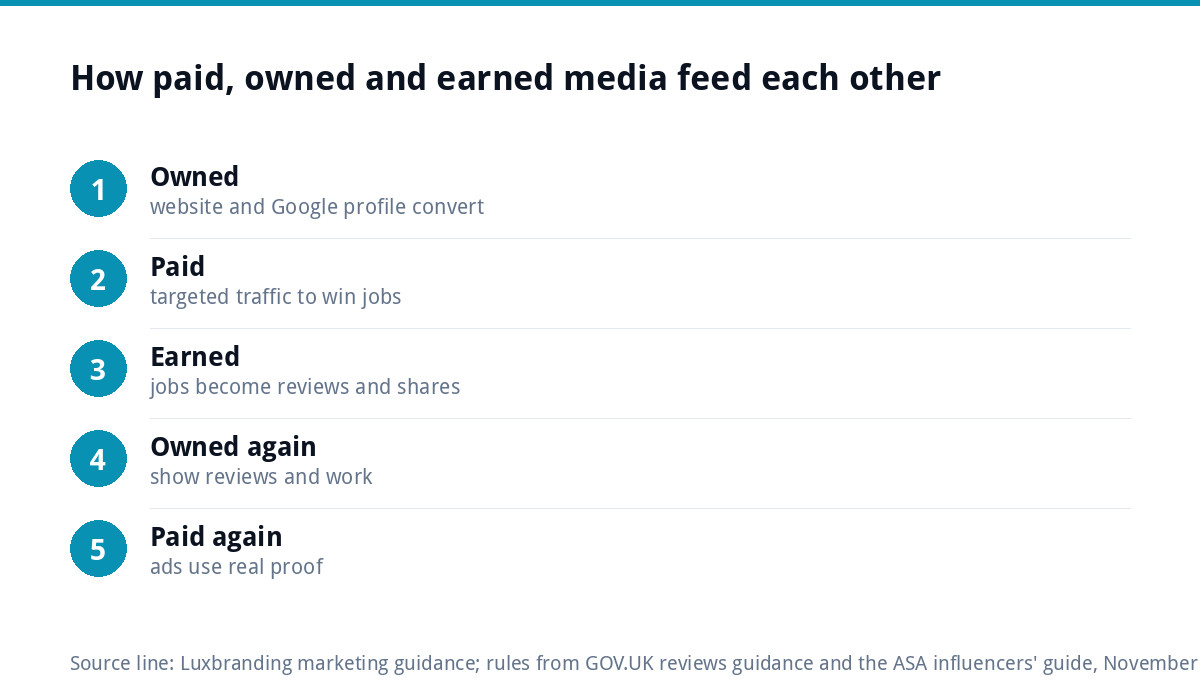
The three types are strongest as a loop, where each feeds the next:
- Owned: build a clear website and Google profile that turn visitors into enquiries.
- Paid: send targeted traffic to it to win jobs faster.
- Earned: turn those jobs into reviews, recommendations and shares.
- Owned again: show those reviews and photos on your website and in your emails.
- Paid again: use real reviews and real work in your ads, which makes them more convincing.
Each pass round the loop makes the next one cheaper. A business with strong reviews and a clear website pays less for each customer from ads, because more of the people who click go on to get in touch.
Where to focus at each stage
| Stage | Priority | Why |
|---|---|---|
| Just starting | Owned first: logo, website, Google Business Profile | Paid traffic is wasted if there is nowhere convincing to send it |
| First customers | Earned: ask every customer for a review | Reviews make every other channel work better |
| Steady work, want more | Paid: targeted ads for your most profitable service | Fastest way to fill gaps in the diary |
| Established | Owned: SEO, content and an email list | Reduces reliance on paying for every enquiry |
Worked example: a window cleaner’s first year
Here is how the mix might look for a new window cleaning round in a market town:
- Months one and two, owned: a logo on the van and workwear, a simple one-page website with prices and areas, a complete Google Business Profile and a leaflet for the streets they want to work.
- Months two to four, earned: every new customer gets a text after the first clean with a direct link to leave a review, and neighbours start asking the customer who cleans their windows.
- Months four to six, paid: a small Facebook ad targeted at nearby postcodes, using real before-and-after photos and quoting real reviews, sending people to the website’s booking form.
- Months six to twelve, owned again: an email or text reminder list of regular customers, a gallery of jobs on the website and a short page for each area covered.
By the end of the year, the round depends far less on ads, because reviews and word of mouth bring a steady flow of enquiries that cost nothing per lead.
Measuring each type
- Paid: cost per enquiry and cost per job won, not clicks
- Owned: website enquiries, email replies and calls from your Google profile
- Earned: new reviews each month, your average rating and “how did you hear about us?” answers
Ask every new customer how they found you and write it down. Over a few months, that simple habit tells you more about your marketing mix than any dashboard.
Common mistakes
- All paid, no owned, so enquiries vanish the day the ad budget runs out
- Relying on one rented platform, such as a single social media page
- Never asking for reviews and hoping they arrive on their own
- Unlabelled influencer posts or incentivised reviews that break the rules
- Sending ad traffic to a weak website that does not convert
- Measuring likes instead of enquiries and jobs
Getting help with each channel
We can help across all three. For owned media, our Google Business Profile setup and optimisation is £199, our monthly SEO is £249 a month and our content marketing and blog writing service keeps your website growing. For paid media, ads management starts from £199 a month. To keep social channels active, our Social Media Management is £249 a month. All prices are on our pricing page.
Get the UK SEO DIY Audit Checklist (free)
A 32-point checklist UK SMEs can run against their own website in an afternoon. Surfaces the quick wins before paying for a paid audit.
No spam. UK GDPR compliant. We only use your email to send this resource, unless you tick the box to hear from us.
Frequently asked questions
What is the difference between paid, owned and earned media? +
Paid media is attention you buy, such as Google or Facebook ads and sponsored posts. Owned media is what you control, such as your website, domain, email list and printed materials. Earned media is what others give you for free, such as reviews, recommendations, shares, local press coverage and links from other websites.
Is social media owned or earned media? +
Your own posts and profiles count as owned media, though they are really rented, because they run on another company's platform and rules. Shares, mentions and comments from other people are earned media. Boosted posts and ads are paid media. Never rely on a social profile as the only place customers can find you.
Which type should a new small business focus on first? +
Owned media first: a clear logo, a website and a complete Google Business Profile, because paid traffic is wasted without somewhere convincing to send it. Then ask every customer for a review to build earned media. Add paid ads once you have steady work and want to fill specific gaps.
Can I pay for reviews or influencer posts? +
Not without breaking the rules if it is hidden. GOV.UK guidance says fake reviews and concealed incentivised reviews became a banned practice under a law in force from April 2025. The ASA says any incentive, even a free product, counts as payment, so resulting posts must be clearly labelled as an ad upfront.
How do I measure paid, owned and earned media? +
Measure paid media by cost per enquiry and per job won, owned media by enquiries from your website and Google profile, and earned media by new reviews each month and how customers say they heard about you. Asking every new customer how they found you is the simplest and most reliable measure.