Quick answer: locksmith website costs
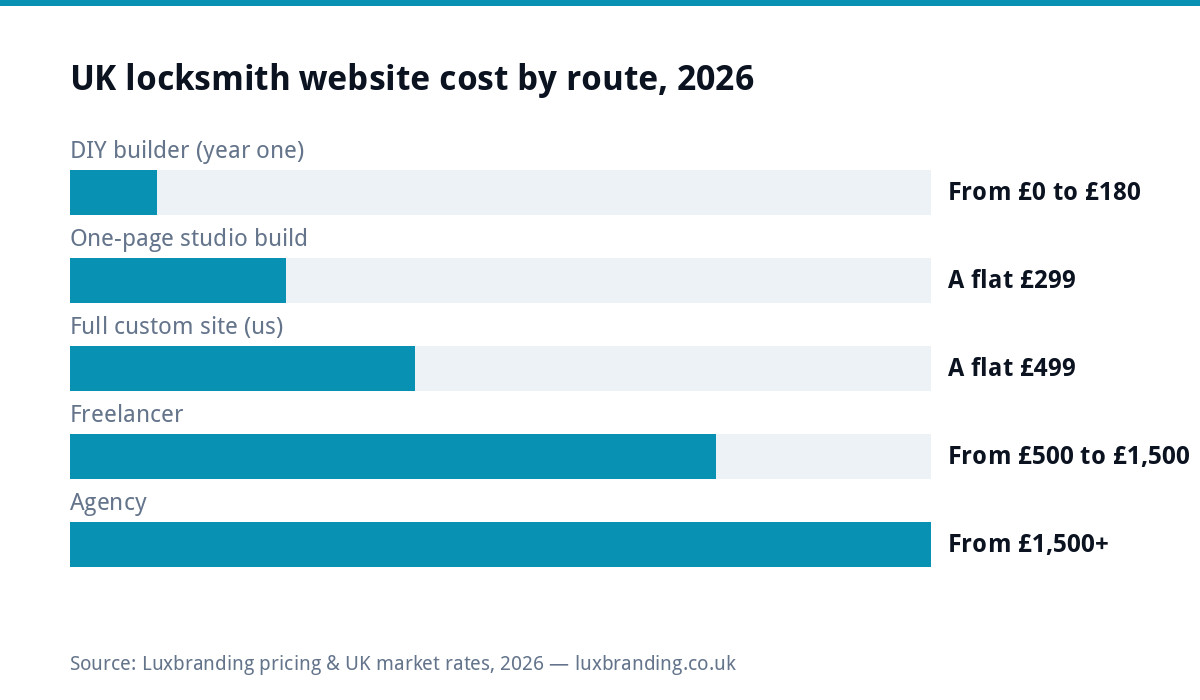
A locksmith website that actually wins emergency work costs £299 to £700 in the UK at fixed prices: our one-page build is £299 and a multi-page custom WordPress site is £499. Freelancers typically quote £500 to £1,500, agencies more. Ongoing costs run £30 to £60 a year for the domain plus hosting and maintenance, £20 a month on our managed plan. Every figure here is on the public price list, and the wider market maths are in the free website cost calculator.
Why locksmith sites are a special case
Most trades websites sell a considered purchase: a bathroom, an extension, a rewire. A locksmith site sells to someone standing outside their own front door at 11pm. That single fact drives every design decision: the phone number must be visible without scrolling and tappable with cold thumbs, the page must load fast on 4G, the service area must be answerable in one glance, and the trust signals must work in seconds. Conversion here is measured in taps, not enquiry forms.
The cost table: routes compared
| Route | Upfront cost | Strengths | Watch for |
|---|---|---|---|
| DIY builder | £0 to £180/year | Cheap start | Slow templates, your evenings, weak local SEO |
| Fixed-price studio (one-page) | £299 | Fast, mobile-first, known cost | Single page limits rankings |
| Fixed-price studio (full site) | £499 | Per-service pages, room to grow | Needs your content input |
| Freelancer | £500 to £1,500 | Custom work | Availability, support continuity |
| Agency | £1,500+ | Full service | Overkill for a sole trader |
The emergency page: your real homepage
For a 24/7 locksmith, the emergency call-out section IS the business. It needs: the number as a giant tap target, repeated after every block; “average arrival 30 to 45 minutes” style response expectations, honestly stated; the call-out fee and labour structure; areas covered with real place names; and a line about non-destructive entry first. Everything else on the site exists to make the person trust that number enough to tap it. We build exactly this pattern into trades sites, and the broader pricing context for your trade sits in the tradesman website cost guide.
Trust signals that separate you from the rogue end
Locksmithing is an unregulated trade in the UK, which customers half-know and fully fear. The counters that work: Master Locksmiths Association approval displayed with your licence number, since MLA approval involves vetting, inspection and DBS checks; insurance stated with amounts; real named reviews rather than anonymous stars; photos of you, your van and your ID badge; and honest pricing structure. Consumer guidance from Which? tells customers to check exactly these things, so showing them preempts the checklist.
Click-to-call and speed: the technical bar
Every phone number on the site should be a tel: link, tracked so you know which pages produce calls. Target a sub-two-second load on mobile: compressed images, no slider carousels, no autoplay video of key-cutting. Google Business Profile matters as much as the site for “locksmith near me” searches, and the two reinforce each other; our Google Business Profile setup guide covers that side. A slow beautiful site loses to a fast plain one in this trade every single night of the week.
Worked example: sole trader, one town, £299
A newly MLA-approved locksmith covering one market town orders the one-page build: emergency section up top, then domestic, auto and uPVC specialisms, honest price structure, MLA and insurance badges, twelve reviews pulled from his profile, and a service-area map. Ongoing: domain £12 a year, managed hosting £20 a month. Total first-year cost £551. Two emergency call-outs cover it, and he stops paying £40 per lead to directories for work his own site now brings in at marginal cost zero.
When to grow beyond one page
Add pages when you want search visibility beyond your name and immediate area: a page each for auto locksmithing, safes, commercial master-keying and burglary repairs, each answering real questions with real prices; town pages only for places you genuinely serve; and a small set of honest articles, what a lock change costs, what non-destructive entry means, uPVC mechanism failures. That is the £499 custom WordPress build shape, and it typically pays back through one extra job a month in ranked terms.
Ongoing costs, honestly
Domain £10 to £30 a year. Hosting and maintenance either your own time on a builder, or £20 a month managed with updates, security and backups handled. No mandatory monthly marketing spend: a locksmith site plus a well-tended Google profile and genuine review flow is a complete acquisition system for a one-van operation. Paid ads are optional acceleration for competitive urban areas, not a survival requirement, and the maths for that decision live in our Google Ads cost guide.
By situation: what to buy
Just qualified, first van: £299 one-pager plus Google profile; spend the difference on the MLA membership. Established, directory-dependent: £499 full site with per-service pages, then wean off per-lead fees as rankings arrive. Multi-van, two towns: full site plus genuine per-area pages and call tracking. Auto specialist: dedicated pages per vehicle service; this niche searches specifically and pays well. Commercial contracts: add case studies and compliance credentials; procurement people read differently from locked-out homeowners.
Local SEO: the site and profile working as one system
For emergency trades, Google Business Profile and the website split the work: the profile wins the map pack and the midnight call, the site wins considered work like lock upgrades, uPVC repairs and commercial contracts, and each strengthens the other. Keep name, address and phone identical everywhere, categorise the profile precisely, and let the site’s service pages give the profile somewhere specific to link. Reviews do double duty: they rank the profile and convert the site, so wire a review request into your job-completion routine, a text with the direct link an hour after the door opens. Ten fresh reviews a quarter outrank most paid tactics in this trade, and they cost a sentence of asking.
Content that earns rankings between emergencies
A locksmith site with four honest articles beats a brochure site in three months of searches: what a lock change actually costs and why call-outs vary, what non-destructive entry means and when drilling is genuinely necessary, why uPVC mechanisms fail in cold snaps, and what British Standard kitemarks insurers expect on final-exit doors. Each answers a question customers type at calmer moments, each pre-sells your honesty before the emergency, and each gives the considered-work customer a reason to choose you over the biggest ad. Write them once, from real jobs, in plain language: the trade knowledge you consider obvious is exactly what ranks, because nobody locked out has ever written it down.
Mistakes locksmith websites keep making
The recurring ones: numbers as images rather than tappable links, which silently loses mobile callers; stock photos of American deadbolts on a site selling British Standard upgrades; hiding the call-out fee and paying for it in trust; town lists stretching thirty miles beyond any van you actually run, which customers and search engines both read as noise; and no reviews on the site while forty sit unused on the profile. Every one of these is a five-minute fix inside a proper build, and together they explain most of the gap between locksmith sites that ring and locksmith sites that just exist.
What to do next
Order the £299 one-page build or the £499 full site, both with click-to-call wiring, honest-pricing sections and trust-badge placement built for the emergency trade. Or benchmark your quotes first with the free calculator; it takes a minute and requires no email.
Get the UK Website Project Brief Template (free)
A 2-page template for briefing any UK web designer — sitemap, integrations, audience, deliverables. Cuts revision rounds in half.
No spam. Unsubscribe any time. UK GDPR compliant — your email is only used to send this resource.
Frequently asked questions
How much does a locksmith website cost in the UK? +
A professional locksmith site costs £299 to £700 fixed-price for a one-page or small business site, £500 to £1,500 from freelancers, and more through agencies. Our one-page build is £299 and a full custom WordPress site £499, both mobile-first with click-to-call throughout.
What matters most on a locksmith website? +
Speed and the phone number. Most emergency customers are locked out, on a phone, stressed, and will call the first credible result. A site that loads in under two seconds with a tappable number in the header wins work that a beautiful slow site loses.
Should a locksmith show prices on their website? +
Show call-out structure honestly: the call-out fee, labour basis and typical ranges for common jobs like lock changes. Customers burned by rogue operators actively look for price transparency, and it filters out time-wasters before they call.
Is MLA approval worth displaying? +
Prominently. Master Locksmiths Association approval involves vetting and inspection, and it is the one trust mark customers may actually recognise. Pair it with DBS-checked, insured, and real reviews, and you separate yourself from the unvetted end of the trade.
Do locksmiths need more than one page? +
Starting out, no: one strong page with services, area, prices and proof converts fine at £299. Add pages when you want to rank beyond your name: per-service pages for auto, safes and commercial work, and honest content about common lock problems.