Quick answer
Linktree is a free or low-cost list of links (paid plans were £5 to £18.50 a month at the time of writing) that lives on Linktree’s address. A one-page website (ours is £299 one-off) lives on your own domain, can rank on Google and takes enquiries. Use Linktree for social bios; use a one-page site as your business’s home.
Linktree prices here were read from its UK pricing page in October 2026 and change from time to time. This guide compares the two for a small UK business: what each does, what each costs over a year, and how to use both together.
What each one is for
They solve different problems, which is why the comparison is often muddled.
- Linktree is a link-in-bio page. Social platforms give you limited space for a link in your profile, so you point that link at a Linktree page listing several destinations: your shop, your booking page, your latest video, your reviews.
- A one-page website is a complete small website on a single scrolling page: who you are, what you do, where you work, prices or a quote route, proof of your work, and a contact form. It sits on your own domain, such as yourbusiness.co.uk.
A Linktree page is a signpost. A one-page website is a destination. Most businesses that rely on a Linktree page are really missing the destination.
Side by side
| Question | Linktree | One-page website |
|---|---|---|
| Main job | Send social visitors to other links | Explain your business and win enquiries |
| Address | Linktree’s address with your name on it | Your own domain |
| Setup | Minutes, yourself | Built for you by a designer |
| Starting cost | Free plan available | £299 one-off with us |
| Ongoing cost | £0 to £18.50 a month, depending on plan | Hosting, plus your domain |
| Found on Google for your services | Not designed for it | Yes, with proper content and structure |
| Contact form into your inbox | Not its main purpose | Included |
| Platform branding removed | Premium plan | No third-party branding |
| If the platform changes its rules | You go with it | You own the code and can move |
What Linktree costs
The Linktree pricing page lists four plans: Free, Starter, Pro and Premium. It notes that prices vary by region and that annual billing is discounted. In UK pounds at the time of writing:
- Free: £0, with unlimited links, core appearance options and basic analytics.
- Starter: £5 a month, or £4.08 a month billed annually, adding more appearance controls and link scheduling.
- Pro: £9 a month, or £7.50 a month billed annually, adding advanced analytics, monetisation tools and SEO controls.
- Premium: £18.50 a month, or £16 a month billed annually, adding full analytics, commerce features, priority support and removable Linktree branding.
For a sole trader who just wants to list four links, the free plan genuinely does the job.
Where Linktree falls short for a business
It is not your address
Everything you build on a link-in-bio page sits on someone else’s address. If you print it on a van or a flyer, you are advertising their domain with your name attached. If they change their plans, features or prices, you follow or start again. Our UK domain names guide explains why owning your address matters.
It does not win search enquiries
People looking for a plumber, a dog groomer or a wedding florist search Google, not Instagram bios. Google’s SEO starter guide talks about pages with descriptive titles, clear headings and helpful, readable text. A list of buttons does not give Google much to understand about what you do or where you do it. If you already have a site that is not appearing, our guide to a website not showing on Google covers the usual reasons.
It adds a step
Someone taps your bio link, lands on a list, then has to choose again. Each extra tap loses some people. A one-page site can put the most important action (call, quote, book) right at the top.
Where Linktree is the right tool
None of that makes Linktree bad. It is good at what it is for:
- Creators and makers who post several things a week and want one link that always points to the latest.
- Businesses with several platforms (a shop on one site, bookings on another, a podcast elsewhere) that need a menu.
- Short campaigns, where you want to swap the top link quickly without touching a website.
If those describe you, use it. Just do not let it stand in for a website if your work comes from local customers searching online.
A year of costs compared
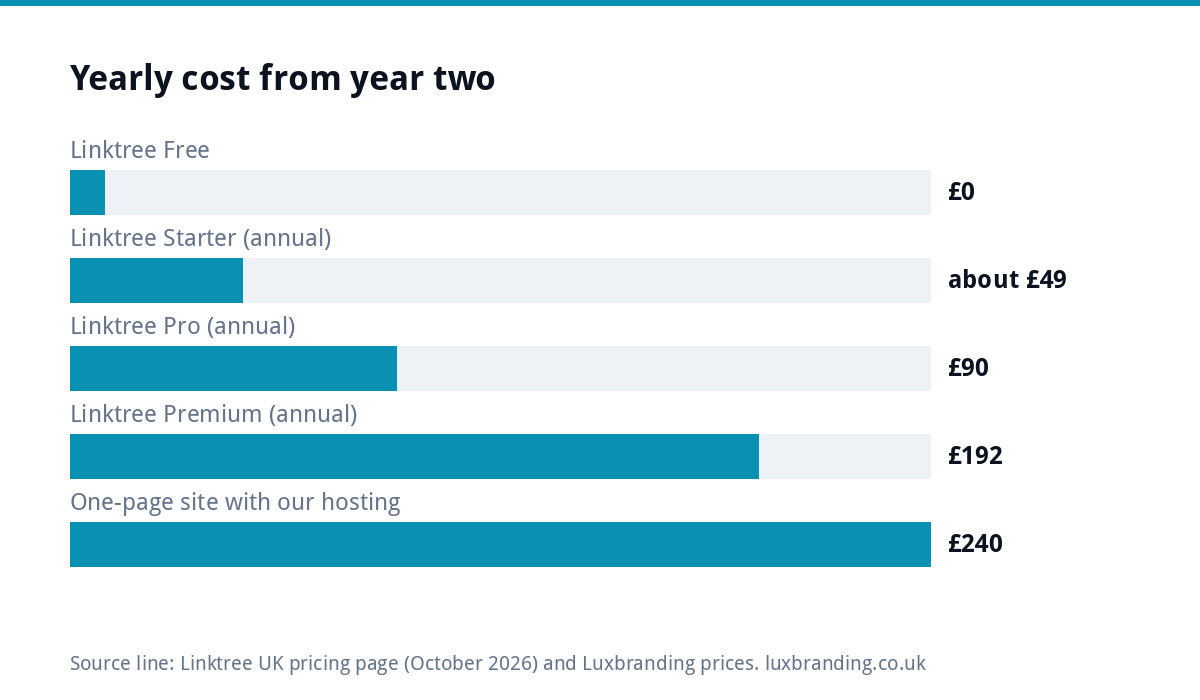
| Option | Year 1 | Year 2 onward | Notes |
|---|---|---|---|
| Linktree Free | £0 | £0 | Linktree branding shown |
| Linktree Starter, annual | About £49 | About £49 | £4.08 a month billed annually |
| Linktree Pro, annual | £90 | £90 | £7.50 a month billed annually |
| Linktree Premium, annual | £192 | £192 | £16 a month billed annually |
| Our one-page website with our hosting | £539 | £240 | £299 build plus £20 a month hosting |
Domains are left out because you need one for the website and it is a good idea to own one anyway. The website costs more in year one; from year two the gap with Premium is £48 a year. The website figure includes UK hosting, SSL, daily backups, security monitoring, updates and up to three business email mailboxes, and you can host the site anywhere you like.
The best setup: use both
For most small businesses the answer is not either/or. Point the people who search at your website, and point your social bio wherever is most useful.
- Build a one-page website on your own domain with your services, areas, proof and a contact form.
- Put your website address on your Google Business Profile, van, cards and quotes.
- Either point your social bio straight at the website, or keep a link-in-bio page with the website as the first link.
- If you use a Canva design for your bio page, note that Canva’s guide to publishing Canva websites says Link in Bio designs publish only to a canva.link address.
- Check monthly which links people actually tap, and cut the rest.
If your Google Business Profile does a lot of your enquiry work, our guide to Google Business Profile optimisation is the companion piece.
What the one page should hold
If you replace or back up a link-in-bio page with a one-page website, the page has to do more than list links. In top-to-bottom order, a good one-page site for a small business covers:
- A plain headline saying what you do and where: “Boiler servicing and repairs across north Leeds”, not a slogan.
- The main action straight underneath: call, request a quote or book, as a button that works with one thumb.
- Your services, each with a sentence or two written as real text, so Google can read it.
- Proof: photos of real work, accreditations you genuinely hold, and your rating if you have one.
- Areas covered, listed by town, because that is how people search.
- Prices or a price guide, even if only “from” figures, so enquiries arrive already expecting your rates.
- A contact form that lands in your inbox, plus your phone number and opening hours.
- Your social links at the bottom, which is the job Linktree was doing all along.
That last point is the key one. A good one-page site contains everything a link-in-bio page does, as one section of a page that also explains your business. When you outgrow a single page, the same content becomes the starting point for a bigger site, and nothing is wasted.
A worked example
Say a mobile beautician gets most bookings from Instagram and uses a free Linktree page with links to a booking app, a price list image and WhatsApp. New clients from Google are rare, because there is nothing on Google to find. The fix is a one-page site on her own domain with treatments, prices as text, the towns she covers and a booking button. Her Instagram bio then points to the website, and the Linktree page can go, or stay with the website as its first link.
What we offer
Our One-Page Website is £299 one-off: custom design, mobile-first build, an SEO foundation (schema, meta and sitemap), contact forms connected to your inbox, Google Analytics, a written guide to editing it and 30 days of support. It is hand-coded with no page builders, and you own the code. See the one-page website page, or our landing page design service if you need a single page for one campaign. All prices are on our pricing page.
Get the UK Website Project Brief Template (free)
A two-page template for briefing any UK web designer: sitemap, integrations, audience and deliverables. Cuts revision rounds in half.
No spam. UK GDPR compliant. We only use your email to send this resource, unless you tick the box to hear from us.
Frequently asked questions
Is Linktree enough instead of a website? +
For a creator or a hobby business that gets all its customers from social media, it can be. For a business that wants customers searching Google, it usually is not, because a list of links on Linktree's address gives search engines little to understand. A one-page website on your own domain fills that gap.
How much does Linktree cost in the UK? +
Linktree has a free plan. At the time of writing its UK pricing page listed Starter at £5 a month, Pro at £9 and Premium at £18.50 a month, with lower monthly prices when billed annually. Only Premium lists removable Linktree branding. Prices vary by region and change, so check the current page.
Can a Linktree page rank on Google? +
It is not designed for it. A link-in-bio page is mainly a list of buttons, while Google looks for pages with descriptive titles, headings and helpful text about what you do and where. Paid Linktree plans list SEO controls, but a page about your services on your own domain gives you far more to work with.
Should I put my Linktree or my website on my van? +
Your website. It is your own address, it explains what you do, and it can take enquiries directly. A Linktree address advertises Linktree's domain with your name attached and adds an extra tap before the customer reaches anything useful. Keep the link-in-bio page for your social profiles if you need it.
How much is a one-page website? +
Our One-Page Website is £299 one-off, with a custom design, mobile-first build, an SEO foundation, contact forms connected to your inbox, Google Analytics and 30 days of support. You own the code and can host it anywhere. Our hosting plan is £20 a month if you want us to look after it.