Quick answer
A small-business website of up to eight pages usually takes two to four weeks from a signed-off brief to launch, which is the timeframe we work to for a £499 custom WordPress site. The build is rarely the slow part. Waiting for text, photos and feedback is what stretches most projects from weeks into months.
This guide breaks the timeline into stages, shows who each stage waits on, and gives you a week-by-week plan for a typical trades or service website so you can see where your own project might slip.
Timelines by type of website
The number of pages matters less than the number of decisions. A one-page site with clear content can be finished faster than a five-page site where nobody has agreed what the services are. As a rough guide for a small business with its content ready:
| Type of site | Typical build time | What sets the pace |
|---|---|---|
| One-page website | Days to two weeks | How quickly you supply the text and photos |
| Brochure site, up to 8 pages | 2 to 4 weeks | Service page content and one round of feedback |
| Larger site, up to 14 pages | 4 to 8 weeks | More pages to write, check and approve |
| Online shop, up to 20 products | 3 to 6 weeks | Product photos, descriptions, delivery rules and payment setup |
| Booking system, portal or web app | Quoted per project | Features, integrations and testing |
These are typical ranges, not promises. For our own work, the fixed timeframe we publish is two to four weeks for a custom WordPress website of up to eight pages. Bigger builds and anything with logins or member areas are quoted in writing before work starts, including the timescale.
Where the weeks actually go
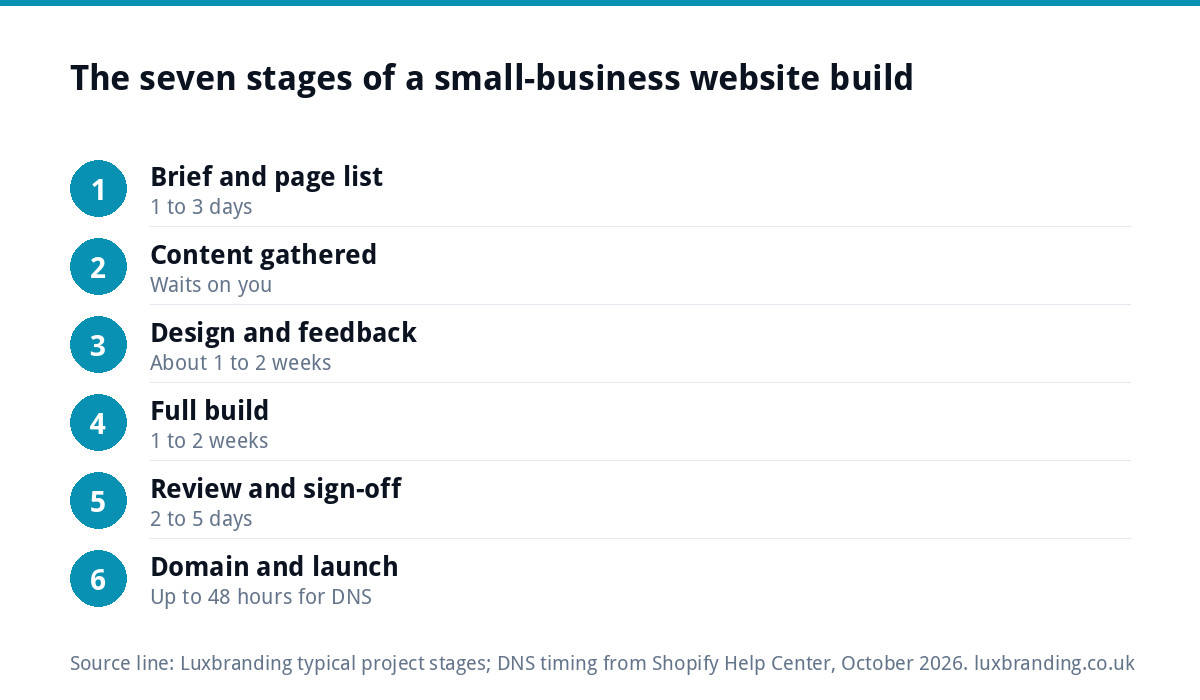
A website project is a chain of stages, and each stage waits on someone. Here is the order most small-business builds follow:
| Stage | Typical time | Who it waits on |
|---|---|---|
| 1. Brief and page list agreed | 1 to 3 days | You and the designer |
| 2. Content gathered (text, photos, logo files) | Anything from a day to a month | You |
| 3. Design of the home page and a key inner page | 3 to 5 days | The designer |
| 4. Feedback on the design | 1 to 7 days | You |
| 5. Full build, mobile-first | 1 to 2 weeks | The developer |
| 6. Review, fixes and sign-off | 2 to 5 days | Both |
| 7. Domain connected and launch | Same day, plus up to 48 hours for DNS | Whoever controls the domain |
Look at the right-hand column. Three of the seven stages wait on the business owner. That is why two identical projects can finish five weeks apart.
Content is the usual bottleneck
Ask any web designer what delays projects and the answer is almost always the same: the words and pictures. Writing six service pages feels quick until you sit down to do it between jobs. Photos of your own work are often scattered across three phones.
The fix is to start gathering before the project starts. For a typical trades site you need:
- A short description of each service you want to be found for, with the jobs it covers and the areas you work in.
- Ten to twenty photos of real work, before and after where possible.
- Your logo in a proper vector format. If you only have a blurry JPG, sort that first, because it holds up the design stage.
- Three to five genuine reviews you have permission to quote.
- Accreditations and memberships, with numbers customers can check.
- Your business details: phone, email, address or coverage area, and company number if you are a limited company.
If you hand all of that over on day one, a two-week build stays a two-week build.
Feedback rounds: the hidden delay
The second big delay is feedback. A design sits in your inbox while you finish a bathroom refit, then a partner sees it and wants changes, then someone wants the original back. Each loop can cost a week.
Agree before the project starts who signs off the design and give feedback in one consolidated list rather than in drips. A screenshot with numbered notes is clearer than five separate emails, and it stops the designer guessing which comment is the latest.
Domain and email: the 48-hour wait
Launch day is rarely instant. Pointing your domain at the new site means editing DNS records, and the change has to spread across the internet. Shopify’s own help centre, for example, says it might take up to 48 hours for a newly connected domain to be fully live, and other platforms give similar windows.
Two things make this smoother. First, know who holds your domain login before launch week, because a missing password can add days. Second, make sure your email records are copied across, so quotes and enquiries keep arriving. Our UK domain names guide explains the records involved and the traps that cost money.
After launch: Google keeps its own clock
A finished website is not the same as a website people can find. Google has to discover, crawl and index the new pages, and that runs on its timetable, not yours. Google’s documentation on asking for a recrawl says plainly that crawling can take anywhere from a few days to a few weeks.
Ranking well takes longer again. Google’s SEO starter guide notes that some changes take effect in a few hours while others can take several months. Plan for the site to be live and correct first, then judge search results over the following months, not the following days.
What makes a project slip
Most overruns come from a short list of causes. Watch for these:
- Scope creep. “Can we add a booking system?” halfway through turns a brochure site into a different project.
- Missing logo files. The design cannot be finalised around a logo that pixelates.
- Too many decision-makers. Every extra person in the feedback loop adds a round.
- Waiting for the perfect photos. Good phone photos now beat a professional shoot in three months.
- Domain access. The domain is registered to a former developer or an old email address nobody checks.
- Last-minute legal pages. Privacy notice and company details left until launch day.
How to speed it up without cutting corners
You can shave weeks off a project without rushing the bits that matter. Use this as a checklist before your first call with any designer:
- Write a one-line job for every page: who lands there and what should they do next.
- Collect your photos into one shared folder before the brief.
- Find your domain login and confirm you can reach the account email.
- Decide one person who approves designs.
- Book time in your diary for feedback, the same way you would book a job.
- Keep a “phase two” list for ideas that arrive mid-project, rather than adding them now.
Our website launch checklist covers the final pre-live checks, so the last week is about testing rather than scrambling.
A realistic four-week plan for a trades website
Here is how a six-page site for a roofing firm in the Midlands might run when the owner has content ready:
- Week 1: brief agreed, pages fixed (home, three service pages, about, contact), content and logo files handed over, home page design started.
- Week 2: home and service page designs shared, one round of consolidated feedback, build begins.
- Week 3: full build on mobile and desktop, contact form connected to the owner’s inbox, analytics added, review copy sent.
- Week 4: fixes, final sign-off, domain connected, launch, and the site submitted to Google.
The same project with content arriving late in week three would simply start its real build in week four. Nothing about the code changes; only the waiting does.
DIY builders: faster to start, not always faster to finish
Website builders let you have something online in an afternoon, which is genuinely useful. The catch is that the time moves to you: choosing a template, writing every page, fixing mobile layouts and learning the settings. Many owners find a “weekend project” stretches across months of evenings. Our comparison of AI website builders against a custom site covers where those builders save time and where they cost it later.
If a single page would do the job, a one-page website at £299 is the quickest professional route, because there are fewer pages to write and approve.
What our timescale includes
For a £499 custom WordPress site, the two to four weeks covers custom design, a hand-coded mobile-first build with no page builders, the SEO foundation (schema, meta and sitemap), contact forms connected to your inbox, Google Analytics, a written guide to editing your content, and 30 days of support after launch. You own the code and can host it anywhere.
The clock starts once the brief is agreed and your content is with us. Every package is listed on our pricing page, and the website cost calculator gives a quick estimate if your project sits between packages. To get started, order online or email us at support@luxbranding.co.uk with your page list.
Get the UK Website Project Brief Template (free)
A two-page template for briefing any UK web designer: sitemap, integrations, audience and deliverables. Cuts revision rounds in half.
No spam. UK GDPR compliant. We only use your email to send this resource, unless you tick the box to hear from us.
Frequently asked questions
How long does it take to build a small business website? +
Most small-business websites of up to eight pages take two to four weeks from an agreed brief to launch, provided the text, photos and logo files are ready. Larger sites of around fourteen pages often take four to eight weeks. Online shops depend heavily on how quickly product photos and descriptions arrive.
What usually delays a website project? +
Content is the most common delay: service descriptions, photos and reviews that arrive late. Slow or scattered feedback is the second. Other causes include scope added mid-project, a logo that only exists as a low-quality JPG, and nobody being able to log in to the domain account when it is time to launch.
How long after launch will my website appear on Google? +
Google has to crawl and index a new site first. Its own documentation says crawling can take anywhere from a few days to a few weeks. Ranking well for competitive searches usually takes months, so judge search performance over a season rather than in the first week after launch.
Can a website be built in a week? +
A simple one-page website can be finished within a week if the content is ready and feedback is quick. Multi-page sites usually need longer because each page needs writing, designing and approving. Rushing tends to cut testing on phones and forms, which is where problems show up after launch.
How long does Luxbranding take to build a website? +
Our custom WordPress website is £499 for up to eight pages and takes two to four weeks once the brief is agreed and your content is with us. Larger builds, e-commerce extras and member areas are quoted in writing, including the timescale, before any work starts. Order online or email support@luxbranding.co.uk.