Quick answer
In the UK a designer usually owns copyright in commissioned work unless it is assigned in writing, and most design terms let them show finished work in a portfolio. You can ask to delay, anonymise or refuse portfolio use, but agree it in writing before work starts. Using your name or a testimonial needs your permission.
Most business owners never think about this until they spot their new logo in a designer’s Instagram feed, or a competitor mentions seeing their unreleased website. Usually it is harmless, and often it is good publicity. Sometimes it is not: a product that has not launched, a sensitive client, a rebrand you have not announced. This guide explains who owns what, what designers normally ask for, and the reasonable options you have. It is general information, not legal advice.
Who owns the work, and why it matters
Copyright is the starting point. GOV.UK’s guidance on ownership of copyright works says the creator is the first owner of copyright unless the parties agree otherwise in writing, and that a freelancer working under a contract for services will usually keep copyright in what they produce. Without a clear transfer, the person who commissioned the work may only have an implied licence to use it for its intended purpose.
That matters twice over. First, it decides whether you fully own your logo, which is why every design contract should say what happens to copyright on payment. Second, if the designer keeps copyright, they generally keep the right to show the work, unless your agreement says otherwise.
Even where copyright is transferred to you, many design terms keep a separate permission for the designer to display the work in their portfolio. That is a licence back to them, and it is negotiable like any other term.
Moral rights: being named as the designer
Creators also have moral rights. GOV.UK’s page on licensing and selling copyright lists them: the right to be identified as the author, to object to derogatory treatment of the work, and to object to changes. A creator can keep or waive them.
In practice, this is why designers like to credit their work, and why some contracts include a waiver so you can adapt the logo later without asking. If you plan to modify or extend your branding with other suppliers, check the contract covers it.
What designers usually ask for
“Portfolio use” can mean several different things. It helps to separate them, because you may be comfortable with some and not others:
| Type of use | What it looks like | Typical sensitivity |
|---|---|---|
| Portfolio image | The finished logo or website shown on the designer’s own site | Low once launched |
| Social media post | The work posted on Instagram, LinkedIn or Behance | Low once launched; high before |
| Case study | The brief, the process and sometimes results | Medium: may reveal plans or figures |
| Client name or logo in a “worked with” strip | Your business shown as a client | Medium: implies an endorsement |
| Testimonial | Your words quoted in their marketing | Needs your permission |
| Award entries and talks | Work shown to judges or audiences | Usually low; ask to be told |
Your reasonable options
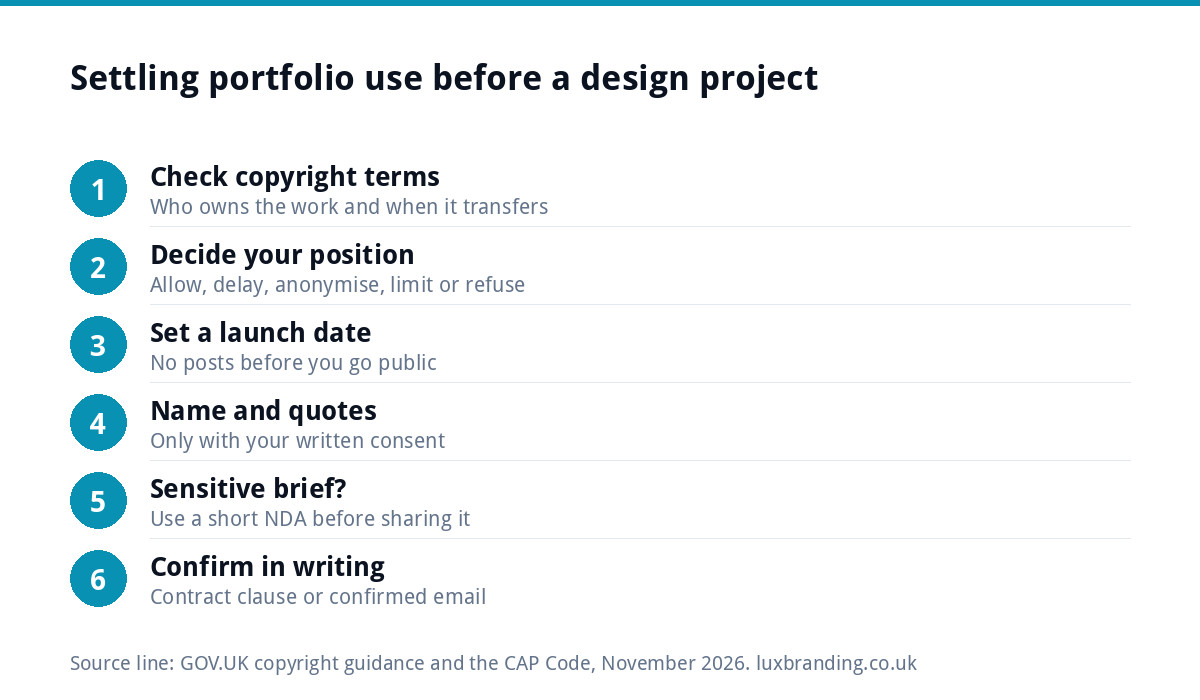
You do not have to accept or refuse everything. These are all normal requests to make before signing:
- Allow it. The simplest route, and it can bring you goodwill and the occasional referral.
- Delay it. No portfolio use until after your launch date, or until you confirm in writing. Useful for rebrands and new products.
- Anonymise it. The work can be shown, but without your business name or identifying details, or only as a crop.
- Limit it. Portfolio site only, no social posts, no case study figures.
- Refuse it. Reasonable for confidential work. Some designers price this in, because portfolio use is part of how they win work.
Whichever you choose, put it in writing. An email the designer replies to agreeing the point is better than a conversation nobody remembers.
Testimonials and case studies need permission
Advertising rules are clear on endorsements. The UK Code of Non-broadcast Advertising, in section 3 of the CAP Code, says marketing must not feature a testimonial without permission, with limited exceptions, and that marketers must hold documentary evidence that a testimonial is genuine, plus contact details for the person who gave it.
So if a designer wants to quote you, or present your results in a case study, they should ask. If a figure in a case study is yours, such as an increase in enquiries, you are entitled to check it is accurate and not presented in a misleading way before it goes out.
When portfolio use is a real risk
Most portfolio use does no harm. These are the situations where it is worth being careful:
- Unlaunched products or rebrands. A post before launch can tip off competitors or confuse customers.
- Confidential clients. If you work under a confidentiality agreement with your own customers, your marketing materials may reveal who they are.
- Tenders and bids. A designed bid document may contain pricing or methods you do not want public.
- People and homes. Photos of staff, customers or customers’ properties used in your branding should not be shown more widely than you agreed with those people.
- Internal documents. Staff handbooks, pitch decks and price lists are rarely meant for a public portfolio.
For genuinely sensitive projects, a short non-disclosure agreement before you share the brief is sensible. The Intellectual Property Office publishes free NDA templates, though they are written mainly with inventions in mind.
If your project is already online
If you find your work posted somewhere you did not expect, start calmly. Most designers will take a post down or delay it when asked politely, because a happy client is worth more to them than one image.
- Check what you agreed. Read the designer’s terms and your emails. If portfolio use was allowed, your request is a favour, not a demand, so ask accordingly.
- Be specific. Say which post or page, what the problem is (an unlaunched product, a client name, a staff photo) and what you would like: removal, a delay until a date, or an anonymised version.
- Ask in writing and keep the reply, so the agreement is on record for the future.
- Escalate only if needed. If the post breaches a written agreement or shows personal details of people who did not consent, and the designer will not act, take legal advice before going further.
Then fix the gap for next time: add a portfolio line to your own supplier checklist so the question is settled before any project starts.
A clause you can adapt
If the designer’s terms are silent or too broad, a few plain sentences cover most needs. For example:
“The designer may display the final approved designs in their portfolio and on their own social media, but not before [launch date] and not with any figures, documents or images of people without the client’s written consent. The client’s name and any quotation may be used only with the client’s written consent.”
Change the details to suit, and have anything significant checked by a solicitor.
Checklist before you sign
| Check | Why it matters |
|---|---|
| Who owns copyright, and when it transfers | Decides whether you fully own the final artwork |
| Whether portfolio use is allowed | Sets what the designer can show and where |
| Any delay until launch | Protects rebrands and new products |
| Use of your name, logo or quotes | Endorsements need your permission |
| Moral rights waiver | Lets you adapt the work later with other suppliers |
| Source files you receive | Owning copyright is little use without editable files |
For the files side, our guide to logo file formats explains what a complete handover looks like, and our UK guide to logo copyright and trade marks covers ownership in more depth.
Showing your own customers’ work
The same principles apply in reverse. If you are a trade business posting photos of finished jobs, ask the customer first, avoid house numbers and number plates, and keep anything identifying out unless they are happy with it. A simple line on your quote, asking permission to photograph completed work for your website and social media, settles it in advance. Our guide to branding for trades businesses covers using real work in your marketing.
Getting branding you own and can use
When you commission a logo or identity, ask the same questions of any designer: who owns the result, which files you get, and how the work may be shown. Our Logo Design is £129 with every file format and stacked, horizontal and icon-only layouts included, and Brand Identity Design is £299 for the logo, colours, typography, imagery and brand guidelines. Every fixed price is on our pricing page.
Get the UK Branding Budget Worksheet (free)
A printable worksheet: decide what your brand needs now and price it against fixed published prices and the IPO trademark fee.
No spam. UK GDPR compliant. We only use your email to send this resource, unless you tick the box to hear from us.
Frequently asked questions
Can a designer use my logo in their portfolio without asking? +
Often, yes. In the UK the designer is usually the first owner of copyright unless it is assigned in writing, and many design terms include permission to show finished work. Check the terms you agreed. If you need the work kept private or delayed, agree that in writing before the project starts.
Do I own the copyright in a logo I paid for? +
Not automatically. GOV.UK guidance says the creator is the first owner of copyright unless the parties agree otherwise in writing, and a freelancer will usually keep copyright without a written transfer. Make sure your contract or terms state that copyright passes to you, and when, so you can use and adapt the logo freely.
Can I stop a designer posting my project before launch? +
Yes, if you agree it with them. Asking for no portfolio or social media use until after your launch date is a common and reasonable request, especially for rebrands and new products. Put the date in writing, ideally in the contract or in an email the designer replies to confirming it.
Does a designer need permission to quote my testimonial? +
Yes. The CAP Code, which governs non-broadcast advertising in the UK, says marketing must not feature a testimonial without permission, apart from limited exceptions. The marketer must also hold evidence that it is genuine and contact details for the person who gave it. The same applies to case study figures attributed to you.
What should a portfolio clause in a design contract say? +
It should say where the designer may show the work, such as their website and social media, from when, and what is excluded, such as figures, internal documents or photos of people. It should also say whether your business name, logo or quotes may be used, which normally needs your written consent.