
Quick answer
Keep a new service under your main brand unless it serves different customers, needs a different price position or might be sold separately; a separate brand means new design, a new web presence and a trade mark from £205. A sub-brand borrows the parent’s trust; a new brand starts from zero but keeps risk apart.
Adding a new service or product line raises a branding question every growing business meets eventually. The electrician adding EV charger installs, the plumber opening a bathroom showroom, the cleaning company launching its own product range: should the new thing carry the main name, a variation of it, or something completely new? This guide sets out the three structures, five questions that settle the choice, worked examples, and the real costs of each route.
The three ways to structure it
| Structure | What it looks like | Strength | Weakness |
|---|---|---|---|
| One brand (a new service line) | “Hartley Electrical: EV charger installation” | All trust and reviews shared; cheapest | Can blur what you are known for |
| Endorsed sub-brand | “ChargeHome by Hartley Electrical” | Its own identity, still backed by the parent’s reputation | Two identities to keep consistent |
| Separate brand | “Voltway”, with no visible link | Clean positioning; can be sold or closed on its own | Starts with no trust, reviews or recognition |
Most small businesses should start at the top of this table and only move down when there is a clear reason. Every step down roughly doubles the work: another logo, another website or section, more profiles to run and more names to protect.
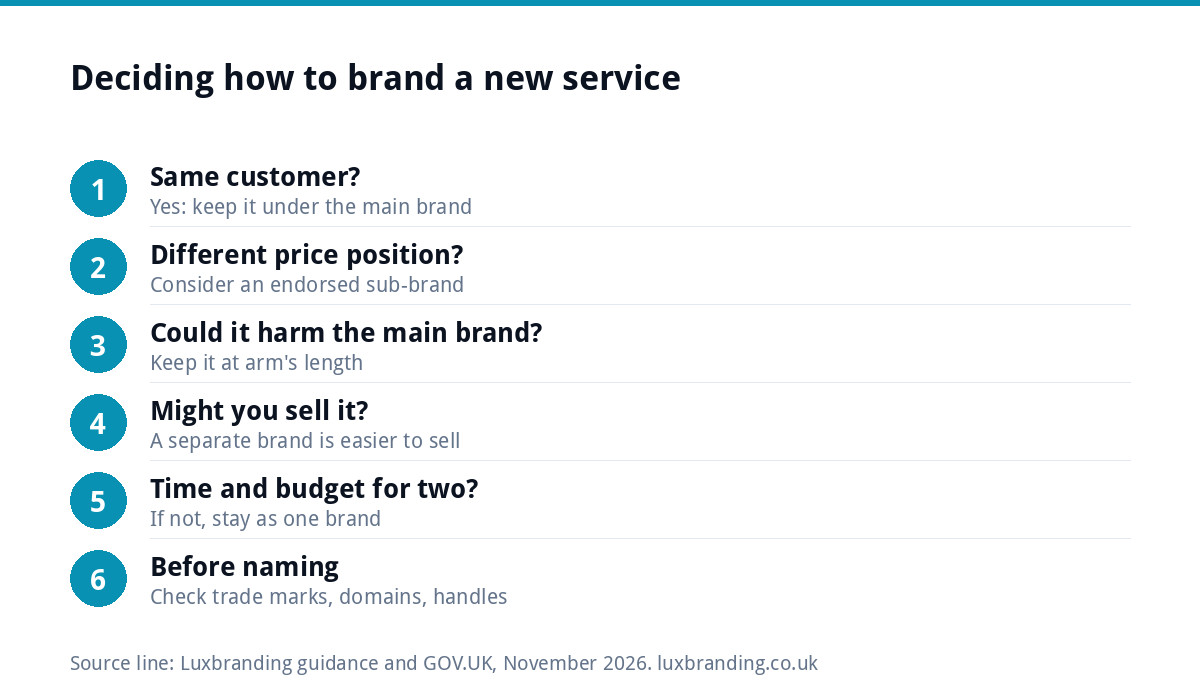
Five questions that decide it
- Is it the same customer? If the people buying the new service are the same people who already trust you, keep it under your main brand. A different buyer, such as trade customers instead of homeowners, points towards a sub-brand.
- Is the price position different? A premium design-and-build service sitting under a budget repairs brand can be held back by the association, and vice versa. A big price gap favours separation.
- Could it damage the main brand if it goes wrong? An experimental product, or a service with higher complaint risk, is safer at arm’s length.
- Might you sell it or bring in a partner? A separate brand is far easier to sell, license or hand over than a service tangled into your main identity.
- Can you afford to run two? Every brand needs design, a web presence, a Google Business Profile where relevant, social accounts and marketing time. If you are stretched with one, two will suffer.
If you answer “same customer, similar price, low risk, not for sale, stretched already”, the answer is simple: add it as a service line and promote it properly.
Worked examples
An electrician adding EV charger installs. Same homeowners, similar price band, and the electrical credentials are exactly what buyers want to see. Verdict: a service line under the main brand, with its own page on the website and its own section in marketing.
A plumber opening a bathroom showroom. The customers overlap, but the showroom sells design and products at a higher price, to people who may never need an emergency plumber. Verdict: an endorsed sub-brand, such as a showroom name “by” the main firm, so it can look more premium while keeping the trust.
A cleaning company launching its own range of products for retail. Different buyers, different channels (shops and online rather than call-outs), and a product that could one day be sold separately. Verdict: a separate brand, perhaps with “made by the team behind…” on the packaging story.
A builder adding a lettings and property management arm. A different service with different legal obligations and a different customer. Verdict: usually a separate brand, or at least a clearly endorsed one, so a problem in one side of the business does not land on the other.
What a sub-brand needs from the design
A sub-brand should look related to the parent without being mistaken for it. In practice that usually means:
- The same typefaces, so the family resemblance is obvious.
- A distinct accent colour, while keeping the parent’s core colour somewhere in the palette.
- A logo built on the same principles, often with an endorsement line such as “by Hartley Electrical”.
- Shared photography style and tone of voice.
- Clear rules on when the parent logo appears alongside, for example on vans and quotes.
A separate brand needs none of that. It needs a full identity of its own, built for its own customer.
What each route costs
| Item | Service line | Endorsed sub-brand | Separate brand |
|---|---|---|---|
| Design | Usually none; use existing brand | Logo Design £129 or Brand Identity Design £299 | Brand Identity Design £299 |
| Website | A new page on your existing site | A section or a landing page (£199) | Its own site, from £499 for a custom build |
| Trade mark | Usually covered by your existing name | Worth considering for the new name | At least £205, per GOV.UK |
| Google Business Profile | Add the service to your existing profile | Depends on how it trades | Separate profile if it is a separate business |
| Social and marketing time | Shared | Partly shared | Fully separate |
The design and build costs are one-off; the running costs, in time and attention, carry on every month. That is usually the deciding factor for small firms.
The legal and admin side
A new name is a new thing to protect. GOV.UK’s guide on registering a trade mark says registration costs at least £205, usually more depending on your circumstances, including how many goods or services you want to cover, and that a trade mark lasts 10 years before renewal. The Intellectual Property Office also checks your mark is not the same as, or similar to, existing ones, so search before you fall in love with a name. Our guide to logo copyright and trade marks in the UK explains the basics.
Trading names have rules of their own. GOV.UK’s guidance for sole traders on choosing a business name says you can trade under another name, but must include your own name, and your business name if you have one, on official paperwork such as invoices and letters. A business name must also not be too similar to another company’s trade mark.
If the sub-brand will have its own Google Business Profile, check Google’s business profile guidelines. They require the name to reflect the real-world name used consistently on your signage, website and stationery, and say all locations of a business in one country should share one name, with exceptions that include sub-brands. A profile with a made-up name you do not actually trade under risks suspension.
Domains and social handles
Before committing to a sub-brand or separate name, check the domain and the main social handles are available, along with Companies House if you plan to register a company. Our business name checker does the first pass in one go, and our guide to UK domain names explains the .co.uk and .com choice.
For an endorsed sub-brand, a section of your existing website often beats a separate domain: it inherits your site’s reputation in search, and you only have one site to maintain.
Signs a service line has outgrown your main brand
Starting as one brand is not a permanent decision. Watch for these signals that a service line is ready to stand on its own:
- Customers for the new service regularly assume you only do the original work, or the reverse.
- The new service has its own team, premises or phone line and is run almost separately.
- Its marketing needs a different tone, such as premium design language for a showroom next to emergency call-out messaging.
- It has grown to a meaningful share of the business and you can picture selling it one day.
- Reviews for one side of the business are confusing buyers of the other.
When two or three of these are true, an endorsed sub-brand is usually the natural next step, and it can always become fully separate later. Going the other way, folding a failed separate brand back into the main one, is harder and more visible.
Common mistakes
- Creating a separate brand for a service that the same customers would happily buy from you.
- A sub-brand that looks nothing like the parent, so the borrowed trust never transfers.
- Choosing a name before checking trade marks, domains and social handles.
- Splitting your reviews across two profiles too early, weakening both.
- Launching a second brand without the time or budget to market it.
Next steps
If you decide on a sub-brand or a separate identity, Brand Identity Design is £299 for the logo, colours, typography, imagery and brand guidelines, and Logo Design is £129 with stacked, horizontal and icon-only layouts included. If you are weighing how much identity you need, our comparison of brand identity vs logo design sets out the difference. Every fixed price is on our pricing page.
Get the UK Branding Budget Worksheet (free)
A printable worksheet: decide what your brand needs now and price it against fixed published prices and the IPO trademark fee.
No spam. UK GDPR compliant. We only use your email to send this resource, unless you tick the box to hear from us.
Frequently asked questions
What is the difference between a sub-brand and a new brand? +
A sub-brand has its own name or identity but stays visibly linked to the parent, often with a line such as "by" the main business, so it borrows the parent's trust. A new brand has no visible link, which keeps its positioning and risk separate but means building recognition, reviews and trust from scratch.
Should I create a separate brand for a new service? +
Usually not. If the same customers would buy it from you at a similar price, add it as a service line under your main brand and give it its own page and marketing. Consider a separate brand when the customer, price position or risk is very different, or when you might sell it later.
Do I need a trade mark for a sub-brand? +
It is worth considering if the new name will be used widely or for a long time. GOV.UK says registering a trade mark costs at least £205, more depending on how many goods or services it covers, and lasts 10 years. Search the register first, because marks too similar to existing ones can be refused.
Can a sub-brand have its own Google Business Profile? +
Sometimes. Google's guidelines say a profile name must reflect the real-world name used consistently on signage, website and stationery, and they allow exceptions for sub-brands to the rule that all locations share one name. A name you do not genuinely trade under risks the profile being suspended.
How much does it cost to design a sub-brand? +
With us, a sub-brand logo is Logo Design at £129, with stacked, horizontal and icon-only layouts included, or Brand Identity Design at £299 if it needs its own colours, typography, imagery and guidelines. A landing page for it is £199, and a separate custom WordPress website starts at £499.