Quick answer
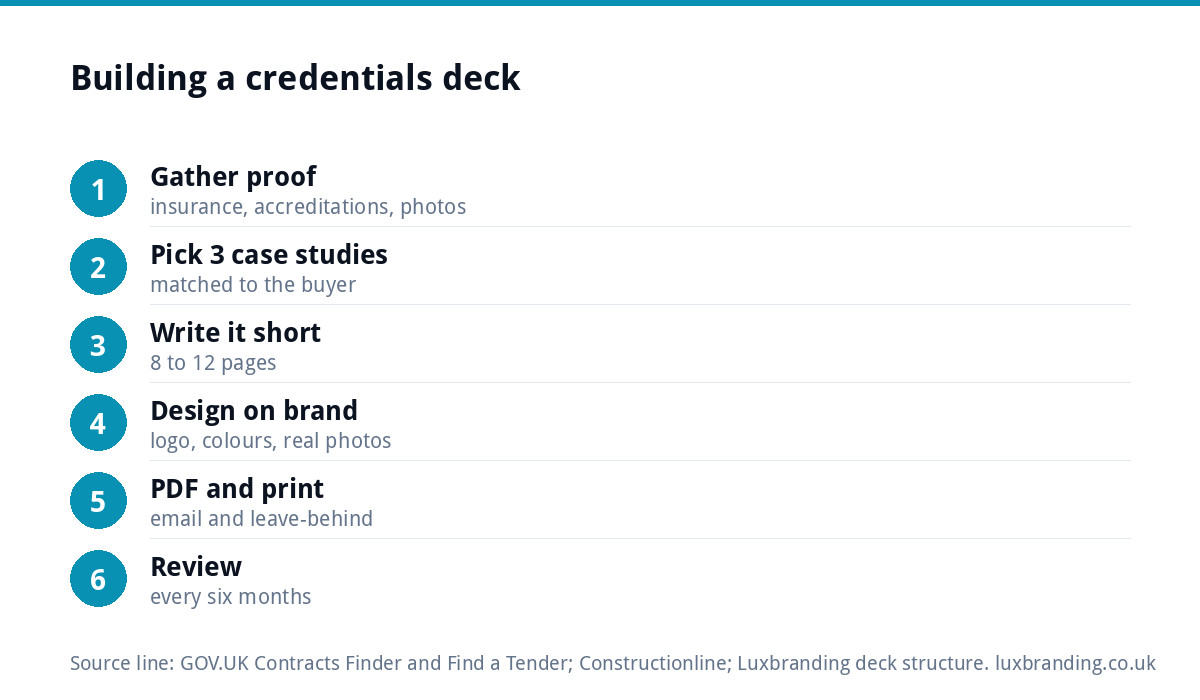
A credentials deck is a short, branded document, usually 8 to 12 pages, that shows a bigger client who you are, what you have delivered and why you are safe to hire. Include a company overview, services, three case studies with photos, accreditations and insurance, key people and contact details. Send it as a PDF and keep a printed copy.
Small contractors and agencies often lose bigger jobs not on price or quality, but on presentation. A main contractor, facilities management company or council buyer compares several suppliers quickly, and the one whose paperwork looks organised starts ahead. This guide sets out the page-by-page structure, how to write case studies a buyer believes, the format choices and the mistakes that make a small firm look smaller than it is.
What a credentials deck is, and is not
A credentials deck, sometimes called a capability statement or company profile, is a summary of your business written for buyers. It answers the questions a procurement manager or site manager asks before adding a new supplier to a list: can this firm do the work, have they done it before, are they insured and accredited, and who will turn up?
It is not a brochure full of adjectives, and it is not a tender response. A tender answers one buyer’s specific questions in their format. The deck is the reusable document you send when someone says “send us some information about your company”, and it often decides whether you are invited to tender at all.
If you are working towards commercial and public sector work more broadly, our guide to winning commercial contracts as a trade covers where the work is and what buyers check. This article focuses on the document itself.
Who will ask for one
- Main contractors building their subcontractor lists for upcoming projects.
- Facilities management companies that subcontract maintenance across many sites.
- Property managers and letting agents choosing approved contractors for a portfolio.
- Schools, councils and other public bodies. GOV.UK’s Contracts Finder lists government contract opportunities worth over £12,000 including VAT, and larger contracts appear on Find a Tender.
- Larger businesses looking for a design, marketing or IT supplier who will be around next year.
The page-by-page structure
Keep it short. A buyer skimming between meetings should be able to understand your business in two minutes.
| Page | What goes on it | Tip |
|---|---|---|
| 1. Cover | Company name, logo, one-line description, a strong photo of real work | No stock images of handshakes |
| 2. About us | Who you are, how long trading, where you work, team size | Plain facts in short paragraphs |
| 3. Services | What you do and the type of client you do it for | Group into three to six headings |
| 4 to 6. Case studies | One project per page: client type, problem, what you did, result, photos | Specific numbers and timescales |
| 7. Accreditations and insurance | Memberships, certificates, insurance types and cover levels | Only what you hold today |
| 8. Health, safety and quality | How you manage safety, quality and the environment | Summarise; offer the full policies on request |
| 9. Key people | Two to four people, roles, qualifications, a sentence each | Photos optional; no close-up selfies |
| 10. Contact | Named contact route, phone, email, address, website | Make the next step obvious |
Writing case studies a buyer believes
The case studies do most of the persuading. Generic praise does nothing; specifics do everything. Each one should answer five questions in a few short lines:
- Who was the client? Name them if you have permission; otherwise describe them (“a 120-pupil primary school in Kent”).
- What was the problem or brief?
- What did you do? Include the scope and anything difficult: occupied building, tight deadline, out-of-hours working.
- What was the result? Delivered on time, no snags, on budget, repeat work since. Use numbers where you have them.
- What does it look like? Two or three good photos of the finished work.
Choose case studies that look like the work the buyer has. A facilities management company wants to see planned maintenance across several sites, not your best domestic kitchen. That is one reason to keep several versions, which we come to below.
Accreditations, insurance and policies
For trades and construction-related work, this page is often checked first. List the accreditations and memberships you hold, the types of insurance you carry and the level of cover. Many buyers use prequalification schemes; Constructionline, for example, validates members against PAS 91, the standard prequalification questions used in construction. If you hold a scheme membership, say so clearly, because it can save the buyer their own checks.
Never include a badge or logo for a body you are not a member of, or a certificate that has lapsed. Buyers check, and a single false claim ends the conversation.
Design: make it look like your business
A credentials deck is judged in seconds, and the design does much of that judging. The aim is not decoration but consistency: the deck should look like the same business as your van, website, quotes and invoices.
- Use your logo, brand colours and fonts throughout, the same as everywhere else.
- Use your own photos of real work, well lit and cropped tidily.
- Keep plenty of white space. A crowded page signals a crowded business.
- Use one clear layout grid so every page feels related.
- Check every page on a phone screen as well as a laptop. Many buyers open attachments on a phone first.
If your branding is not consistent yet, fix that first, because a polished deck next to a home-made van livery undoes itself. Our brand identity design is £299 and covers the logo, colours, typography, imagery and brand guidelines, and our guide to branding for trades businesses shows how it all fits together.
PDF, print or both?
| Format | Best for | Watch out for |
|---|---|---|
| PDF by email | First contact, buyers who forward it to colleagues | Keep the file small enough to email; compress photos |
| Printed booklet | Meetings, site visits, leaving something behind | Needs print-ready artwork with bleed; reprint when it dates |
| Single-page summary | Networking events, a quick introduction | Only a teaser; link to the full deck |
| Web page | Buyers who search for you first | Keep it in step with the PDF |
Most small firms need the PDF and a short printed version. For print, the file needs setting up properly so the printer does not reject it; our guide to print-ready artwork explains what that involves.
Tailoring it for each buyer
One master deck, three or four variations, is the practical approach. Keep the cover, about, accreditations and contact pages the same, and swap the services emphasis and case studies to suit the type of buyer: one version for main contractors, one for facilities management, one for schools and public bodies. Add a short covering email naming the buyer’s project or sector, so it never feels like a mass mailing.
Keep a simple log of who received which version and when. When a buyer gets back in touch six months later, you will know exactly what they saw, and you can follow up with a new case study that matches their work rather than resending the same file. The deck becomes the start of a relationship rather than a one-off attachment.
Keeping it current
An out-of-date deck is worse than none. Set a reminder to review it every six months and whenever something changes:
- Insurance renewed, or cover levels changed.
- A new accreditation gained, or one lapsed.
- A better case study completed.
- Key people joined or left.
- Contact details, website or branding changed.
Mistakes that make a small firm look smaller
- Thirty pages of everything. Buyers skim. Cut it to what earns its place.
- Stock photos. They suggest you have no work of your own to show.
- Vague claims. “High quality, reliable service” says nothing. A delivered project with dates says everything.
- Inconsistent branding. Three logos and four fonts signal a business that is not organised.
- No clear next step. End with exactly how to get in touch.
Getting it designed
If you have the content but not the time or design skills, our flyer design service is the natural fit for the one-page summary and a printed leave-behind, with business cards to match for meetings. For a longer deck, email support@luxbranding.co.uk with the page count and your content, and we will confirm what is involved before any work starts. If you already have a design that just needs preparing for the printer, print-ready artwork is £49. Every price is on our pricing page.
Get the UK Print-Ready Artwork Checklist (free)
A one-page checklist for any UK designer or printer covering CMYK, bleed, fonts and resolution. Saves you the pre-press fix-up fees.
No spam. UK GDPR compliant. We only use your email to send this resource, unless you tick the box to hear from us.
Frequently asked questions
What is a credentials deck? +
It is a short, branded document, sometimes called a capability statement or company profile, that shows a potential client who you are, what you do, what you have delivered and why you are safe to hire. It is the document you send when a buyer asks for information about your company.
How long should a credentials deck be? +
Usually 8 to 12 pages. Buyers skim between meetings, so every page should earn its place: a cover, about, services, three case studies, accreditations and insurance, health and safety, key people and contact details. A one-page summary is useful for networking events.
What should a case study in a credentials deck include? +
The type of client, the brief or problem, what you did including anything difficult, the result with numbers where possible, and two or three good photos of the finished work. Pick case studies that look like the work the buyer has, and name clients only with permission.
Should I send a credentials deck as a PDF or print it? +
Both, usually. A compressed PDF works for first contact and is easy for buyers to forward. A short printed version is useful for meetings and site visits. Printed copies need properly prepared print-ready artwork with bleed so the printer does not reject the file.
Can Luxbranding design a credentials deck? +
Our flyer design service suits the one-page summary and a printed leave-behind, with business cards to match. For a longer deck, email support@luxbranding.co.uk with the page count and we will confirm what is involved before work starts. If your branding is not consistent yet, brand identity design is £299, and print-ready artwork preparation is £49. All prices are on our pricing page.