Quick answer
A designed annual report in the UK can cost next to nothing if you lay it out yourself in Word or Canva (Canva Pro is £100 a year), or a per-project quote from a designer. Page count, charts and infographics, photography, copywriting, accessibility and rounds of approval from trustees or directors are what move the price.
First, separate what the law asks for from what design adds. Companies file statutory accounts and charities in England and Wales file a trustees’ annual report; neither has to be designed. A designed annual report or impact report is a communication tool for funders, members, customers and staff. Below we cover what is required, the routes and what drives cost, three examples by situation and how to brief a designer so the quote holds.
What is required, and what is optional
| Organisation | What the law asks for | What design adds |
|---|---|---|
| Private limited company | Statutory accounts sent to shareholders, Companies House and HMRC | An optional annual review for customers, staff or investors |
| Charity registered in England or Wales | A trustees’ annual report alongside the accounts | A designed impact report for funders and supporters |
| Social enterprise or community group | Depends on legal structure | A short report to show impact and attract funding |
| Membership body or trade association | Depends on legal structure and rules | A members’ annual review |
GOV.UK’s guide to company annual accounts explains that statutory accounts go to shareholders, people entitled to attend general meetings, Companies House and HMRC, and lists what they contain. For charities, the Charity Commission’s guidance on how to prepare a charity trustees’ annual report sets out the required sections, including objectives and activities, achievements and performance, and a financial review. Your accountant or independent examiner deals with the statutory side. A designer works on the version people actually want to read.
The routes and what they cost
- DIY in Word or Google Docs: no extra spend if you already have the software. Fine for a short, plain report; harder to make look polished.
- DIY with a design tool: Canva Pro is £100 a year for one person at the time of writing, according to Canva’s UK pricing page. Templates help, but other organisations may use the same ones.
- Designer layout of your content: you supply the words, figures and photos; a designer lays out the report. Usually quoted per project or per page.
- Full service: design plus copywriting, infographics and sometimes photography. The most expensive route, and the one that produces the most persuasive report.
What drives the price
| Cost driver | Why it adds cost | How to control it |
|---|---|---|
| Page count | More layout and more proofing | Aim for a tight 8 to 16 pages; link to the full accounts |
| Charts and infographics | Each one is drawn, checked and corrected | Pick the five numbers that matter most |
| Photography | Sourcing, permissions and retouching | Use your own photos, with consent from anyone shown |
| Copywriting | Turning board papers into readable stories | Write a first draft in-house; pay for editing |
| Approval rounds | Every trustee or director comment means another proof | Agree one person to collect and send changes |
| Print-ready files, proofs and a print bill | Print a short run, or go digital-first | |
| Accessibility | Accessible documents take extra setup | Publish an HTML version on your website |
Approval rounds are the cost most organisations underestimate. A report that goes to eight trustees, each sending separate changes at different times, can double the design time. One coordinator and one consolidated list of changes per round keeps a quote fixed.
Accessibility: plan for it from the start
Many annual reports end up as a PDF on the website and nowhere else. GOV.UK’s guidance on publishing accessible documents says HTML is the most accessible format and should be the first choice, and that PDFs often do not work well with screen readers. That guidance is written for government, but the principle helps any organisation whose funders, members or service users include disabled people.
A practical approach: design the report once, publish the key content as a web page on your own site, and offer the designed PDF as a download alongside it. If your website makes adding a page like that difficult, our custom WordPress website is £499 one-off for up to 8 pages, hand-coded with no page builders, with a written CMS walkthrough so your team can publish reports themselves.
Print or digital
Printed reports still suit funder meetings, AGMs and events. If you print, the designer needs to supply print-ready files with bleed and the right colour setup. Our guide to print-ready artwork explains the checks, and what to do when a printer rejects your artwork covers the usual fixes. Digital-first reports avoid the print bill entirely and can be updated if a figure turns out to be wrong.
Examples by situation
- A small local charity: a 12-page impact report for funders, digital first with 50 printed copies for the AGM. The budget goes on layout and three or four simple charts. The trustees’ report and accounts are linked, not redesigned.
- A growing building firm: a short annual review for clients and staff, showing finished projects, safety record and new accreditations. Photography of real sites does most of the work; the design keeps it consistent with tender documents.
- A trade association: a members’ review with event highlights, campaign results and the year’s figures. The cost is mostly in gathering content from several committees on time.
What a readable annual report contains
The designed version works best when it follows a simple, predictable structure that readers can skim in five minutes:
- A short welcome from the chair, founder or managing director: one page, not three.
- The year in numbers: five or six headline figures, each with one line of context.
- Two or three stories: a person helped, a project finished, a problem solved, told with real photos.
- A plain-English money summary: where income came from and where it went, with a link to the full accounts.
- Thank-yous: funders, partners, volunteers or clients, as appropriate.
- What comes next: the plans for the coming year, which is often what funders read most closely.
Every extra section adds pages, proofing and cost. If a section would not change a reader’s view of the organisation, leave it in the statutory documents.
A realistic timeline
Most annual report overspends are really timetable problems. Work back from the date you need it:
- Eight weeks out: agree the structure, page count and who writes what.
- Five weeks out: final text, figures and cleared photos to the designer.
- Three weeks out: first proof, with one consolidated set of changes.
- Two weeks out: final proof, sign-off and print files to the printer.
Rushing the last fortnight usually means paying for urgent print and extra proof rounds, which quickly eat into the budget.
Build a template, not a one-off
The first designed annual report is the expensive one. If the designer builds it as a reusable template, with styles for headings, charts, quotes and case studies, next year’s report is mostly a matter of new words and figures. Ask how the second edition would be priced before you approve the first, and make sure you receive the editable source files.
A template only works if your brand is settled: logo, colours, fonts and the way you use photography. If those vary from document to document, the report will look like it was put together by committee. Our brand identity design is £299 and covers the logo, colours, typography, imagery and brand guidelines a report template is built from. Our guide to brand guidelines costs shows what a good set includes, and if your materials have drifted apart, start with our guide to a brand that looks different everywhere.
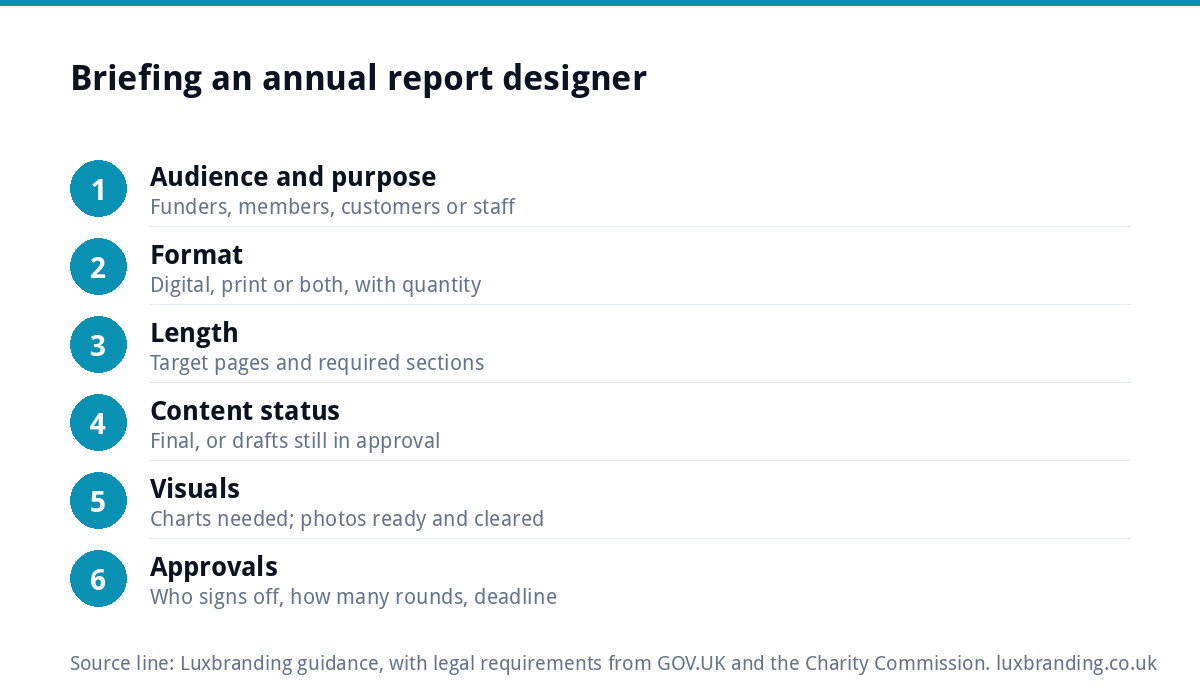
How to brief an annual report designer
- Audience and purpose: funders, members, customers, staff or all of them.
- Format: digital, print or both, and the print quantity.
- Length: target page count and the sections you need.
- Content status: final text and figures, or drafts still being approved.
- Visuals: number of charts, and whether photos are ready and cleared.
- Approvals: who signs off, how many rounds, and the final deadline.
Send content that is final, or as close to final as possible. A designer quoting on complete content can give a fixed price; a designer quoting on “figures to follow” has to build in room for change.
The short version
The statutory documents are for your accountant; the designed report is for the people you want to keep on side. Keep it short, lead with five clear numbers and real stories, publish an accessible web version, and build it as a template you can reuse next year. Every price we publish, from brand work to websites, is on our pricing page.
Get the UK Print-Ready Artwork Checklist (free)
A one-page checklist for any UK designer or printer covering CMYK, bleed, fonts and resolution. Saves you the pre-press fix-up fees.
No spam. UK GDPR compliant. We only use your email to send this resource, unless you tick the box to hear from us.
Frequently asked questions
How much does annual report design cost in the UK? +
It ranges from next to nothing if you lay it out yourself in Word or Canva, with Canva Pro at £100 a year at the time of writing, to a per-project quote from a designer. Page count, charts and infographics, photography, copywriting, accessibility, print and the number of approval rounds are what move a designer's price.
Does an annual report have to be designed? +
No. Companies send statutory accounts to shareholders, Companies House and HMRC, and charities in England and Wales prepare a trustees' annual report, but neither has to be designed. A designed annual or impact report is optional: it presents the year to funders, members, customers and staff in a form they will actually read.
How can a charity keep annual report costs down? +
Keep it to 8 to 16 pages, lead with the five numbers that matter most, use your own photos with consent, write the first draft in-house and nominate one person to collect all trustee comments. Consolidated changes keep a designer's quote fixed, and a reusable template makes next year's report much cheaper.
Should an annual report be a PDF? +
A PDF is fine as a download, but it should not be the only version. GOV.UK's guidance on accessible documents says HTML is the most accessible format and PDFs often work poorly with screen readers. Publishing the key content as a page on your website, with the designed PDF alongside, reaches more readers.
What should I send a designer to get an accurate quote? +
Tell them the audience and purpose, whether it is digital, print or both, the target page count and sections, whether text and figures are final, how many charts you need, whether photos are cleared, who signs off and the deadline. Final content gets a fixed price; content still being approved needs room for change.