Quick answer
Most small businesses need one of seven types: a one-page site (£299 with us), a brochure site of up to eight pages (£499), a landing page for adverts (£199), an online shop (£499), a larger premium site (£1,499), a pay-monthly site, or a booking system or portal. Choose by what visitors must do.
“I need a website” covers everything from a single page with your phone number to a full online shop with customer accounts. Picking the wrong type wastes money in both directions: paying for features you never use, or outgrowing a site within a year. This guide sets out the seven types small businesses actually buy, what each is for, and a few questions that settle which one fits you.
Start with what visitors need to do
The best way to choose is to ignore features for a moment and ask what a visitor needs to do on your site. For most trades and local services, the answer is to understand what you offer, trust you, and call or send an enquiry. For a shop it is to buy. For a salon or clinic it may be to book a slot. For a business with regular clients it might be to log in and see documents or invoices.
Once you know the main action, the type of website almost chooses itself. Everything else, from the number of pages to the design, follows from it. Write the main action down in one sentence before you talk to any designer, such as “homeowners in our area should be able to see our work and request a quote in under a minute”. It keeps every later decision honest.
The seven types at a glance
| Type | Main job | Typical size | Our price |
|---|---|---|---|
| One-page website | Get found and get called | One long scrolling page | £299 one-off |
| Brochure website | Explain services, build trust, win enquiries | Up to 8 pages | £499 one-off |
| Landing page | Turn advert clicks into enquiries | One focused page | £199 one-off |
| Online shop | Sell products and take payment | Up to 20 products | £499 one-off |
| Premium website | Cover many services or areas in depth | Up to 14 pages | £1,499 one-off |
| Pay-monthly website | Spread the cost | Varies | £79 a month, 12-month minimum, hosting included |
| Booking system, portal or web app | Let customers book, log in or manage things | Built around the task | From £1,999 |
Our prices are listed for clarity; the categories apply whoever builds your site. If you want a rough figure for your own situation, our website cost calculator gives one in a couple of minutes.
The seven types explained
One-page website
Everything on one scrolling page: what you do, where you work, a few photos, reviews and a contact form. It suits new businesses, sole traders and anyone who mainly needs a credible place to send people from a van, a business card or a Google profile. The limitation is search: one page can only target a narrow set of searches, so it is a starting point rather than a long-term home if you want to be found for several services. Our one-page website is £299.
Brochure website
The classic small business site: a home page, a page for each main service, an about page, a gallery or projects page and a contact page. Separate service pages give Google something specific to rank for each job you do, which is why this is the right type for most established trades and service firms. Our custom WordPress websites start at £499 for up to eight pages, hand-coded without page builders, with an SEO foundation, forms connected to your inbox and 30 days of support.
Landing page
A single page built for one campaign, usually an advert. It has one message, one offer and one action, with little or no menu so visitors do not wander off. It works alongside a main website rather than replacing it. Our landing page design is £199.
Online shop
A site where customers choose products, pay and receive an order confirmation. Shops need more than a brochure site: product pages, a basket, a checkout, payment processing, delivery settings and legal pages. Our e-commerce websites start at £499 for up to 20 products on WooCommerce or Shopify, with Stripe and PayPal.
Premium website
A bigger brochure site for businesses with many services, several areas or a lot to explain, such as a building contractor covering extensions, loft conversions and commercial fit-outs. Our premium custom WordPress website covers up to 14 pages for £1,499.
Pay-monthly website
The same kind of site paid for monthly instead of upfront. It suits businesses that would rather keep cash in hand. Our pay-monthly website is £79 a month on a 12-month minimum term, with hosting included. Over a few years the total is higher than paying upfront, so weigh the cash-flow benefit against the overall cost.
Booking system, portal or web app
When the website needs to do a job rather than just describe one: take bookings with deposits, let clients log in to see documents, manage jobs or show a dashboard. These are built around your process and quoted in writing before any work starts. Our web applications start at £1,999.
Online shop rules you cannot skip
Selling online brings legal duties that a brochure site does not have. GOV.UK’s guidance on online and distance selling says that before an order is placed you must give customers your business name, contact details and address, the price including all taxes, delivery arrangements and costs, and tell them they can cancel up to 14 days after delivery.
Payment processing also has a cost on every sale. At the time of writing, November 2026, the Stripe UK pricing page lists 1.5% + 20p for standard UK cards. Build those fees into your prices from day one. Our guide to e-commerce website costs covers the full running costs.
What about DIY builders?
Website builders can produce any of the first three types, and they are a reasonable way to test an idea. The trade-offs are monthly fees that never stop, limited control over speed and search settings, and the difficulty of moving the site elsewhere later. Our comparison of Wix and a custom website goes into the detail.
Whichever route you take, the basics of being found are the same. Google’s SEO starter guide stresses helpful, reliable content and organising your site logically so search engines and people understand how pages relate. That is easier with a page per service than with everything crammed onto one page.
Which type by business situation
| Situation | Usually the right type |
|---|---|
| Brand new sole trader, mostly word of mouth | One-page website |
| Established trade wanting more local enquiries from Google | Brochure website |
| Running Google or Facebook ads for one service | Landing page, alongside a main site |
| Selling products to the public | Online shop |
| Many services, several areas, lots to explain | Premium website |
| Want a professional site without a large upfront payment | Pay-monthly website |
| Appointments, deposits or client logins at the heart of the business | Booking system or portal |
Questions that settle it
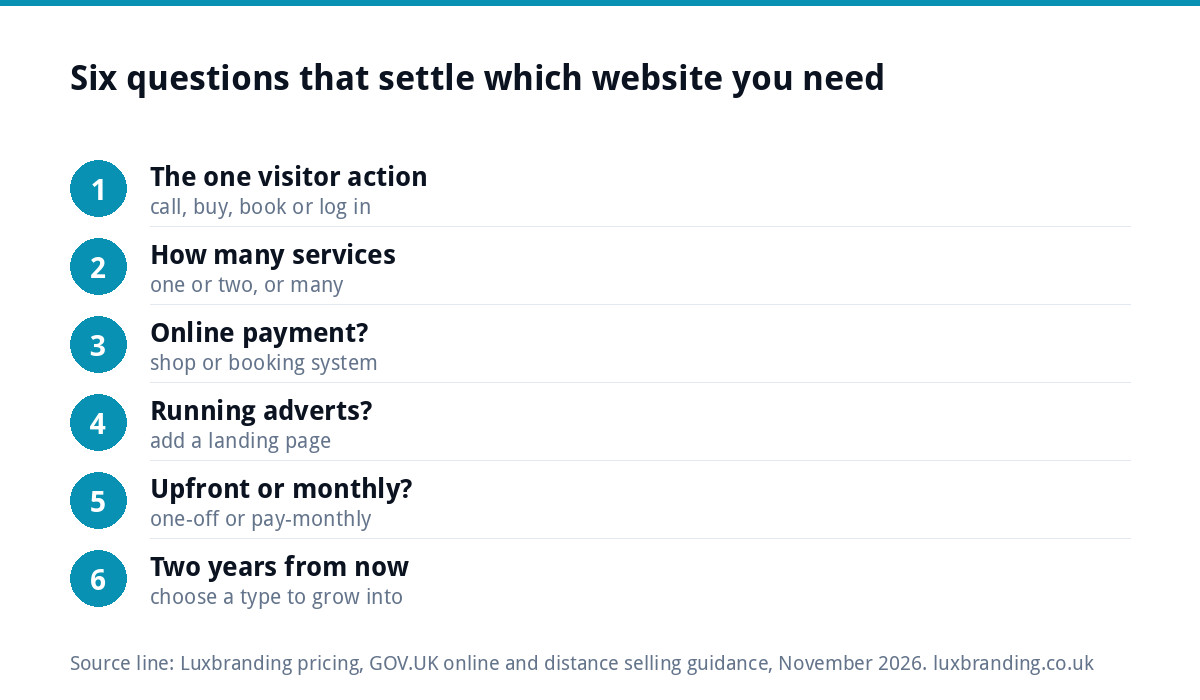
- What is the one thing a visitor must be able to do? Call, buy, book or log in.
- How many different services do you want to be found for? One or two suits a one-page site; more needs separate pages.
- Will you take payment online? If yes, you need a shop or a booking system with payments.
- Are you about to run adverts? If yes, plan a landing page.
- Would you rather pay upfront or monthly? That decides between a one-off build and pay-monthly.
- Where will you be in two years? Choose a type you can grow into, not out of.
Can you start small and grow?
Yes, and many businesses should. A one-page site can become a brochure site as you add services. A brochure site can gain a shop section or a booking system later. The thing to check at the start is that you own the domain, the hosting account and the site files, so growing never means starting again from scratch. Every site we build is yours: no platform lock-in, and you can host it anywhere.
Where we fit
We build all seven types, hand-coded and mobile-first. If you are unsure which you need, our guide to how much a website costs in the UK compares prices across the market, and every one of our prices is on the pricing page. When you are ready, order online or email us at support@luxbranding.co.uk with a line about your business and what visitors need to do.
Get the UK Website Project Brief Template (free)
A two-page template for briefing any UK web designer: sitemap, integrations, audience and deliverables. Cuts revision rounds in half.
No spam. UK GDPR compliant. We only use your email to send this resource, unless you tick the box to hear from us.
Frequently asked questions
What type of website is best for a tradesperson? +
For most established trades, a brochure website with a page for each main service, a projects or gallery page and a clear contact page works best, because separate service pages give Google something specific to rank. A brand new sole trader can start with a one-page website and grow it as work and services increase.
Is a one-page website enough for a small business? +
It can be at the start. A one-page site gives you a credible place to send people from your van, cards or Google profile. Its limit is search: one page can only target a narrow set of searches. If you want to be found for several services or areas, plan to grow into separate pages.
What is the difference between a landing page and a website? +
A website covers your whole business, with several pages and a menu. A landing page is a single page built for one campaign, usually an advert, with one offer and one action and little or no navigation. Landing pages work alongside a main website rather than replacing it, and they usually convert advert clicks better.
Do I need an online shop or just a website? +
You need a shop if customers will choose products and pay online. If you sell services that need quoting, a brochure website with a good enquiry form is usually better. A shop brings extra legal duties, such as telling customers about their 14-day cancellation right, and payment fees on every sale.
Can I upgrade my website type later? +
Yes. A one-page site can grow into a brochure site, and a brochure site can add a shop or booking system later. The important thing is to own your domain, hosting account and site files from the start, so growing never means rebuilding from scratch or being locked into one provider.