Quick answer
A good swing tag (hang tag) carries your logo, the product name, price or barcode, and one line that sells the brand, printed on sturdy card with a clean hole for the string. For clothing, keep the legally required fibre content on a sewn-in label, not only on the tag. Our Packaging Design service is £99.
The swing tag is often the first piece of your brand a customer touches. On a market stall, in a boutique or inside a delivery box, it does three jobs at once: identifies the product, gives practical details and tells a small story about who made it. This guide covers what to put on a tag, which sizes, materials and finishes suit which products, the UK labelling points to keep in mind, and how to brief a designer and printer so the tags come back right first time.
What a swing tag is for
Swing tags (also called hang tags) hang from a product by string, a ribbon, a safety pin or a plastic fastener. They are common on clothing, accessories, candles, homeware, gifts and handmade goods. Unlike a sewn-in label or a product sticker, a swing tag is designed to be removed, so think of it as point-of-sale marketing that also carries useful details.
A well-designed tag should help a shopper answer three questions in seconds: what is this, how much is it, and why should I trust this brand?
What to put on a swing tag
| Element | Front or back | Notes |
|---|---|---|
| Logo | Front | Usually the main element; must read clearly at small size |
| Product name or style | Back | Helps with reorders and stock checks |
| Price | Back, or a price sticker | Leave a space if prices vary by stockist |
| Size | Back, or a separate size sticker | One tag design can serve many sizes |
| Barcode or SKU | Back | Needed if you sell through retailers or use a till system |
| Short brand line | Back | “Handmade in Cornwall” or one line about materials |
| Care symbols or a care summary | Back | Useful extra; not a substitute for a sewn-in label |
| Website or social handle | Back | So customers can find you again |
Resist the urge to fill every millimetre. A clean front with your logo and a tidy back with the essentials looks more premium than a crowded tag.
The labelling rules to keep in mind
If you sell clothing or other textiles, there are legal labelling requirements that sit alongside your swing tag. The government’s textile labelling guidance says the label must show the fibre content, including fur and other animal parts, that items with components of different fibre content must show each one, and that manufacturers and retailers are responsible for complying.
The Business Companion guide on labelling of textiles, produced for Trading Standards, adds that the label must be on the item (or, for multipacks, on the packaging), must be in English, and must be durable, easily legible, visible and accessible. A swing tag that is cut off at the till is not durable, so as general guidance keep fibre content on a sewn-in label and treat the swing tag as an extra. If you sell food, cosmetics or toys, other product-specific rules apply; our guide to product label design in the UK covers those.
This is general guidance, not legal advice. If you are unsure what applies to your product, your local Trading Standards service is the place to ask.
Sizes, shapes and materials
| Choice | Options | Suits |
|---|---|---|
| Size | Small business-card size up to larger rectangular tags | Small tags for jewellery and accessories; larger for knitwear and homeware |
| Shape | Rectangle, square, rounded corners, custom die-cut | Rounded corners feel softer; die-cut shapes add cost and character |
| Card weight | Heavier card stock | Heavier card feels premium and resists bending |
| Paper | Uncoated, kraft, recycled, coated | Kraft and uncoated suit handmade and natural brands |
| Finish | Matt, soft-touch, foil, embossing | Use one special finish at most, on the logo |
| Attachment | Cotton string, ribbon, safety pin, plastic tag fastener | Match to product: pins for knitwear, string for gifts |
Ask your printer for samples before committing to a full run. Card weight and finish feel very different in the hand than on a screen.
Sustainable choices that are real
Many small brands want tags that match their values. Recycled or responsibly sourced card is the simplest step. If you want to show a certification, use only one your printer can prove. The Forest Stewardship Council explains its three labels: FSC 100% (all materials from FSC-certified forests), FSC Recycled (100% recycled material) and FSC Mix (a mixture of certified, recycled and controlled material). The FSC mark should only appear on your tag if your supplier’s certification allows it, so ask before adding it to the artwork.
Other practical steps: cotton string rather than plastic fasteners, no plastic lamination, and one tag rather than several.
Designing a tag that works
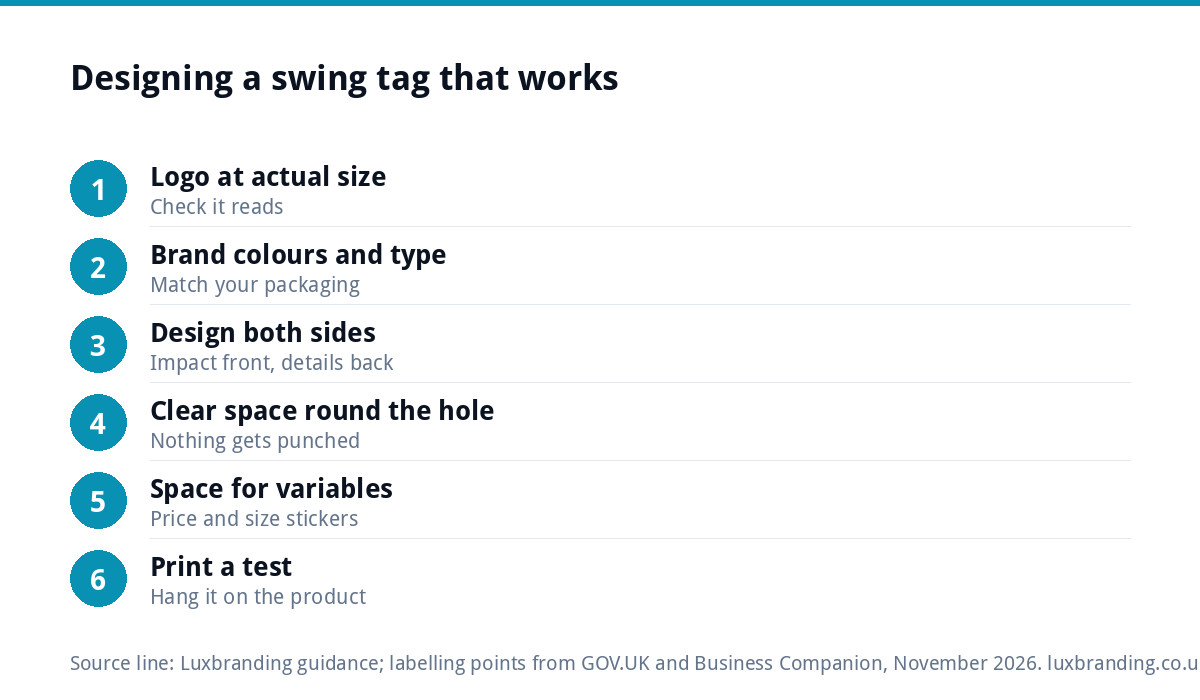
- Start with your logo at actual size. If it does not read at the size of a tag, you may need a simplified or icon-only version.
- Use your brand colours and typefaces so the tag matches your packaging, website and stall.
- Design both sides together, front for impact and back for information.
- Leave clear space around the hole so the punch does not cut into text or the logo.
- Leave space for variables such as price and size if they will be stickered or handwritten.
- Print a test at home, cut it out and hang it on the product before ordering.
If your logo was never designed with small sizes in mind, our Logo Design is £129 with stacked, horizontal and icon-only layouts all included, which gives you a version that works on a tag.
A worked example
Picture a hypothetical candle maker in Shropshire selling at markets and through three gift shops. Her first tags were printed at home on thin card, with the price printed on, so every price rise meant a new batch. The redesign uses one tag for the whole range: the logo in a single colour on the front of an uncoated recycled card, and on the back the scent name, burn time, a short safety reminder, her website and a blank panel for a small price sticker. The hole sits in a clear corner and the tag hangs from natural cotton string. The gift shops can now add their own prices, she orders one design in a larger quantity at a lower unit cost, and the tags match her boxes and market banner.
Ordering quantities
Unit prices usually fall as quantities rise, which tempts people to over-order. As a rule of thumb, order enough for a season of sales, not a lifetime. Keep variable details such as price and size on stickers or stamps so one design can serve the whole range, and so a change in pricing does not leave you with boxes of out-of-date tags.
Getting the artwork print-ready
Most reprint problems come from artwork, not printing. Your printer will typically want a print-ready PDF in CMYK, with bleed, crop marks, the hole position marked and any special finish (foil or spot UV) on a separate layer. Our guide to print-ready artwork explains the terms, and if a printer has already sent your files back, our guide to printer-rejected artwork decodes the usual errors.
Check one physical proof for colour, especially if your brand colour is a strong or unusual shade. Colours on screen and on uncoated card can look noticeably different.
Swing tags as part of the whole package
Tags work best when they belong to a family: the same look on your boxes, mailers, stickers, thank-you cards and website. If you are planning several pieces at once, our guide to packaging design for small brands covers how to plan them together, and if you also make branded workwear or merchandise, our workwear and merch design guide covers printing logos on fabric.
Common mistakes
- Logo too small or too detailed to read at tag size.
- Text placed where the hole will be punched.
- Thin card that curls or creases in the shop.
- Printing prices on a large run, then changing them.
- Using the tag as the only place for legally required textile information.
- A different style from the rest of your packaging, so the brand feels disjointed.
Get your swing tags designed
Our Packaging Design service is £99. If you need swing tags to match, mention them in your brief so the tags, boxes and labels are planned as one family from the start. You can see every price on our pricing page.
Get the UK Print-Ready Artwork Checklist (free)
A one-page checklist for any UK designer or printer covering CMYK, bleed, fonts and resolution. Saves you the pre-press fix-up fees.
No spam. UK GDPR compliant. We only use your email to send this resource, unless you tick the box to hear from us.
Frequently asked questions
What should be on a clothing swing tag? +
Usually your logo on the front, and on the back the product name or style, price or a space for a price sticker, size, a barcode or SKU if you sell through retailers, a short brand line and your website or social handle. Keep it uncluttered. Legally required fibre content belongs on a sewn-in label as well.
Can fibre content go on a swing tag instead of a sewn-in label? +
Treat that with caution. Business Companion's guidance for Trading Standards says a textile label must be on the item and be durable, easily legible, visible and accessible. A swing tag is designed to be removed, so as general guidance keep fibre content on a sewn-in label and use the tag as an extra. Check with Trading Standards if unsure.
What is the difference between a swing tag and a hang tag? +
None in practice. Both names describe a printed card tag attached to a product with string, ribbon, a pin or a plastic fastener. Swing tag is the more common term in the UK clothing trade, while hang tag is widely used elsewhere. Both are point-of-sale marketing pieces that also carry practical details such as price and size.
What card should I use for swing tags? +
A heavier card stock that will not curl or crease is the usual choice. Uncoated, kraft or recycled card suits handmade and natural brands; coated card gives sharper colour. Use one special finish at most, such as foil on the logo, and ask your printer for physical samples before ordering a full run.
Can I put the FSC logo on my swing tags? +
Only if your printer or paper supplier's certification allows it. The FSC has three labels, FSC 100%, FSC Recycled and FSC Mix, and each describes where the material comes from. Ask your printer whether they can supply certified card and provide the correct mark before adding it to your artwork.