Quick answer
For regular UK payments, GoCardless’s standard plan charges 1% + 20p per Direct Debit, capped at £4, while Stripe charges 1.5% + 20p for standard UK cards plus 0.7% for its Billing subscriptions tool. Direct Debit is cheaper for fixed monthly amounts; cards suit instant, one-off or variable payments. Many businesses use both.
If you charge customers every month, such as a cleaning contract, a maintenance plan, a membership or a retainer, the way you collect that money matters more than it first appears. Fees eat into every payment, failed payments cost you time, and the wrong method can put customers off signing up. This guide compares Stripe and GoCardless for UK recurring billing, with fees at the time of writing (November 2026), worked examples and a guide to which suits which kind of business.
The short version
- GoCardless is built around Direct Debit: the customer authorises you to pull money from their bank account. Lower fees, fewer failed payments from expired cards, but money takes longer to arrive.
- Stripe is built around cards, with Direct Debit as an option. Instant authorisation, better for one-off and variable payments, but card fees are higher and cards expire.
Neither is “better” across the board. The right choice depends on how much you charge, how often, and how quickly you need the money.
Fees side by side
These figures come from the Stripe UK pricing page and the GoCardless pricing page at the time of writing. Both change their pricing from time to time, so check before you commit.
| Fee | Stripe | GoCardless |
|---|---|---|
| Standard UK cards | 1.5% + 20p | Not its core product |
| Premium UK cards | 2.8% + 20p | Not its core product |
| UK Direct Debit | Bacs Direct Debit: 1%, minimum 20p, capped at £4 | Standard plan: 1% + 20p, capped at £4 |
| Subscription tool | Billing: 0.7% of billing volume on pay as you go | Recurring collection built in |
| High-value payments | No surcharge listed | +0.3% on Direct Debits over £2,000 |
| Monthly fee | None, apart from the optional pay-monthly Billing plan | None for most users on the standard plan |
| VAT on fees | Not stated on the pricing page | Prices exclude VAT, which is charged to UK merchants |
GoCardless also lists Advanced (1.25% + 20p, capped at £5) and Pro (1.4% + 20p, capped at £5.60) plans with extra features, and optional add-ons such as showing your business name on customers’ bank statements.
How Direct Debit differs from card payments
With a card subscription, you charge the customer’s card each month. It is instant to set up, and the money is authorised straight away. The weakness is that cards expire, get replaced after fraud scares or hit their limits, and each of those causes a failed payment you have to chase.
With Direct Debit, the customer gives you permission to collect from their bank account. Bank accounts rarely change, so payments keep working for years. The trade-off is time: a Direct Debit takes a few working days to collect, so it is less suited to “pay now and I will start tomorrow” situations.
For a small business charging the same amount every month to the same customers, Direct Debit’s reliability often matters more than its speed.
The Direct Debit Guarantee and what it means for you
Every UK Direct Debit is covered by the Direct Debit Guarantee. The official Direct Debit guarantee text says the customer must be notified (normally 10 working days) in advance if the amount, date or frequency changes, is entitled to a full and immediate refund from their bank if an error is made, and can cancel at any time by contacting their bank.
That protection is why customers are comfortable signing Direct Debit mandates. For you, it means two things: give proper notice before changing what you collect, and accept that a customer can reclaim a payment through their bank if they believe it was taken in error. Clear terms and good records protect you.
Worked examples: what you would pay
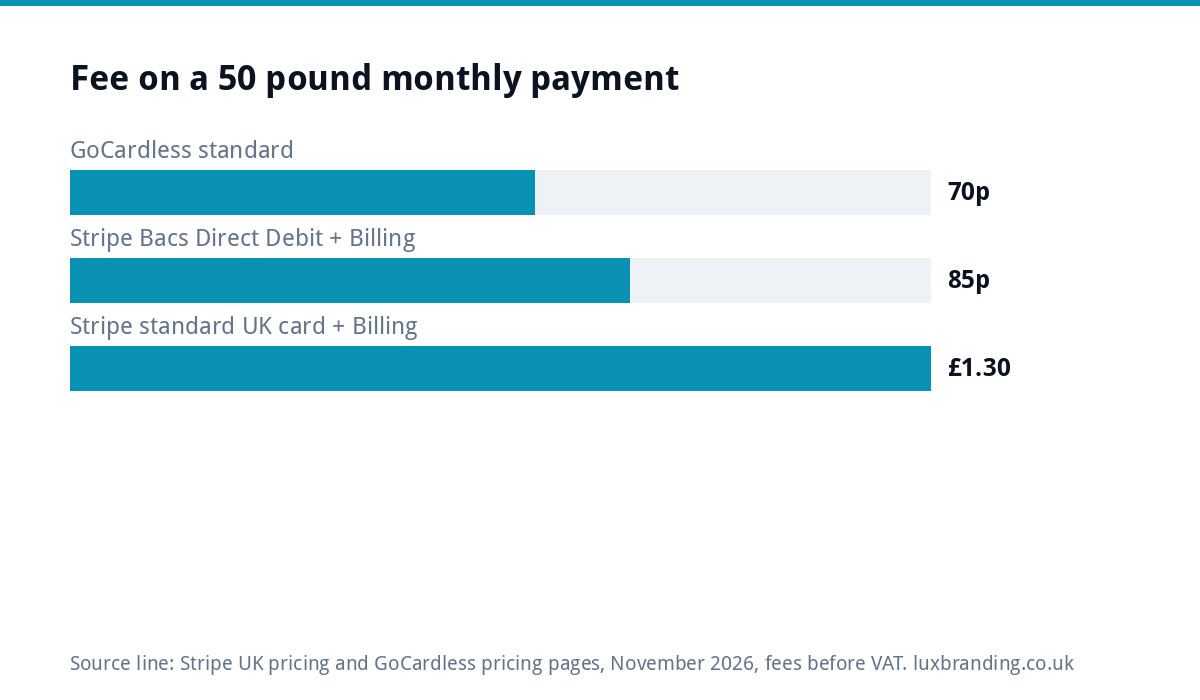
Here is what each route would cost per payment on two common amounts, using the listed fees before any VAT on fees. The Stripe figures include the 0.7% Billing fee, because you would normally use Billing to run subscriptions.
| Monthly payment | GoCardless standard | Stripe Bacs Direct Debit + Billing | Stripe standard UK card + Billing |
|---|---|---|---|
| £50 (for example a cleaning contract) | 70p | 85p | £1.30 |
| £500 (for example a monthly retainer) | £4.00 (cap reached) | £7.50 (£4 cap plus £3.50 Billing) | £11.20 |
The pattern is clear. On small amounts the gap is pennies. On larger amounts the Direct Debit cap makes a real difference, because card fees keep rising with the payment while Direct Debit fees stop at £4. Premium cards, such as some business and reward cards, cost more again on the card route.
Failed payments and chasing
Fees are only part of the cost. Every failed payment means an email, a phone call or a pause in service, and some customers quietly drift away at that point. Card-based subscriptions tend to fail when cards expire or are replaced. Direct Debits tend to fail when there are not enough funds on the collection day or the customer cancels the mandate.
Both Stripe and GoCardless offer automatic retries and reminder emails. Whichever you choose, switch those on, and decide in advance what happens after a second failure, such as pausing the service and sending a polite message with a link to update payment details.
Which suits which business
- Fixed monthly contracts (cleaning, gardening, window cleaning, maintenance plans): GoCardless or Stripe’s Bacs Direct Debit. Low fees, few failures.
- Memberships with a free trial or instant access: Stripe cards, because access starts immediately and trials convert at the moment of sign-up.
- Variable monthly invoices (accountants, bookkeepers, agencies): Direct Debit, with notice of each amount as the guarantee requires.
- One-off deposits plus monthly instalments: a card for the deposit, Direct Debit for the instalments.
- Customers abroad: cards, since UK Direct Debit is a UK bank system.
Using both together
Plenty of businesses offer both: card for customers who want to start straight away, Direct Debit for those on longer arrangements. Stripe can handle both itself, which keeps everything in one dashboard. Others pair Stripe for cards with GoCardless for Direct Debit to get GoCardless’s dedicated tools. Two systems mean two dashboards and two sets of reports for your bookkeeping, so only split them if the savings or features justify it.
If you also sell products online, our guide to e-commerce website costs covers what a shop with card checkout costs to build and run.
What to tell customers at sign-up
Whichever provider you choose, the sign-up page does a lot of the persuading. Customers are more likely to complete a mandate or card form when they can see, in plain words, exactly what will happen next. Before you launch, make sure your sign-up page or email covers:
- The amount, how often it is collected and the date of the first payment.
- What the payment covers, such as visits per month or hours per month.
- How much notice you give before any price change, which for Direct Debit should follow the guarantee’s advance notice.
- How to cancel, and whether any minimum term applies.
- Who to contact about a payment problem, with an email address that is actually monitored.
Put the same details in your terms and in the confirmation email. When a customer later queries a payment, being able to point to clear wording agreed at sign-up saves an awkward conversation.
Connecting it to your website or system
Both providers offer hosted sign-up pages that need almost no technical work, which is fine for a handful of customers. As you grow, you will want sign-ups on your own website, customer records that update automatically when a payment fails, and invoices or access that follow the payment status.
That is where a booking system or a customer portal comes in. Our guides to booking system costs and client portals for small businesses show what is involved, and our guide to web app development costs explains the price ranges.
Where we fit
We build custom web applications, including booking systems, portals and dashboards with Stripe or Direct Debit payments built in, from £1,999. Bigger systems are quoted in writing before any work starts. If you just need a shop with card payments, our e-commerce websites start at £499 with Stripe and PayPal included. See all our prices on the pricing page, then order online or email us at support@luxbranding.co.uk.
Get the UK Website Project Brief Template (free)
A two-page template for briefing any UK web designer: sitemap, integrations, audience and deliverables. Cuts revision rounds in half.
No spam. UK GDPR compliant. We only use your email to send this resource, unless you tick the box to hear from us.
Frequently asked questions
Is GoCardless cheaper than Stripe? +
For UK Direct Debit on larger amounts, usually yes. GoCardless's standard plan charges 1% + 20p capped at £4, while a Stripe card subscription costs 1.5% + 20p plus 0.7% for Billing, with no cap. On small amounts the difference is pennies. Stripe's own Bacs Direct Debit is also 1%, capped at £4, plus Billing if you use it.
Can Stripe take Direct Debit payments in the UK? +
Yes. Stripe's UK pricing page lists Bacs Direct Debit at 1%, with a minimum fee of 20p and a £4 cap. That lets you run cards and Direct Debit from one dashboard. If you use Stripe Billing to manage the subscriptions, its 0.7% pay-as-you-go fee applies on top of the payment fee.
How long does a Direct Debit take to reach my account? +
Longer than a card payment. Direct Debits are collected through the UK Bacs system, which takes a few working days, so they suit regular payments rather than pay now and start today situations. Check your provider's dashboard for the exact collection and payout timings for your account before you promise start dates to customers.
Can customers cancel a Direct Debit whenever they like? +
Yes. The Direct Debit Guarantee says customers can cancel at any time by contacting their bank or building society, and are entitled to a full and immediate refund if a payment is taken in error. That is why customers trust Direct Debit, and why your contract terms should say what happens if a mandate is cancelled.
Do I need a developer to set up recurring payments? +
Not to start. Both Stripe and GoCardless offer hosted sign-up pages that work with little setup. A developer becomes useful when you want sign-ups on your own website, customer records that update when payments fail, or access to a portal or booking system that follows payment status automatically.