
Quick answer
Use email for most marketing: it costs little per message, carries photos and detail, and suits newsletters, offers and reminders. Use SMS for short, urgent messages people have agreed to receive, such as filling a cancelled £60 appointment today or confirming tomorrow’s visit. Texts cost per message, and in the UK both channels follow the same consent rules.
Texts get read; emails get filed. That is the usual argument for SMS, and it has some truth in it. But texts are also more personal, more intrusive and more expensive per message, so using them for everything wears out the goodwill that makes them work. This guide compares SMS and email marketing for a UK small business: the rules, the costs, what each is good for, which to use by business type, and how to write a marketing text that does not annoy people.
SMS vs email at a glance
| Factor | SMS | |
|---|---|---|
| Length | Short; long texts are split and charged in parts | As long as you need, with images and links |
| Feel | Personal and immediate | Less intrusive; read when convenient |
| Cost per message | Charged per message segment | Usually priced by list size or volume, so very low per message |
| Best for | Reminders, last-minute slots, urgent updates | Newsletters, offers, guides, follow-ups |
| Risk | Annoys quickly if overused | Ignored or filtered if poorly targeted |
| UK consent rules | Same rules as email | Same rules as SMS |
The rules are the same for texts and emails
Many owners assume texts are less regulated than emails. They are not. The ICO’s guidance on electronic mail marketing says the same rule applies to emails, texts, picture messages, video messages and voicemails, and that messages sent by SMS count as electronic mail. In short:
- You generally need an individual’s specific consent before sending them marketing texts or emails.
- The soft opt-in lets you market to existing customers who bought, or discussed buying, a similar product or service, provided you gave them a clear chance to opt out when you collected their details and offer an opt-out in every message.
- You must not hide who is sending the message, and you must give a valid way to opt out and act on it promptly.
- Sole traders and some partnerships count as individuals under these rules.
Service messages, such as an appointment confirmation the customer asked for, are different from marketing. But a reminder that also pushes an offer is marketing, so keep the two separate.
What SMS is genuinely good for
- Appointment reminders and confirmations. Fewer no-shows for salons, clinics, garages and trades.
- Last-minute availability. “We have a slot at 2pm today” to customers who asked to hear about cancellations.
- On-the-way messages. “Your engineer is 20 minutes away” saves calls.
- Time-limited offers to people who opted in, used sparingly.
- Short service updates, such as a closure or a change of hours.
Notice the pattern: short, timely and useful to the reader right now.
What SMS is poor at is just as important. Texts are a bad fit for anything that needs explaining, anything that is not urgent, and anything sent to people who have not heard from you in years. A text from a business someone barely remembers feels like an intrusion, and it is the quickest way to collect opt-outs and complaints. If the message could wait until the weekend and would benefit from a photo, it belongs in an email.
What email does better
- Showing your work with photos of finished jobs or new products.
- Explaining something: a seasonal checklist, a guide, a price change.
- Regular newsletters that keep you in mind between jobs.
- Automated sequences such as a welcome series or a review request after each job.
- Anything with several links or more than one idea.
Email also scales cheaply. Sending one more email to a list rarely changes your bill, while every extra text adds to it.
What texts cost: a worked example
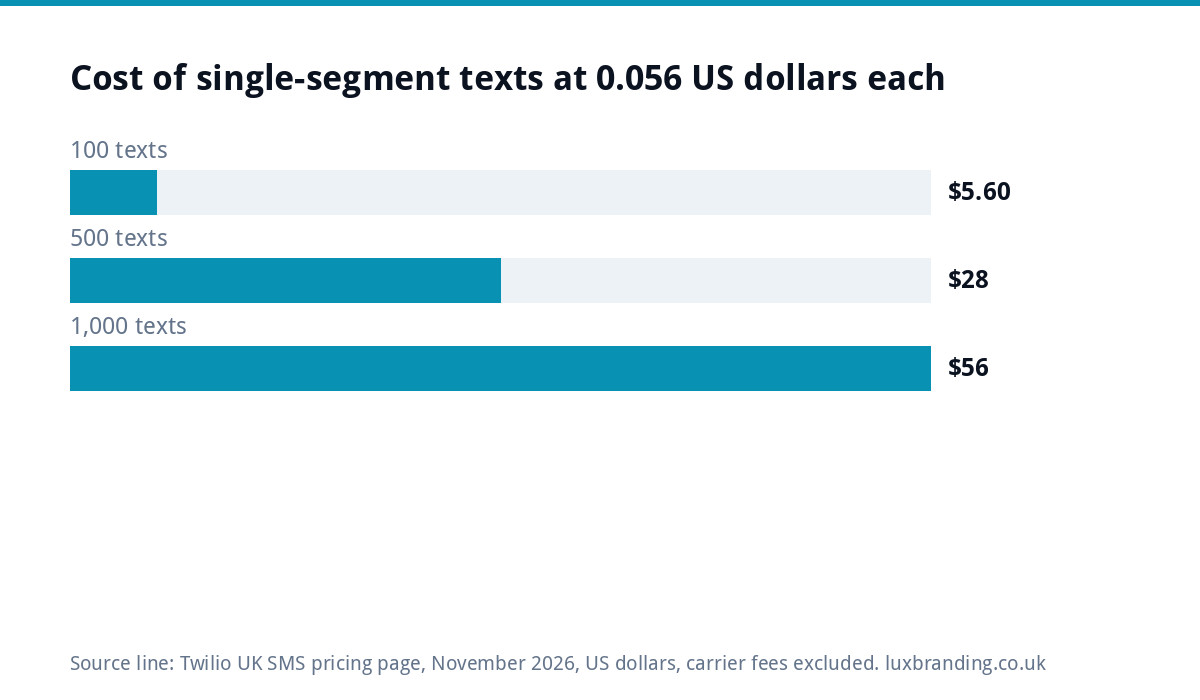
SMS providers charge per message segment. At the time of writing, Twilio’s UK SMS pricing lists $0.056 per segment for messages to UK mobile numbers, in US dollars, and notes that carrier fees may apply and failed messages carry a small processing fee. Other providers price differently, often in pounds, with bundles and monthly plans.
Using that rate, single-segment texts would cost about:
| Texts sent | Approximate cost at $0.056 each | Typical use |
|---|---|---|
| 100 | $5.60 | A week of appointment reminders for a small salon |
| 500 | $28 | One offer to an opted-in customer list |
| 1,000 | $56 | A seasonal reminder to a larger list |
Longer texts, and texts using emojis or special characters, can be split into more segments, each charged separately, so check your provider’s segment rules. Compare that with email, where most platforms price by the number of contacts and the cost of each extra send is close to nothing.
Which to use, by business type
| Business | Use SMS for | Use email for |
|---|---|---|
| Salon, barber, beauty clinic | Reminders, cancellations to fill | Monthly news, new treatments, aftercare guides |
| Garage or MOT centre | MOT and service reminders, car ready | Seasonal checks, offers, review requests |
| Trades: plumbing, heating, electrical | On-the-way and booking confirmations | Annual service reminders, tips, referrals |
| Restaurant or takeaway | Quiet-night offers to opted-in regulars | Menus, events, opening hours |
| Online shop | Delivery updates | Product launches, abandoned basket reminders, offers |
How to write a marketing text people do not mind
- Say who you are first. “Hi Sam, it’s Hart Plumbing.” The ICO says you must not hide your identity.
- One message only. One offer, one reminder or one slot.
- Make the action obvious. Reply to book, call, or tap a short link.
- Include an easy opt-out, such as “Reply STOP to opt out”, and honour it promptly.
- Send at sensible times. Working hours on weekdays, not late evening or early morning.
- Keep the frequency low. For most small businesses, a marketing text every month or two is plenty.
Building an opted-in list for both channels
The list matters more than the channel. A small list of people who asked to hear from you will outperform a large one assembled from old invoices and business cards. Practical ways to build it properly:
- At booking or quote stage, add two separate tick boxes: one for marketing emails and one for marketing texts. Leave both unticked by default.
- On your website, offer something useful in return for an email address, such as a seasonal maintenance checklist or early access to busy dates.
- In person, ask. “Would you like a text when we have a cancellation?” works well for salons, clinics and garages with waiting lists.
- After a job, a thank-you email can invite customers to stay in touch, with a clear choice.
Write down where and when each person opted in. If a customer ever asks why they received a message, you can answer in one line.
Getting the email side right
If email does most of your marketing, make sure it arrives. Yahoo’s sender best practices ask senders to authenticate their email with SPF or DKIM, include a clearly visible unsubscribe link in the body, honour unsubscribes within two days and keep their spam rate below 0.3%. Gmail’s rules are similar. If your messages already land in junk, our guide to business emails going to spam explains how to fix it.
Using both together
The most effective setups use each channel for its strength. Email carries the regular relationship: news, advice and offers. SMS handles the moments that need attention now: tomorrow’s appointment, today’s free slot, the engineer on the way. Collect both an email address and a mobile number when customers book, with separate, clear choices about marketing for each, and record what each person agreed to. Then plan the year: which reminders go by text, which news goes by email, and roughly when each will be sent.
Booking systems often send reminder texts and emails automatically, which is the easiest way to start. Our guide to booking system costs covers what those tools usually include.
Getting set up
Our email marketing automation service is the place to start if you would rather have the platform and your automated emails set up for you. If you want sign-ups and bookings to come through your own site, our custom WordPress website is £499 one-off for up to 8 pages, with contact forms connected to your inbox. Where reminders need to connect to your own booking or customer records, our web applications start from £1,999, and our client portal guide shows what that can look like. See every fixed price on our pricing page.
Get the UK SEO DIY Audit Checklist (free)
A 32-point checklist UK SMEs can run against their own website in an afternoon. Surfaces the quick wins before paying for a paid audit.
No spam. UK GDPR compliant. We only use your email to send this resource, unless you tick the box to hear from us.
Frequently asked questions
Do I need consent to send marketing texts in the UK? +
Generally, yes. The ICO says texts count as electronic mail, so the same rules apply as for marketing emails: specific consent, unless the soft opt-in covers existing customers who bought or discussed buying something similar and were given a clear chance to opt out. Every text must identify you and offer an opt-out.
Are appointment reminders marketing messages? +
A reminder about an appointment the customer booked is a service message, not marketing, so it is not covered by the marketing consent rules in the same way. But if the reminder also promotes an offer or another service, it becomes marketing. Keep service texts and marketing texts separate to stay on the right side.
How much does it cost to send a text message to customers? +
It depends on the provider and volume. At the time of writing, Twilio lists $0.056 per message segment to UK mobiles, in US dollars, with possible carrier fees. Other providers sell bundles or monthly plans in pounds. Long texts and some characters split into extra segments, each charged.
How often can I send marketing texts? +
There is no legal maximum, but texts feel personal, so frequency wears out goodwill quickly. For most small businesses, a marketing text every month or two, sent during working hours, is plenty. Watch opt-outs after each send; a jump tells you to slow down or make the messages more useful.
Should I collect mobile numbers or email addresses? +
Both, where customers are happy to give them, with a separate, clear choice about marketing for each. Use email for regular news and offers, and the mobile number for reminders and urgent updates. Record what each person agreed to and when, so you can show consent if anyone asks.