
Quick answer
Most small businesses do not need a paid SEO tool at first: Google Search Console is free and shows the searches you already appear for. If you do pay, Ahrefs lists Starter at £23 a month and Lite at £99, and Semrush’s SEO plan is £113 billed monthly. A tool only pays off if someone uses it every week.
SEO tools promise to show you exactly what to fix and which keywords to chase. They can, but they are built for marketers who spend hours in them each week, and they are priced accordingly. This guide compares the paid tools small businesses most often consider, sets out what the free options already cover, and helps you decide whether a subscription, your own time or outside help is the better use of the money. Prices are from the providers’ own pricing pages at the time of writing, November 2026, and change often, so check before you subscribe.
What paid SEO tools actually do
The big tools overlap heavily. Most offer:
- Keyword research: estimates of how often terms are searched and how hard they are to rank for.
- Rank tracking: where your pages appear for chosen searches over time.
- Backlink analysis: which other websites link to you and to your competitors.
- Site audits: crawls that flag broken links, missing titles, slow pages and similar issues.
- Competitor research: which searches bring traffic to rival sites.
Two cautions. First, search volumes and traffic figures are the tools’ own estimates, not Google’s data, so treat them as rough guides. Second, a long audit report is not a plan. Many flagged issues make little difference to a small site, and someone still has to decide what matters.
Start with what is free
Before paying anything, set up the free tools:
- Google Search Console. Google describes it as a free service to help you monitor and fix how your site appears in search. It shows real queries, clicks, impressions and average positions from Google itself, which no paid tool can match for your own site.
- Free tiers of paid tools. Semrush lists a free plan with one demo project and 10 reports a day, and Ahrefs offers a free option for data on your own site.
- Our free SEO audit, which checks the technical basics of a page for free.
For a typical local business site, these cover most of what you need: what people search to find you, which pages show up, and what is technically broken.
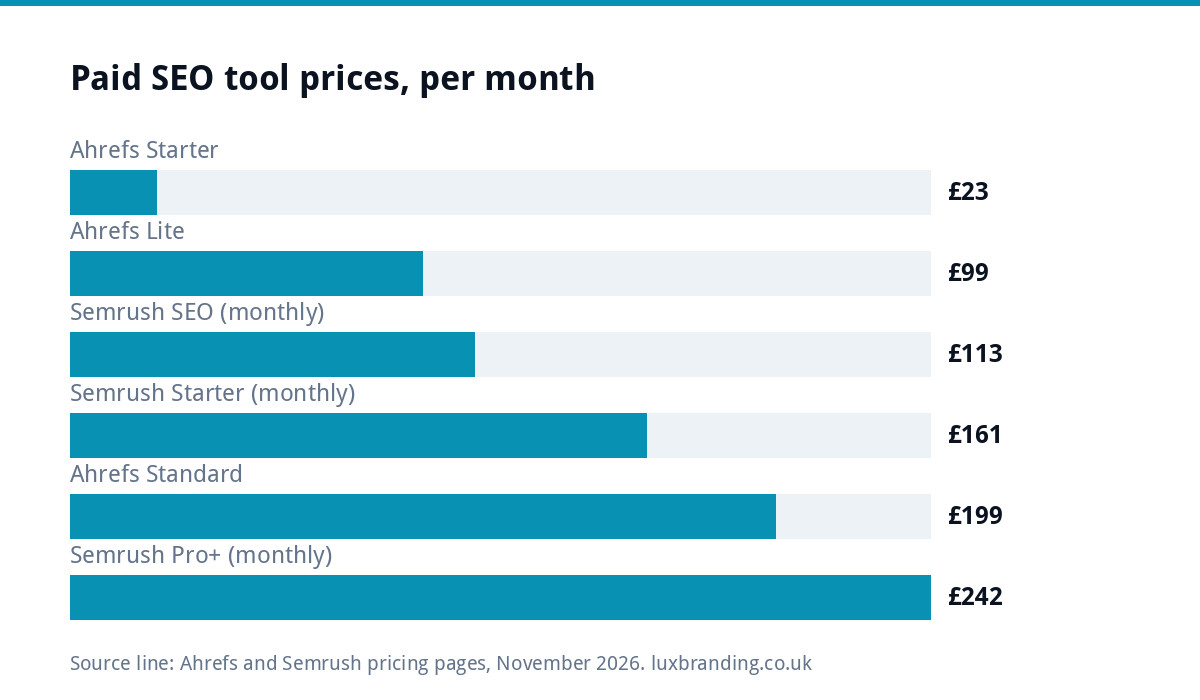
Paid SEO tools compared
| Tool and plan | Listed price | Notes |
|---|---|---|
| Ahrefs Starter | £23 a month | Entry option on the pricing page |
| Ahrefs Lite | £99 a month | Standard £199, Advanced £359, Enterprise £1,199 with an annual commitment |
| Semrush SEO | £113 a month billed monthly, or £95.07 a month billed annually | Aimed at freelancers and small businesses |
| Semrush Starter | £161 billed monthly, or £133.84 billed annually | Aimed at small teams and agencies |
| Semrush Pro+ | £242 billed monthly, or £201.09 billed annually | Aimed at growing teams and agencies |
| Google Search Console | Free | Your own site’s real Google data |
Figures from Ahrefs’ pricing page and Semrush’s pricing page. Check what each plan includes, such as the number of projects, tracked keywords and users, because limits vary and extra users or add-ons can raise the bill.
Which tool for which job
| Job | Free route | When a paid tool helps |
|---|---|---|
| See which searches bring visitors | Search Console | Rarely needed for your own site |
| Find new topics to write about | Customer questions, Search Console queries | Researching many topics at once |
| Track rankings | Search Console average position | Tracking specific searches daily, or by town |
| Check technical problems | Search Console reports, a free audit | Larger sites with many pages |
| Study competitors | Search their name and services yourself | Seeing their traffic and links in depth |
| Find link opportunities | Local directories, suppliers, partners | Analysing competitors’ links at scale |
Do you need one? Decide by situation
- A local trade or service with a small site: usually no. Search Console plus a good Google Business Profile does more.
- A business publishing guides every month: possibly. Keyword research helps choose topics, and a lower-cost plan may be enough.
- An online shop with hundreds of products: more likely. Site audits and rank tracking earn their keep on larger sites.
- A brand new website: not yet. Give Search Console a few weeks to collect data, fix the basics it reports, and get the site indexed before paying to research keywords you cannot yet compete for.
- A business paying an agency for SEO: no. The agency should already use tools and report the results to you in plain English.
How to test a tool before paying
If you are tempted, use a free plan or trial with a specific job in mind rather than clicking around. Set yourself three questions that matter to your business and see how quickly each tool answers them:
- Which searches could bring us more enquiries? Look for terms your customers actually use, including your towns and services, not just the biggest numbers.
- What is holding our main service page back? See whether the audit gives clear, prioritised fixes or a long undifferentiated list.
- Why does a particular competitor outrank us? Check whether the tool shows useful differences, such as content depth or the sites linking to them.
Then check the practical details before entering card details: how many projects and tracked keywords the plan allows, whether extra users cost more, whether the price shown assumes annual billing, and how cancellation works. A tool you can answer those three questions with in half an hour is worth considering. One you cannot is not, whatever its feature list says.
For local businesses, start nearer home
For a business that serves one town or county, the biggest gains rarely come from keyword tools. They come from a complete, accurate Google Business Profile, steady reviews, consistent contact details across directories, and service pages that clearly say what you do and where. None of that needs a subscription. Our guide to Google Business Profile optimisation covers the profile side in detail. Once that groundwork is in place, a keyword tool becomes more useful, because you are refining a working setup rather than searching for one.
The cost nobody budgets: your time
A tool subscription is the smaller cost. The bigger one is the hours needed to learn it, interpret the data and act on it. A report saying you have 140 issues is only useful if someone can tell which five matter and fix them.
Be honest about whether you will log in every week, and who in the business will act on what the tool shows. If nobody will, a monthly subscription quietly becomes an expensive habit. It is easy to pay for months while changing very little on the website itself.
A simple monthly routine, with or without a paid tool
- Check Search Console for the searches and pages that gained or lost clicks.
- Pick one page to improve, usually one already appearing on page two for a useful search.
- Answer the questions behind that search more fully, with your own photos and examples.
- Fix one technical issue from your audit, starting with broken links or missing titles.
- Earn one new link or listing, such as a supplier, trade body or local directory.
- Note what you changed and check the effect next month.
Mistakes to avoid
- Chasing tool scores. Authority scores and site health percentages are the tools’ own measures, not Google’s.
- Targeting national keywords a local business can never win, because the tool shows big volumes.
- Fixing everything an audit flags, including issues that make no difference.
- Paying for two tools that do the same job.
- Forgetting the annual renewal on a plan you stopped using.
Tool, time or help?
If you have the time and enjoy it, a free setup plus occasional paid research can take a small site a long way. If you do not, the money may be better spent on someone doing the work. Our SEO service is £249 a month and covers rankings, content, technical health, link building and reports, so the tools and the time sit with us rather than with you. Our guide to SEO costs in the UK compares that with other routes, and what an SEO audit costs explains one-off options. If your site has simply stopped appearing, start with why a website is not showing on Google. Every fixed price is on our pricing page.
Get the UK SEO DIY Audit Checklist (free)
A 32-point checklist UK SMEs can run against their own website in an afternoon. Surfaces the quick wins before paying for a paid audit.
No spam. UK GDPR compliant. We only use your email to send this resource, unless you tick the box to hear from us.
Frequently asked questions
Is Semrush or Ahrefs better for a small business? +
Both cover keyword research, rank tracking, backlinks and site audits, so the better one is the one you will use. At the time of writing, Ahrefs lists entry plans from £23 a month and Semrush's SEO plan is £113 billed monthly. Try free tiers first and compare how easily you can answer your own questions.
Can I do SEO without paid tools? +
Yes, for most small business sites. Google Search Console is free and shows the real searches, clicks and positions for your own site. Combine it with customer questions, a well-kept Google Business Profile and a free technical audit, and you can make steady progress without a subscription.
Are SEO tool traffic numbers accurate? +
Treat them as estimates. Search volumes, competitor traffic and authority scores come from each tool's own data and models, not from Google, and they can differ widely between tools. For your own site, Google Search Console shows actual clicks and impressions, so use it as the reference point.
How much time does a paid SEO tool need? +
Enough to log in regularly, interpret the data and change the website. If nobody will spend an hour or two a week on it, the subscription rarely pays back. A short monthly routine based on Search Console often delivers more for a small business than an unused paid plan.
Do I need my own SEO tool if I pay an agency? +
Usually not. An agency or SEO provider should already use professional tools and report results to you in plain English, including what was changed and why. You can still keep your own Search Console access, which lets you see real search data for your site independently.