Quick answer
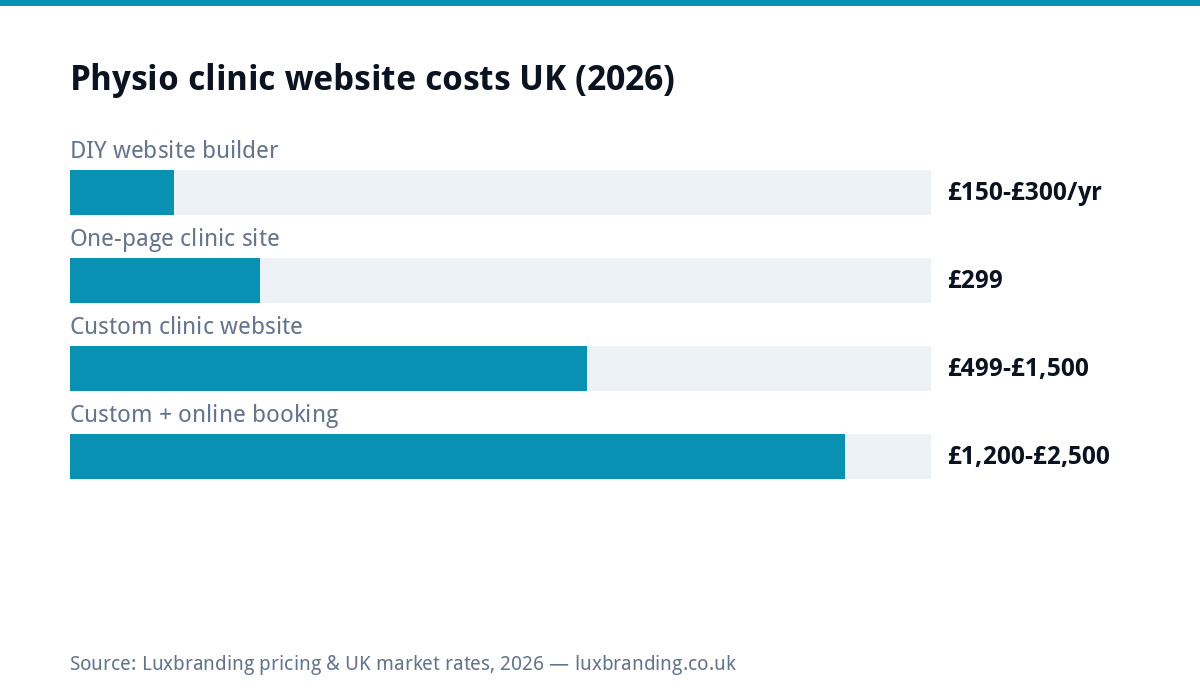
A physiotherapy clinic website costs between £299 and £2,500 in the UK in 2026. A one-page professional site with your services, registration details and contact information costs around £299. A custom clinic website with individual condition and treatment pages runs £499 to £1,500. Add online booking that syncs with your diary and the total reaches £1,200 to £2,500. The right budget depends less on clinic size than on how much of your caseload is self-pay, because self-pay patients are the ones a website actually wins.
What physio websites cost: the 2026 bands
| Option | Typical price | What you get | Right for |
|---|---|---|---|
| DIY builder | £150-£300 per year | Template site you maintain yourself | Brand-new sole practitioners testing demand |
| One-page clinic site | £299 one-off | Services, registration, fees, map, contact, built for you | Sole practitioners with full diaries |
| Custom clinic website | £499-£1,500 | Condition and treatment pages, practitioner profiles, fees page | Clinics competing for self-pay patients |
| Custom + online booking | £1,200-£2,500 | All of the above plus diary-synced booking | Multi-practitioner clinics |
Our own numbers are public on the price list: £299 for a one-page site, custom WordPress from £499, hosting £20 a month.
Self-pay or insurer: where the website earns its fee
Be clear-eyed about your patient mix before you spend. Insurer-referred and occupational-health caseloads arrive through networks and contracts; a website barely influences them beyond looking credible when a case manager checks you exist. Self-pay patients are the opposite: they search “physio near me”, “physio for back pain”, and “shockwave therapy cost”, compare two or three clinics, and book the one that looks most competent. If self-pay is 20% of your caseload and you want it to be 50%, the website is the machine that does that shifting, and the £499 to £1,500 band is where that machine lives.
Condition pages: the structure that wins self-pay searches
The highest-value structural decision on a physio site is giving each major condition and treatment its own page: back pain, sports injuries, post-surgical rehab, sciatica, shockwave, acupuncture. Patients do not search “physiotherapy clinic”; they search the thing that hurts. A single services list cannot rank for ten different problems, but ten well-written pages can each rank for their own. This is the same page-per-search logic that works for dental practice websites, and it is the main reason clinic sites cost more than brochure sites: they simply contain more pages that earn.
Registration and credibility: HCPC and CSP on the page
Physiotherapist is a protected title, and patients increasingly know to check. Display each practitioner’s HCPC registration number and link it to the HCPC register, and show CSP membership where you hold it; the Chartered Society of Physiotherapy is the credential self-pay patients recognise. Add real photos of practitioners and the treatment rooms. Stock photography of anonymous white-coated models measurably undercuts trust on healthcare sites, and trust is the entire conversion mechanism when someone is choosing who touches their spine.
What online booking adds, and when to pay for it
Most clinics already run diary software (Cliniko, WriteUpp, Nookal and similar), and those platforms include embeddable booking widgets. Integration into a new site is therefore often £150 to £500 of configuration rather than a bespoke build, which is why the booking band overlaps the custom band. Full bespoke booking only makes sense with unusual rules. The deciding question is reception load: if the phone is the bottleneck and evenings go unanswered, online booking recovers patients you currently lose silently. The wider options and their running costs are in our booking system price guide.
Worked examples: three clinics, three budgets
The sole practitioner renting a room. Full diary from insurer work, wants a credible online presence. A £299 one-page site with registration details, fees and a contact form is exactly enough, with total first-year spend around £539 including hosting.
The two-practitioner clinic pushing self-pay. Needs the £799 to £1,200 build: eight condition pages, practitioner profiles, a transparent fees page and Cliniko booking embedded. If the site shifts three self-pay patients a week at £55 a session, it pays for itself inside two months.
The multi-site clinic. Four practitioners, two locations, sports-massage upsells. This is £1,500 to £2,500 territory with location pages, per-practitioner booking and a review pipeline; our review request scripts handle the asking-for-reviews part without awkwardness.
Fees pages: publish your prices
Clinics agonise over publishing session fees, and the evidence keeps landing the same way: patients ring the clinic that shows £55 a session and ignore the one that says “contact us for pricing”, because hidden pricing reads as expensive pricing. Publish initial assessment and follow-up fees, insurer acceptance, and cancellation terms. It filters out mismatched patients before they cost you admin time, and it is content Google can surface for cost-intent searches you would otherwise never appear in.
Google Business Profile: half the battle is the map
“Physio near me” is a map search before it is a website search. Correct categories, real interior photos, up-to-date hours and a steady stream of reviews decide who appears in the local three-pack. The profile then hands searchers to your site to be convinced. Setup done properly is a £199 job; the full breakdown is in our Business Profile setup cost guide.
Running costs and the compliance details
Budget £20 a month for managed hosting with SSL, backups and updates. Two details matter more in healthcare than elsewhere: a privacy policy that actually reflects how enquiry data is handled, since messages about injuries are health data under UK GDPR, and a contact form that reaches a monitored inbox rather than a spam folder. Neither costs much; both are embarrassing to get wrong.
Where clinic websites waste money
The usual failure is spending on the wrong layer: a £3,000 visual redesign of a site with no condition pages, a video header that slows every mobile visit, or a blog of generic wellness posts nobody searches for. The earning layers are condition pages, fees transparency, booking friction and the map profile. Fix those four before spending a pound on polish.
What to prepare before the build starts
Half the cost variance between clinic quotes is really a content question: who is writing the condition pages? Providers writing them for you charge more and should, because credible physiotherapy content takes clinical review. Providers expecting you to supply copy quote lower and then stall for months waiting on it. Before commissioning anything, prepare a one-paragraph clinical bio per practitioner, your fee list, three genuine patient outcomes you can describe without identifying anyone, and a shortlist of the eight conditions you most want to be found for. Clinics that arrive with that pack finish builds in weeks; clinics without it own half-finished websites for a year.
The launch checklist that protects the investment
Before signing the site off, verify five things from a patient’s phone: every condition page loads fast and reads cleanly, the booking route works end to end including the confirmation email, the fees page matches what reception actually charges, each practitioner’s registration number links to the register, and the contact form delivers to a monitored inbox rather than a spam folder. Then point your Business Profile’s website field at the new site and watch enquiry sources for a month. A site that passes those five checks on day one rarely needs touching again beyond fee updates.
What we charge for physio clinic websites
Our custom WordPress builds start at £499, the one-page option is £299, and hosting with management is £20 a month with small content changes included, so updating a fee or adding a practitioner never becomes a billable project. Everything is priced publicly, which in a sector built on trust is exactly how we think it should be.
Get the UK Website Project Brief Template (free)
A 2-page template for briefing any UK web designer — sitemap, integrations, audience, deliverables. Cuts revision rounds in half.
No spam. Unsubscribe any time. UK GDPR compliant — your email is only used to send this resource.
Frequently asked questions
How much does a physiotherapy website cost in the UK? +
Between £299 and £2,500 in 2026. A one-page clinic site costs around £299, a custom website with condition and treatment pages runs £499 to £1,500, and diary-synced online booking takes the total to £1,200 to £2,500.
Do physios need individual condition pages? +
If you want self-pay patients, yes. People search the problem ("physio for back pain"), not the profession, and one services list cannot rank for ten conditions. A page per major condition and treatment is the structure that wins those searches.
Should a physio clinic publish its prices online? +
Yes. Patients consistently choose the clinic showing £55 a session over the one hiding fees behind "contact us", because hidden pricing reads as expensive. Publish assessment and follow-up fees, insurer acceptance and cancellation terms.
Can my existing diary software handle online booking? +
Usually. Cliniko, WriteUpp, Nookal and similar platforms include embeddable booking widgets, so integration is typically £150 to £500 of configuration on a new site rather than a bespoke build costing thousands.
What should a physio website show for credibility? +
Each practitioner's HCPC registration number linked to the register, CSP membership where held, transparent fees, and real photos of the team and treatment rooms. Stock photos of models in white coats undercut the trust the site exists to build.