Quick answer
Use an online printer for standard jobs you can supply print-ready, such as business cards, flyers and leaflets, where price and speed matter: Vistaprint advertised free delivery on orders over £40 at the time of writing. Use a local printer when you need advice, a physical proof, unusual paper or same-day collection. Many small firms use both.
Choosing where to print is rarely about which printer is “best”. It is about matching the job to the way the printer works. This guide sets out the real differences, which jobs suit which route, and what you need to have ready so either one prints exactly what you expected. Third-party details are taken from the printers’ own websites at the time of writing, November 2026, and offers change, so check before you order.
The short version
Online printers run large, automated presses. You upload a file, choose from a fixed menu of sizes, papers and finishes, pay up front and the job arrives by courier. Prices are low because the process is standardised and your job is ganged up with many others on the same sheet.
A local printer is a smaller business you can visit or phone. You talk to a person, they look at your file, suggest a paper, show you samples and print a proof before the full run. You pay for that attention, but you also get someone who will catch problems before they cost you money.
Neither is a bad choice. The mistakes happen when a job that needed a conversation goes through an upload form, or a simple reprint of 500 cards gets the full bespoke treatment and the bill to match.
What an online printer does well
Online printers are built for repeatable, standard products. Their strengths are easy to see:
- Price on standard items. Cards, flyers, leaflets, posters and stickers in common sizes are cheap because the presses run constantly.
- Speed and convenience. instantprint highlights 24-hour dispatch on its website, and MOO advertised next-day delivery on selected products ordered before midday, Monday to Friday. You can order at 10pm from your van.
- Automatic file checks. instantprint states it offers a free artwork check with every order as standard. That catches obvious problems such as missing bleed, but it is not a design review.
- Easy reorders. Your previous job sits in your account, so a reprint of the same card takes a minute.
The trade-off is choice. You get the sizes, papers and finishes on the menu. Anything unusual, such as a custom fold, a particular paper or a tricky colour match, either is not offered or costs more than you expect.
What a local printer does well
A good local printer earns its keep on jobs where judgement matters:
- Advice before you commit. They will tell you that your chosen paper will crack along the fold, or that your dark navy will print almost black on uncoated stock.
- Physical proofs. Holding a printed proof shows you colour, weight and finish in a way no screen can.
- Unusual work. Small runs on special papers, numbered tickets, carbonless pads, mixed jobs and odd sizes are everyday work for many local shops.
- Same-day help. When an event is tomorrow and the banner order went wrong, a local printer you know is the one who might help.
- Accountability. If a run comes out wrong, you can stand at the counter with the box.
The trade-off is usually price per unit on standard items, and opening hours. Expect to pay more for 500 plain business cards than you would online.
Online vs local: side by side
| Factor | Online printer | Local printer |
|---|---|---|
| Price on standard items | Usually lower | Usually higher |
| Advice on paper and finish | Product pages and FAQs | A person, with samples |
| Proofs | Digital preview; printed proofs not always offered | Printed proof usually available |
| Artwork checks | Automated or basic checks | Checked by the person running the job |
| Unusual sizes and papers | Limited to the menu | Wide, if they have the kit |
| Turnaround | Fast dispatch, then courier time | Varies; collection possible |
| Fixing problems | Support tickets and reprint policies | Face-to-face conversation |
| Best for | Repeat, standard runs | One-offs, special jobs, tight deadlines |
Which jobs suit which printer
Most businesses do not need to pick one forever. Sort the job, not the printer:
| Job | Usually suits | Why |
|---|---|---|
| Business cards reprint | Online | Same file, same stock, lowest price |
| First run of new business cards | Either; local if you want to feel the paper | Paper weight and finish are easier to judge in hand |
| Door-drop leaflets in thousands | Online | Standard sizes, so the price per thousand matters most |
| Menus on a special paper | Local | Advice on coatings, wipe-clean finishes and folding |
| Event banner needed this week | Local, or online with guaranteed delivery | Deadline risk outweighs the saving |
| Brand colour that must match exactly | Local, with a printed proof | You can approve the colour before the run |
| Quote pads, carbonless forms, numbered tickets | Local | Specialist finishing many online menus do not offer |
Proofs, colour and getting what you expected
The most common complaint about printing is “it looks different from my screen”. That happens with both routes, because screens show colour as light (RGB) and presses print with ink (CMYK). Bright blues, greens and oranges often look duller on paper.
A local printer can run a hard proof so you see the colour on the actual paper. Online printers mostly show a digital preview, which confirms layout and trim but not colour. If colour matters, for example your brand blue across a whole stationery set, either pay for a printed proof or print a small run first.
Coated and uncoated papers also change colour. The same file can look crisp on silk and softer, slightly darker on uncoated stock. Decide the paper before you judge the colour.
Artwork: the part both printers depend on
Whichever printer you use, most print problems start with the file. Printers need:
- The right size plus bleed. Bleed is extra background beyond the trim line, so no white edge appears when the sheet is cut.
- A safe area. Keep text and logos away from the edge so the guillotine does not clip them.
- CMYK colour and high resolution. Photos at print resolution, colours set up for ink rather than screen.
- Vector logos and text. A logo saved as a small JPG prints soft or pixelated.
- A print-ready PDF. Fonts embedded or outlined, so nothing reflows on the printer’s machine.
An online upload checker will flag some of these. A local printer may fix small issues for you, sometimes for an artwork fee. If your file keeps bouncing back, our guide to why printers reject artwork explains each error, and our guide to print-ready artwork covers the full setup. If your logo only exists as a JPG, it needs rebuilding as vector before it will print cleanly; our Recreate & Vectorise service does that.
Delivery, deadlines and the real total cost
Compare the total, not the headline. With online printers, the price you see on the product page may change once you choose a faster service, add finishing or select delivery. Vistaprint listed free delivery on orders of £40 or more at the time of writing, and MOO advertised free delivery on print orders subject to conditions. Read the terms for your order size and deadline.
With local printers, ask whether the quote includes VAT, proofs, artwork corrections and delivery, or whether you collect. A higher quote that includes a proof and a quick fix can work out cheaper than an online order you have to reprint.
Build in a buffer. A courier delay the day before an exhibition is not something any discount covers.
Paper, sustainability and specialist finishes
If your customers care about sustainability, ask either kind of printer about recycled and certified papers. The Forest Stewardship Council says FSC-certified paper and forest products are made with materials that support responsible forestry. Many printers offer certified stock; ask rather than assume.
For finishes such as foil, spot UV, soft-touch lamination, thick cards or textured papers, the big online printers now offer premium ranges, and their product pages show what is available. A local printer is still the place for anything outside a menu, and for seeing a finish before paying for 1,000 of it.
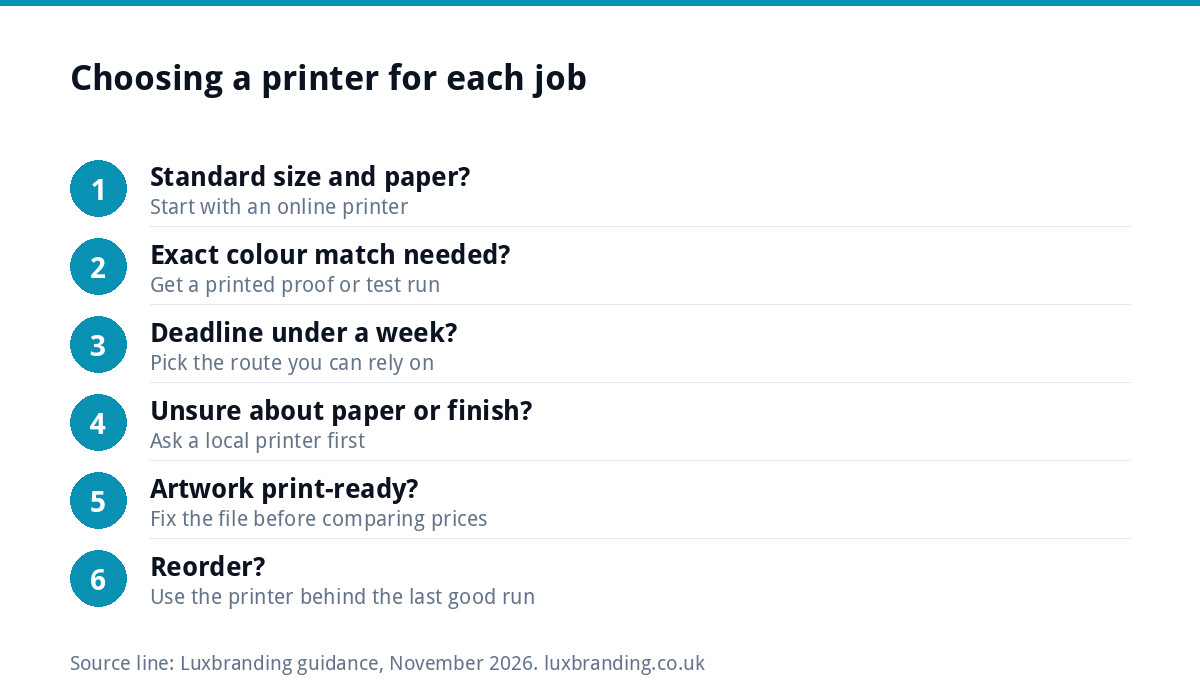
A simple way to choose
Run through these steps for each job:
- Is it a standard size and paper? If yes, an online printer is the natural starting point.
- Does colour need to match exactly? If yes, get a printed proof, which usually means local or a test run.
- Is the deadline under a week? If yes, choose the route you can rely on, not the cheapest.
- Do you need advice? If you are unsure about paper, folds or finish, talk to a local printer first.
- Is the artwork print-ready? If not, fix the file before you compare any prices.
- Is it a reorder? Use whichever printer produced the last good run, with the same file and stock.
Getting artwork ready for either route
We do not print. We design the artwork and supply files built for the press, so you can send them to an online printer, a local printer or both. Our flyer and leaflet design and business card design services supply print-ready files, and our Poster & Banner Design (£89 one-off) comes with CMYK, 300dpi files with bleed and trim marks, plus a print specs sheet with material recommendations. We can recommend suppliers and brief them for you. Print-Ready Artwork, preparing an existing design for the press, is £49.
If you are starting from scratch, a proper brand identity gives every printer the same colours and fonts to work from, which is the easiest way to keep cards, flyers and signs consistent. All our fixed prices are on the pricing page, and you can order online.
Get the UK Print-Ready Artwork Checklist (free)
A one-page checklist for any UK designer or printer covering CMYK, bleed, fonts and resolution. Saves you the pre-press fix-up fees.
No spam. UK GDPR compliant. We only use your email to send this resource, unless you tick the box to hear from us.
Frequently asked questions
Are online printers cheaper than local printers? +
On standard items such as business cards, flyers and leaflets in common sizes, online printers are usually cheaper because their presses run large combined jobs. Compare the total, though: faster delivery, finishing and proofs can add to an online price, while a local quote may already include a proof and small artwork fixes.
Can I get a printed proof from an online printer? +
Some online printers offer printed proofs on certain products, often for an extra charge, but most orders rely on a digital preview. A digital preview confirms layout and trimming, not colour. If an exact colour match matters, a local printer's hard proof or a small test run is the safer route.
Why do my printed colours look different from my screen? +
Screens show colour as light in RGB, while printers use CMYK inks, and some bright colours cannot be reproduced exactly in ink. Paper also changes colour: uncoated stock looks softer and slightly darker than silk. Set your artwork up in CMYK and judge colour on the paper you will actually use.
What file should I send to a printer? +
Most printers want a print-ready PDF at the correct size with bleed, CMYK colour, high-resolution images and fonts embedded or outlined, with logos in vector form. Check the printer's own artwork guide for their bleed and safe-area measurements, because these vary slightly between printers and products.
Does Luxbranding print as well as design? +
No. We design artwork and supply print-ready files you can send to any printer, online or local. For posters and banners we include a print specs sheet with material recommendations, and we can recommend suppliers and brief them for you. You then order the print directly with the printer you choose.