Quick answer
A good thank-you insert says thanks in your own words, tells the customer how to reorder, explains care or use, and gives one next step, such as following you or leaving an honest review. Never offer a discount or gift in exchange for a review: UK guidance and Google’s rules both treat that as manipulation.
For a small online shop, the parcel is the only physical moment you share with a customer. A printed card in the box costs pennies, yet it can turn a one-off order into a repeat customer, a follower or a recommendation. It can also land you in trouble if it asks for reviews the wrong way. This guide covers what to put on an insert, what to leave off, formats and sizes, example wording and how to tell whether it is working.
Why bother with an insert
Online buyers rarely remember where they bought something. The box arrives, the product comes out, the packaging goes in the recycling, and your shop name goes with it. An insert is the one thing that stays in their hands long enough to register who you are.
It also does practical jobs your website cannot: reminding someone how to look after what they bought, telling them how to reorder, and making it easy to come back without searching. For handmade, food, beauty and gift businesses in particular, the insert is part of what the customer feels they paid for.
Seven things worth including
- A genuine thank-you, written the way you speak, not “Thank you for your custom”.
- Your name and web address, big enough to read, so they can find you again.
- Care or use instructions where relevant: washing, storage, best-before advice, how to get the best out of it.
- How to reorder, such as a short web address or a QR code to the product page.
- One social handle, the channel you actually post on, not every platform.
- An honest review request, open to every customer, with no strings attached (more on this below).
- A contact route for problems, so an issue becomes an email rather than a one-star review.
You do not need all seven. Pick the three or four that matter most for your products, and leave white space. A crowded card gets binned faster than a simple one.
What not to put on an insert
- “Leave us a five-star review” or anything that asks for a particular rating.
- A discount, freebie or prize draw in exchange for a review.
- “If you are unhappy, contact us instead of reviewing” wording that steers unhappy customers away from reviews.
- Small print you would not say to their face, such as hidden subscription terms.
- Too many messages at once. One main ask per card.
Asking for reviews the right way
Reviews are where inserts most often go wrong. The CMA’s reviews guidance for businesses says you should not offer inducements, money or gifts, to customers to write positive reviews, and notes that misleading practices can carry fines of up to 10% of global turnover.
Google’s own rules are just as clear. Its policy on contributed content says merchants may not offer incentives such as payment, discounts or free goods in exchange for posting a review, and may not selectively solicit positive reviews or discourage negative ones. It does allow you to encourage genuine reviews without incentives or trying to influence the rating.
So the safe wording is simple: “If you have a moment, we would love to hear what you think. Honest reviews help other customers and help us improve.” Add a QR code to your review page and leave it there.
Using inserts to grow your email list
An insert is a natural place to invite people onto your mailing list, but the invitation has to be genuine consent. The ICO’s guidance on electronic mail marketing says you need specific consent to email individuals, unless the soft opt-in for existing customers applies, and that people must be able to opt out easily in every message.
In practice, a QR code that leads to a sign-up form where the customer chooses to subscribe is fine. Quietly adding everyone who buys to a newsletter because “they got a card about it” is not something to rely on. If you offer a small welcome discount for signing up, that is a sign-up incentive, which is a different thing from paying for reviews. This is general information, not legal advice.
Formats and sizes
| Format | Typical size | Best for | Note |
|---|---|---|---|
| Business-card-sized note | 85 x 55mm | Small parcels, jewellery, cosmetics | Room for one message and a QR code |
| A6 postcard | 105 x 148mm | Most small shops | The usual choice: thanks on one side, care or reorder on the back |
| DL card | 99 x 210mm | Clothing, homeware, longer instructions | Fits tall, narrow boxes and mailing bags |
| A5 folded card | 148 x 210mm, folded | Gift boxes, premium products | Feels special; costs more to print and post |
| Printed sticker or seal | Round or square, small | Sealing tissue paper or bags | Works alongside a card rather than instead of one |
Choose a heavier, uncoated card if you want customers to handwrite a name or initials on it; coated card is better for rich colour and photos.
Handwritten or printed?
A handwritten note feels personal, and in the early days, when you pack every order yourself, it is a lovely touch. It does not scale well. Once you are packing dozens of parcels on a busy day, handwriting becomes the bottleneck, and a rushed scrawl looks worse than a tidy printed card.
The usual middle ground is a printed card with a small space left for a name or initials, or a printed message with a short handwritten “Thanks, Sam” at the bottom. You keep the personal feel without writing the whole card each time. For repeat customers, a handwritten line such as “Lovely to see you again” on the printed card goes a long way.
Whatever you choose, keep the printed wording warm and plain. A card that reads like a terms and conditions page undoes the effort of including it.
Wording examples by type of shop
| Shop | Front | Back |
|---|---|---|
| Handmade candles | “Made by hand in our kitchen in Kent. Thank you for supporting a small business.” | Burn care tips, reorder QR code, social handle |
| Coffee roaster | “Roasted this week, packed by hand. Enjoy it.” | Brewing ratios, best-before advice, subscription link |
| Children’s clothing | “Thanks for choosing us for your little one.” | Washing instructions, size guide link, contact for exchanges |
| Skincare | “Thank you. Here is how to get the most from your order.” | How to use, patch-test advice, honest review request |
Print and design tips
An insert is a small piece of print, but it still needs proper artwork. Set it up at the final size with bleed, keep text away from the trim edge, use your brand colours in CMYK for print and test every QR code from the printed proof, not just the screen. Our guide to print-ready artwork covers the technical checklist, and our packaging design guide for small brands shows how inserts fit with boxes, labels and tissue.
Match the card to the rest of the packaging. A beautifully designed box with a card printed on the office printer undoes the effect. Order a small first print run, live with it for a few weeks and adjust the wording before you order in bulk; reprinting a large batch because of one awkward line is a common and avoidable cost.
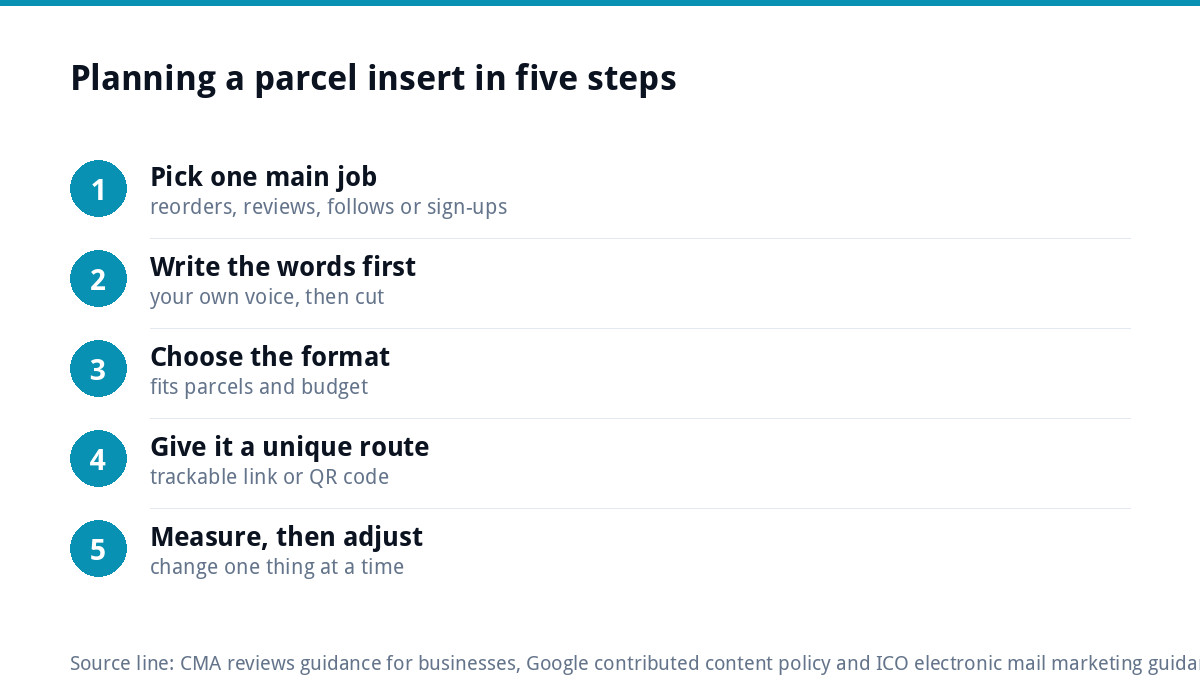
Planning your insert in five steps
- Pick the one main job: repeat orders, reviews, social follows or email sign-ups.
- Write the words before the design, in your own voice, and cut them down.
- Choose the format that fits your parcels and budget.
- Give it a unique route: a dedicated web address or QR code you can track.
- Measure for a couple of months, then change one thing and compare.
Where we fit
If you are designing the packaging itself, our packaging design is £99, and it makes sense to plan the insert at the same time so the two match. If you only need a card or a small leaflet, our flyer and leaflet design service lays it out print-ready, and our business card design suits the smallest inserts. We design; we do not print, but print-ready files go to any printer. See all our prices on the pricing page, then order online or email us at support@luxbranding.co.uk.
Get the UK Print-Ready Artwork Checklist (free)
A one-page checklist for any UK designer or printer covering CMYK, bleed, fonts and resolution. Saves you the pre-press fix-up fees.
No spam. UK GDPR compliant. We only use your email to send this resource, unless you tick the box to hear from us.
Frequently asked questions
What should I write on a thank-you card for customers? +
Keep it short and personal: a genuine thank-you in your own words, your shop name and web address, and one next step, such as how to reorder, care instructions or where to follow you. Write it the way you would speak to the customer in person, and leave plenty of white space.
Can I offer a discount for a review on my insert? +
No. CMA guidance says businesses should not offer money or gifts to customers to write positive reviews, and Google's policy says merchants may not offer incentives such as discounts or free goods in exchange for a review. You can invite every customer to leave an honest review, with no reward attached.
What size should a parcel insert card be? +
A6, which is 105 by 148mm, suits most small shops, with thanks on one side and care or reorder details on the back. A business-card-sized note works for small parcels such as jewellery, and a DL card at 99 by 210mm fits tall, narrow boxes and mailing bags.
Can I add customers to my newsletter because they got an insert? +
Not safely on that basis alone. ICO guidance says you need specific consent to send marketing emails, unless the soft opt-in for existing customers applies, and people must be able to opt out easily. A QR code to a sign-up form where customers choose to subscribe is the straightforward route.
Are thank-you inserts worth the cost? +
For most small shops, yes, because printing a card costs little compared with winning a new customer. Give the insert its own web address, QR code or code so you can see how many people use it. Track that for a couple of months, then change one thing at a time and compare.