Quick answer
A leaflet drop puts something physical through every letterbox in the streets you choose, once. Facebook ads show your message to people within a radius you set, repeatedly, for as long as you pay. With £300, leaflets buy one touch per home that may sit on the side for weeks; Meta buys repeated reach. Test both with one offer.
Both are ways to reach local people who are not searching for you yet, which is what makes them a fair comparison. This guide sets out how each works, how to cost them with your own quotes, which suits which business, and how to measure them so you can decide on evidence rather than habit.
How each one reaches people
Leaflets go to addresses. You pick the streets, postcode sectors or rounds, and every household on them gets one, whether they are your kind of customer or not. Large distributors cover most of the country: Whistl, for example, says its door drop service can reach almost all of the 29 million UK residential homes, and offers targeting by region and demographic. Smaller local distributors and your own two feet cover the rest.
Facebook ads go to people. You choose an area, such as a radius around your town, and Meta shows your ad to users in it, across Facebook and, if you choose, Instagram. Ofcom’s Online Nation 2025 report found Facebook and Messenger reached 93% of UK online adults in May 2025, with 69% using them on an average day, so most of the people in your area are reachable there.
Side by side
| Leaflet drop | Facebook ads | |
|---|---|---|
| Who sees it | Every household on the chosen streets | Facebook users in your chosen area |
| How often | Once per drop | Repeatedly, over days or weeks |
| How long it lasts | As long as it stays on the side or the fridge | Stops when the budget stops |
| Lead time | Design, print and distribution, often a couple of weeks | Can be live within a day of approval |
| Changing it | Reprint needed | Edit or pause at any time |
| Measuring it | Offer codes, QR codes, asking customers | Clicks and messages reported; enquiries need tracking |
| Main failure mode | A weak offer printed thousands of times | Budget spent on people who will never buy |
Costing it with your own numbers
Leaflet prices vary a lot by quantity, paper, area and distributor, so get two or three quotes rather than relying on averages. Then work out the comparable figures:
- Leaflet cost per household = (design + printing + distribution) ÷ number of homes reached.
- Facebook cost = your daily budget × number of days. Meta reports how many people saw the ad and how often.
- Cost per enquiry for each = total spent ÷ enquiries you can trace to it.
- Cost per customer = total spent ÷ paying customers. This is the number that matters.
On Facebook, you control the spend. Meta’s guide to ad costs says that on a daily budget it may spend up to 75% more than the daily amount on a given day, but will not spend more than seven times your daily budget over a week, and it recommends running ads for at least seven days so the system can learn.
A worked example: £300 two ways
Take a window cleaner launching in a new estate with £300 to spend. These are illustrative splits, not quotes.
Route A, leaflets: the £300 covers printing and distributing leaflets to a few thousand homes on the target estate, depending on the quotes received. Every home gets one leaflet with a first-clean offer and a code. Some leaflets go straight in the recycling; some sit by the door for a month.
Route B, Facebook: £10 a day for 30 days, aimed at people within a couple of miles of the estate. The same offer appears repeatedly to people who scroll past it, with a button to send a message. The money stops working on day 31.
Route C, both: £200 on leaflets to the streets most likely to book, £100 on Facebook to the same area over the following two weeks, so people see the offer twice in two places. For many local services, this combination is worth testing, because the second sighting reminds people of the first.
Which suits your business, by situation
| Your situation | Usually start with | Why |
|---|---|---|
| Round-based service (windows, gardens, cleaning) | Leaflets | You can target exactly the streets you can serve |
| New café, shop or salon opening | Both | Leaflets announce it; ads remind people during opening weeks |
| Older customer base | Leaflets, plus Facebook | Ofcom found adults aged 65 and over spend the least time online, though Facebook skews older than other platforms |
| Event, offer or deadline | Facebook ads | Fast to launch and easy to stop |
| Wide service area (a whole county) | Facebook ads | Leafleting a large area thinly rarely works |
| Emergency trade (locksmith, drainage) | Neither first; Google search | Customers search at the moment of need |
Timing and frequency
A single leaflet drop is rarely enough on its own. People keep a leaflet when they have a need, and most households do not need a window cleaner, a carpet fitter or a new café on the day yours lands. Repeating a drop to the same streets, a few weeks apart, catches people when the need arrives and builds recognition each time. Facebook ads build that repetition automatically, which is their main strength for local businesses: the same person sees your offer several times over a fortnight without you paying to reach them again by hand.
Timing matters for both. Drop gardening leaflets in early spring, not August. Run ads for a heating engineer as the first cold nights arrive. Avoid the weeks around Christmas for anything that is not seasonal, when letterboxes and feeds are both crowded. And plan the leaflet’s lead time: design, proofing, printing and distribution all need to fit before the date your offer matters.
What makes a leaflet work
A leaflet gets a couple of seconds on the doormat. In that time it has to say what you do, for whom, and why now. Three rules:
- One offer, big and clear. “First clean half price” beats a list of eight services.
- Local proof. The estate’s name, a nearby street, a photo of a local job.
- One way to respond, with tracking. A code, a QR code to a dedicated page, or a separate number.
Print problems waste money too. Our guide to print-ready artwork covers bleed, resolution and colour, and if a printer has already sent your files back, see our guide to printer-rejected artwork.
What makes a Facebook ad work
- A real photo or short video of your work, not stock imagery.
- The same single offer as the leaflet, so you can compare like for like.
- A sensible area. Meta’s own guidance notes that larger audiences often perform better, which sits awkwardly with very local targeting. Keep the radius to where you genuinely work, and accept that small local audiences see the ad more often.
- Somewhere to land. A message button or a short page with the offer. Our landing page design is £199.
Measuring both fairly
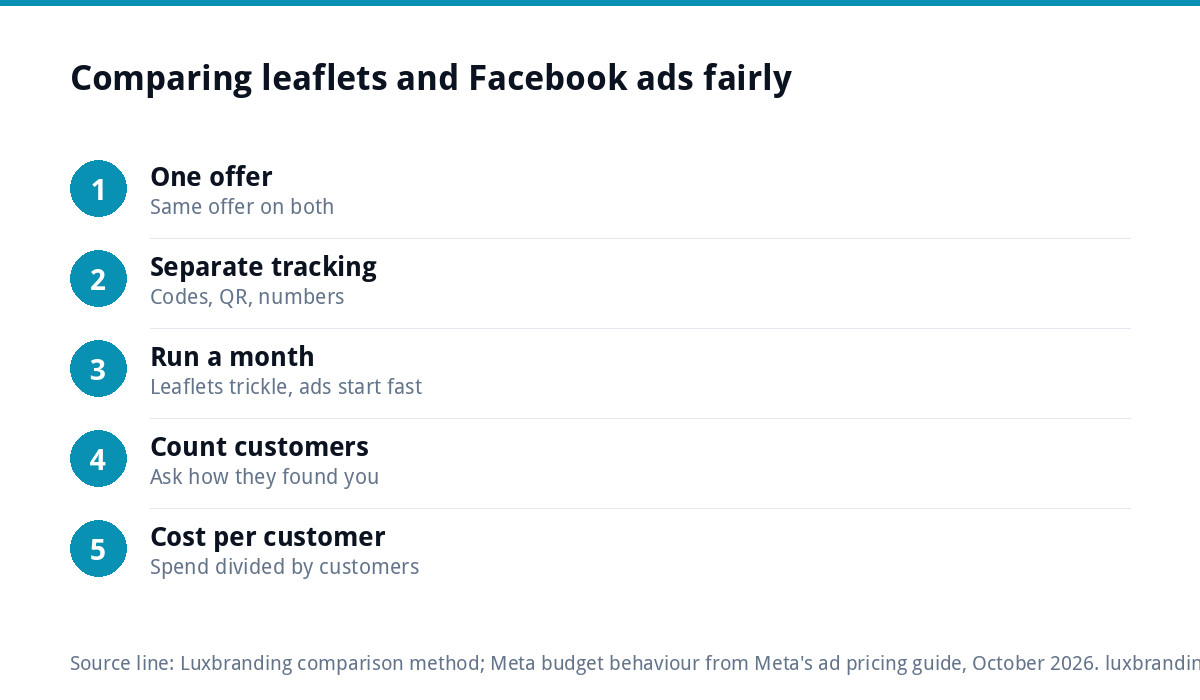
The only way to know which works for you is to measure enquiries and customers from each. Use a different offer code for each channel, a QR code that goes to a page only leaflet readers see, and ask every new customer where they heard about you. Run the test for at least a month, because leaflets bring a slow trickle and ads bring a fast start. Then compare cost per customer, not cost per click or cost per thousand homes.
Keep a simple record as you go: the date of each drop or ad run, the streets or area covered, the amount spent, and every enquiry with its code or source. After two or three rounds, patterns appear, such as one estate that always responds or an ad that only works at weekends, and those patterns are worth more than any average from someone else’s business.
Getting the materials right
Whichever route wins, the material does the selling. Our flyer design service produces leaflets ready for any printer or distributor, and our social media design service creates ad and post graphics that match them, so both channels look like the same business. If you would rather have the ads run for you, our Facebook and Instagram ads service manages campaigns on Meta. Every fixed price we offer is on our pricing page.
Get the UK SEO DIY Audit Checklist (free)
A 32-point checklist UK SMEs can run against their own website in an afternoon. Surfaces the quick wins before paying for a paid audit.
No spam. UK GDPR compliant. We only use your email to send this resource, unless you tick the box to hear from us.
Frequently asked questions
Are leaflets or Facebook ads better for a local business? +
It depends on the business. Leaflets suit round-based services and older customer bases because you choose exactly which streets receive them. Facebook ads suit events, deadlines and wider areas because they launch quickly and can be changed at any time. For many local businesses, testing both with the same offer is the best way to find out.
How much should I spend on Facebook ads for a local business? +
You set the budget. Meta says a daily budget can be exceeded by up to 75% on a given day, but spend will not exceed seven times the daily budget over a week, and it recommends running ads for at least seven days. A modest daily budget for a month is a sensible first test.
How do I measure whether leaflets work? +
Give the leaflet its own offer code, a QR code that goes to a page only leaflet readers see, or a separate phone number, and ask every new customer where they heard about you. Leaflets often bring a slow trickle of enquiries over weeks, so measure for at least a month before judging.
Can I target Facebook ads to my local area? +
Yes. You can set a location such as a radius around your town. Keep it to the area you genuinely serve. Meta's guidance notes that larger audiences often perform better, so very small local audiences may see your ad more often, which is fine for a local offer but worth watching.
Should my leaflet and Facebook ad look the same? +
Yes. Using the same offer, colours and style on both helps people connect the two when they see your business twice, and it makes the comparison fair, because the only difference is the channel. A matching set of print and social graphics is one of the simplest ways to make a small budget work harder.