Quick answer
Judge a design portfolio on range, real clients and fit with your kind of business, not on how polished the thumbnails look. Look for work in use in the real world, several different styles, explained briefs and outcomes, and run a couple of images through a reverse image search to check the work is genuinely the designer’s own.
Every designer’s portfolio looks impressive at first glance, because every designer chooses their best work and presents it beautifully. That makes portfolios hard to compare, especially if you are hiring a designer for the first time. This guide gives you eight checks to separate a strong portfolio from a pretty one, explains how to spot borrowed or invented work, and lists the questions to ask once you have a shortlist.
What a portfolio should prove
A portfolio is evidence for three questions:
- Can this designer solve problems like mine? Not just make something attractive, but make something that works for a business like yours.
- Can they adapt? Will your logo look like you, or like the last ten logos they made?
- Is the work real? Was it made for paying clients and used in the world, or invented for the portfolio?
Keep those three questions in mind and most portfolios sort themselves quickly. Write them on a sheet of paper and score each shortlisted designer against them as you go.
Eight checks
| Check | What good looks like | Red flag |
|---|---|---|
| 1. Range of styles | Bold, minimal, traditional and playful work for different clients | Every logo looks like the same designer’s signature style |
| 2. Range of sectors | Some work close to your sector, plus variety | Nothing remotely like your kind of business |
| 3. Real-world use | Logos on vans, signs, workwear, websites | Only flat images on plain backgrounds or generic mockups |
| 4. Named clients | Real business names you can look up | Made-up names, or no names at all |
| 5. Brief and reasoning | A short explanation of the problem and the choices made | Pictures only, no thinking shown |
| 6. Small-size versions | Icons, stacked layouts and one-colour versions shown | Only the full logo at large size |
| 7. Consistency across items | The same brand carried across cards, web and signage | Single logos with no sign of how they were used |
| 8. Recent work | Projects from the last year or two | Nothing new for years |
Look for range, not one style
Some designers have a recognisable look. That is fine if you love that look, but it can mean your logo ends up resembling their other clients’ logos more than it reflects your business. A strong portfolio shows that the designer listens: a heritage-feel mark for a family joinery firm, something crisp and modern for an electrician, something warm for a café.
If you see the same fonts, the same shapes and the same colour palettes repeated across very different businesses, ask yourself whether your brand would come out any different.
Real-world use beats mockups
A logo on a plain white background, or placed on a stock image of a coffee cup, tells you little. A logo photographed on a real van, a shop sign, an embroidered polo or a live website tells you it survived contact with printers, sign-makers and real budgets.
Real-world photos also show whether the designer thinks about how a brand is used. For trades especially, a logo has to work on a van side, a hi-vis vest and a phone screen. Our guide to branding for trades businesses covers what that involves.
Check the work is genuinely theirs
Unfortunately, some portfolios include work the designer did not make, or concepts that were never used. A quick check takes a minute. Google’s guide to searching with an image explains how to upload an image or right-click one in Chrome and choose “Search with Google Lens”; the results include websites with the same or similar images.
If a portfolio image appears on a design gallery under someone else’s name, or on dozens of template sites, ask about it. There may be an innocent explanation, such as a team project, but you should hear it. Also look up one or two named clients to see whether they really use the logo shown.
Be alert to polished scenes that look too perfect. Generated images of logos on buildings, shopping bags and coffee cups are now easy to produce, and they say nothing about whether a real client ever used the design. A slightly imperfect photo of a real van outside a real yard is better evidence than a flawless render.
Finally, look at the small versions. Ask to see how a logo from the portfolio looks as a social profile picture, a favicon or an embroidered chest logo. A designer who has thought about those uses will have the files ready; one who has not may only ever have seen the logo at full size on a screen, which is where small-size problems start.
Read the case studies, not just the pictures
A short case study is often more revealing than the image itself. Look for the brief (what the client needed), the thinking (why these shapes, colours and fonts), the deliverables (which files and layouts the client got) and, where possible, what happened next, such as the logo going onto a new fleet of vans or a new website.
A designer who can explain their choices in plain English is usually one who will explain them to you during your project, which makes feedback rounds far easier.
Testimonials and reviews: what to trust
Testimonials on a designer’s own site are chosen by the designer, so treat them as supporting evidence rather than proof. Independent reviews on platforms such as Google or Trustpilot carry more weight, especially specific ones that mention a project, a timescale or a problem that was solved.
UK rules back this up. the Competition and Markets Authority’s reviews guidance for businesses says businesses should not offer inducements to customers to write positive reviews or commission fake reviews, so a wall of identical five-star praise with no detail deserves a second look.
Ownership: who owns the work you commission
A portfolio shows what a designer can make; the contract decides what you own. GOV.UK explains that copyright protection is automatic in the UK, with no register and no fee. As a practical rule, do not assume you own a design just because you paid for it: make sure your agreement says in writing that ownership of the final logo transfers to your business on payment. Our guide to logo copyright and trademarks in the UK covers this in detail.
It is also normal for designers to show client work in their portfolio. If you would rather they did not, say so before the project starts.
What to expect at different budgets
| Type of designer | What the portfolio usually shows | What to look for |
|---|---|---|
| Marketplace or contest designer | Large numbers of quick concepts | Evidence of real clients and use, not just entries |
| Freelancer | A personal selection, often in one or two styles | Range, reliability and how files are handed over |
| Small agency | Logos plus wider brand work, websites and print | Consistency across items and clear process |
| Large agency | Big-name case studies and campaigns | Whether they take on projects your size |
Our guide to how much branding costs in the UK sets out typical prices for each route, and our logo cost calculator gives a quick estimate.
Questions to ask after the portfolio
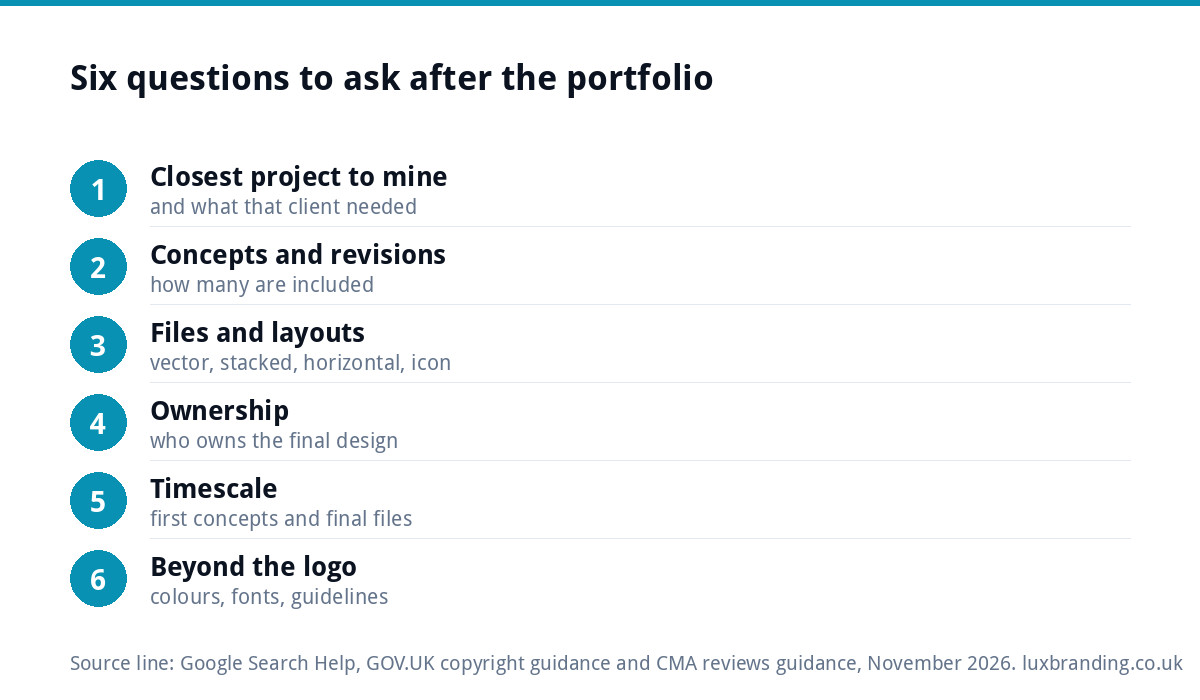
- Which of these projects is closest to mine, and what did that client need?
- How many concepts and revisions are included?
- Which files and layouts do I get at the end? Look for vector files plus stacked, horizontal and icon-only versions.
- Who owns the final design once I have paid?
- How long does it take, from brief to first concepts and to final files?
- Do you do the brand beyond the logo, such as colours, fonts and guidelines, if I need it later?
Where we fit
Our Logo Design is £129 one-off, with unlimited concepts, unlimited revisions within your brief, every file format and a 3D mockup, and stacked, horizontal and icon-only layouts included; first concepts arrive within 48 hours. Our Brand Identity Design at £299 adds colours, typography, imagery and brand guidelines. We are rated 4.8/5 (Excellent) and have delivered 4,500+ projects. If you are weighing up the two, see brand identity vs logo design, and every price is on our pricing page. Order online or email us at support@luxbranding.co.uk.
Get the UK Branding Budget Worksheet (free)
A printable worksheet: decide what your brand needs now and price it against fixed published prices and the IPO trademark fee.
No spam. UK GDPR compliant. We only use your email to send this resource, unless you tick the box to hear from us.
Frequently asked questions
What should a good logo design portfolio include? +
A range of styles for different clients, real business names, logos shown in use on vans, signs, workwear and websites, short explanations of each brief, and small-size versions such as icons and one-colour logos. Recent projects matter too. A portfolio of flat images with no context tells you much less.
How can I tell if a designer's portfolio is fake? +
Run a few images through a reverse image search such as Google Lens. If the same work appears elsewhere under another name or on template sites, ask about it. Look up one or two named clients to see whether they really use the logo, and be wary of portfolios with no client names at all.
Should a designer have work in my industry? +
It helps but is not essential. Some work close to your sector shows they understand your customers and how your logo will be used. A designer with good range across sectors can usually adapt. What matters most is that the portfolio shows listening and problem solving rather than one repeated style.
Are testimonials on a designer's website reliable? +
Treat them as supporting evidence, since the designer chooses which to show. Independent reviews on platforms such as Google or Trustpilot carry more weight, especially specific ones that mention a project or timescale. CMA guidance says businesses must not offer inducements for positive reviews, so detailed, varied reviews are a better sign.
Can a designer show my logo in their portfolio? +
It is common practice for designers to show client work in their portfolios. If you would prefer they did not, or want to wait until after a launch, say so before the project starts and get it agreed in writing. Separately, make sure the agreement transfers ownership of the final design to your business.