Quick answer
Send Google Ads traffic to the page that best answers the search, which is rarely the homepage. If an ad promises one service, link to a page about that service, with the same wording, price guidance and one clear call to action. A homepage only suits searches for your business name or broad “what do you do” queries.
The homepage has to speak to everyone: every service, every customer, the story of the business. An ad click has one question in mind. This guide shows when each option makes sense, what Google itself measures about the page you send people to, and a quick way to test it for your own account.
Why the destination matters as much as the ad
You pay for the click whether the visitor stays or not. If someone searches “emergency roof repair Bristol”, taps your ad and lands on a homepage with a slideshow and seven services, they have to hunt for the answer. Many will not. The ad did its job and the page lost the lead.
Google rates this too. Its help page on landing page experience describes it as a measure of how relevant and useful your page is likely to be to people who click your ad, and says pages rated higher are typically well organised and use text that matches the search. It is one of the three parts of Quality Score, alongside expected click-through rate and ad relevance, each rated above average, average or below average.
Homepage or landing page: the comparison
| Factor | Homepage | Dedicated landing page |
|---|---|---|
| Match to the search | General; covers everything | Built around one service and the words in the ad |
| Calls to action | Several competing links and menus | One main action: call, form or book |
| Distractions | Full navigation, blog, other services | Few or none; navigation often trimmed |
| Measuring results | Mixed traffic muddies the data | Ad traffic is isolated, easier to read |
| Set-up effort | None, it already exists | A page per service or offer |
| Best for | Brand name searches, broad queries | Service searches, offers, local intent |
The pattern is clear: the narrower and more urgent the search, the more a focused page wins.
When the homepage is the right destination
There are honest cases for sending ad clicks home:
- Brand searches. People typing your business name want your business, and the homepage is what they expect.
- One-service businesses. If you only do one thing, say domestic window cleaning in one town, your homepage may already be a good landing page.
- Very small tests. If you are testing whether a service has any demand at all, using the homepage for a fortnight is acceptable while you plan a proper page.
Even then, check that the first screen on a phone answers the search: what you do, where, and how to get in touch, without scrolling.
If you must use the homepage, fix the first screen
Sometimes there is no time or budget for a new page this month. In that case, make the homepage behave more like a landing page for the next few weeks. Put your main service and the area you cover in the headline, not a slogan. Make the phone number tappable and visible at the top on mobile. Remove or pause any auto-playing slider, which pushes the useful content down and slows the page. Add two or three short reviews near the top rather than on a separate page nobody visits. None of this is wasted work, because organic visitors benefit from the same changes.
When a landing page wins
Use a dedicated page when any of these apply:
- You offer several services and the ad is about one of them.
- The ad mentions a price, an offer or a specific area.
- Visitors need reassurance before acting: accreditations, insurance, photos of similar jobs, reviews.
- You want to compare ad traffic cleanly against everything else.
- Your homepage is slow or heavy on mobile.
An existing service page can do this job if it is strong. A separate landing page earns its keep when you want tighter wording and fewer exits than a normal site page allows.
What Google says your destination must do
Separate from quality, Google has rules. Its destination requirements policy covers pages that do not work, display URLs whose domain differs from the final URL, pages Google’s crawlers cannot reach, pages that are frustrating to navigate, and pages with insufficient original content. It also lists unverified or inactive phone numbers among the problems.
For a small business, that translates into simple checks: the page loads on a phone, the domain matches the ad, nothing pops up and blocks the content, the phone number works and the page says something useful in its own words.
What a good ad landing page contains
| Section | What it does | Common mistake |
|---|---|---|
| Headline | Repeats the promise in the ad | A slogan that ignores the search |
| First screen | Service, area, phone number and main button | A large image with nothing to act on |
| Proof | Reviews, accreditations, photos of real work | Stock photos and vague claims |
| Detail | What is included, how it works, rough cost or how you price | Walls of text with no structure |
| Form | Short: name, contact, postcode, a short note | Twelve fields and a CAPTCHA puzzle |
| Repeat the action | Button or number again lower down | Only one button at the very top |
Speed matters on all of it. A heavy page on a 4G signal loses people before the headline appears; our guide to website speed for small businesses covers the usual fixes.
Message match in practice
Message match means the page continues the exact conversation the ad started. If the ad says “Same-day boiler repair in Croydon, Gas Safe registered”, the page headline should say the same thing in nearly the same words, and the Gas Safe detail should be visible straight away. The visitor should never wonder whether they have landed in the right place.
Three places carry most of the weight:
- The headline. Reuse the service and location from the ad. Clever wordplay costs clarity.
- The offer or price guidance. If the ad mentions “free quotes” or “from” pricing, repeat it on the page in the same terms. A mismatch here feels like bait and switch, and people leave.
- The call to action. If the ad says “call now”, make the phone number the first button. If it says “get a quote”, the form should be visible without hunting.
Message match also helps when you write several ads. Group keywords by what the person wants, give each group its own ad, then point each ad at the page that fits. That is why one strong page per service usually beats a separate page for every keyword or town: you get relevance without creating a stack of near-identical pages you then have to maintain.
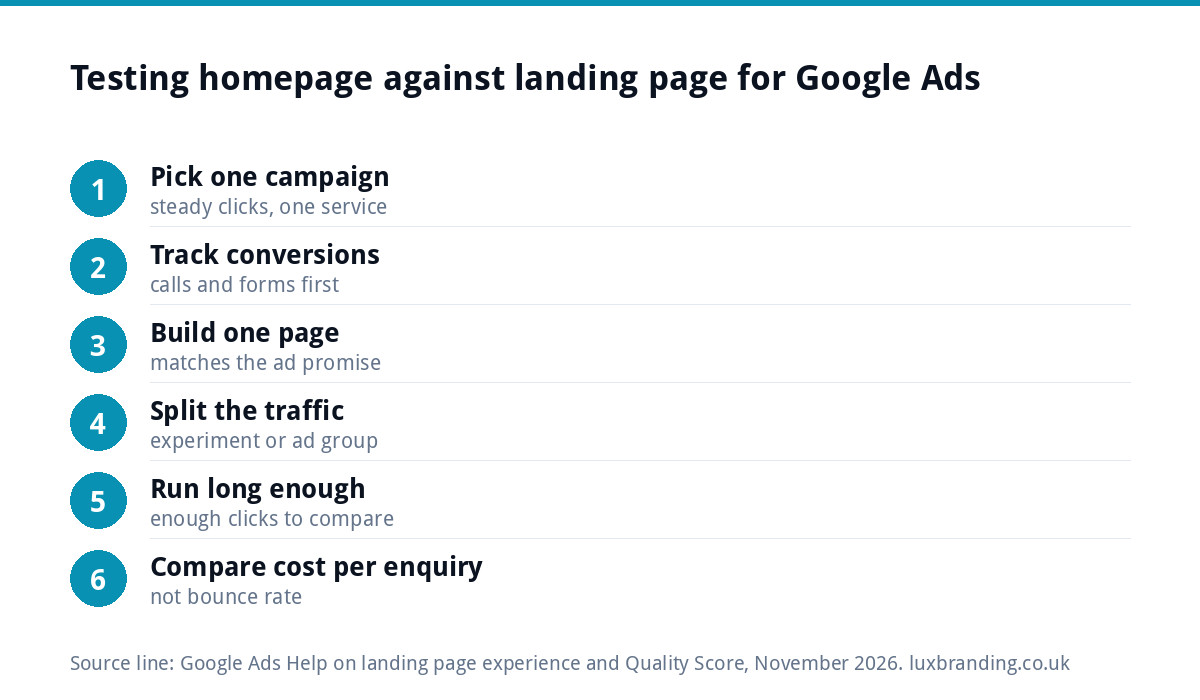
How to test it in your own account
- Pick one campaign with steady clicks, ideally for one service.
- Make sure conversions are tracked for calls and forms first. Without that the test means nothing.
- Build or improve one page that matches the ad’s promise.
- Split the traffic, either with a campaign experiment or by changing the final URL in one ad group and leaving another unchanged.
- Run it for enough clicks to see a difference in enquiries, not just a few days.
- Compare cost per enquiry, not bounce rate. The page that produces cheaper genuine enquiries wins.
Local and trades examples
A roofer running ads for “flat roof replacement” and “gutter cleaning” should not send both to the homepage. Those searchers want different things, at very different prices, and need different reassurance. Two pages, each with its own photos and its own form, will nearly always beat one generic page.
A café advertising a set lunch offer should land on the offer itself, with the price, times and booking link. A bookkeeper advertising “sole trader tax returns” should land on that service, with what is included and a button to book a call. In each case the page continues the conversation the ad started.
Costs and options
You have three routes. You can improve an existing service page, which costs time rather than money. You can add a dedicated page: our landing page design is £199 one-off, built to match your ads. Or, if your whole site is the problem, a one-page website is £299 and a custom WordPress website is £499, both one-off.
Our Google Ads management service covers the account side, and every price is listed on our pricing page. If you are unsure what a fuller rebuild would cost, the website cost calculator gives a figure in a minute.
The short version
Ask one question of every ad: if I clicked this, would the page I land on answer me straight away? If the answer is no, the homepage is costing you leads. Match the page to the promise, keep one clear action, prove the result with tracked enquiries, and the same ad budget will work harder.
Get the UK SEO DIY Audit Checklist (free)
A 32-point checklist UK SMEs can run against their own website in an afternoon. Surfaces the quick wins before paying for a paid audit.
No spam. UK GDPR compliant. We only use your email to send this resource, unless you tick the box to hear from us.
Frequently asked questions
Should I send Google Ads to my homepage? +
Only for searches for your business name, broad queries, or if you offer a single service and your homepage already answers that search clearly on a phone. For most service searches, a page about that specific service, using the ad's wording and one clear call to action, will produce more enquiries for the same spend.
Does the landing page affect Quality Score? +
Yes. Google lists landing page experience as one of three Quality Score components, with expected click-through rate and ad relevance. It reflects how relevant and useful your page is likely to be to people who click the ad. Google describes Quality Score as a diagnostic tool, so use it as a hint about where to improve.
Can a normal service page be my landing page? +
Often, yes. If the page matches the ad, loads quickly on a phone, shows proof and has a clear button or number, it can work well. A dedicated landing page helps when you want tighter wording, fewer exits, a specific offer or a clean way to measure ad traffic separately from everything else.
How many landing pages do I need? +
One per distinct service or offer you advertise, not one per keyword. A roofer advertising flat roofs and gutter cleaning needs two. Ten variations of the same service with a town name swapped are not needed and create near-duplicate pages. Group keywords by intent and give each group the page that answers it.
How much does a landing page cost? +
Our landing page design is £199 one-off, built to match your ads with one clear call to action. A one-page website is £299 and a custom WordPress website is £499, both one-off. Improving an existing service page yourself costs only time, so start there if your current page is close.