
Quick answer
Start with email if you already have past customers: you own the list, messages land in an inbox rather than a feed, and it brings repeat work. Start with social media if you have no customers yet and need to be discovered; opening accounts costs £0. Most small businesses need both, but email usually pays back first.
Owners with limited time often ask which channel to build first, because doing both badly is worse than doing one well. The honest answer depends on where your business is today: how many past customers you have, how people find you, and what you sell. This guide compares the two channels, sets out the UK rules for marketing emails, and gives you a decision table and a 90-day plan you can follow around a full working week.
The core difference: owned versus rented
Your email list is an asset you own. If you change email provider, you take the list with you. When you send a message, it goes to every subscriber’s inbox, subject to spam filtering.
Your social media following is rented. The platform decides who sees each post. Instagram’s own explanation of how its ranking works describes Feed as a mix of posts from accounts you follow, recommended content and ads, ranked by predictions of what each person is likely to interact with. For Reels, it says the majority of what people see comes from accounts they do not follow.
That cuts both ways. Ranking means your followers will not see every post, but it also means people who have never heard of you can discover you. That is social media’s real strength.
Email vs social media: side by side
| Factor | Email marketing | Social media |
|---|---|---|
| Who you reach | People who already know you | Followers, plus new people the platform shows you to |
| Control | You own the list | The platform controls reach and rules |
| Best at | Repeat work, reminders, referrals | Discovery, proof of work, personality |
| Effort | One or two good emails a month | Several posts a week to stay visible |
| Rules | UK consent rules for marketing emails | Platform policies and advertising rules |
| Starting point | Your existing customer list | Zero; you build an audience from scratch |
| Measuring | Replies, clicks, bookings | Reach, engagement, enquiries via messages |
Which to start with, by situation
| Your situation | Start with | Why |
|---|---|---|
| Established trade with years of past customers | Servicing reminders and seasonal check-ins bring repeat work from people who already trust you | |
| Brand new business, no customers yet | Social media, plus a sign-up form | You need to be discovered first; capture emails from day one |
| Online shop | Email, close behind | Order follow-ups, restock news and offers to past buyers usually outperform posts |
| Visual work: cakes, interiors, hair, landscaping | Social media | Before-and-after photos are made for feeds |
| Business-to-business services | Email, with LinkedIn as the social channel | Decisions take months; regular, useful emails keep you in mind |
The UK rules for marketing emails
Email has rules social posting does not, and they are worth knowing before you send anything. The ICO’s guidance on electronic mail marketing says:
- You generally need an individual’s specific consent before sending them marketing emails or texts.
- The “soft opt-in” lets you email existing customers without specific consent if they bought, or discussed buying, a similar product or service from you, you gave them a clear chance to opt out when you collected their details, and you offer an opt-out in every message.
- The soft opt-in does not cover prospects or bought-in lists.
- You must not hide who is sending the message, and you must act on opt-outs.
- Sole traders and some partnerships are treated as individuals.
For most trades, that means your past customers are a legitimate starting list, provided you gave them a way to say no when you took their details and you keep doing so. A list of strangers’ emails is not.
Getting emails delivered
Sending from a business domain is not enough on its own. Google’s email sender guidelines say all senders need SPF or DKIM authentication, and that marketing messages must support one-click unsubscribe. They ask senders to keep spam rates reported in Postmaster Tools below 0.3%. Senders of more than 5,000 messages a day to Gmail accounts must also set up DMARC.
A small business will rarely hit 5,000 a day, but authentication still matters for everyone. If your emails already land in spam, fix that first; our guide to business emails going to spam walks through it.
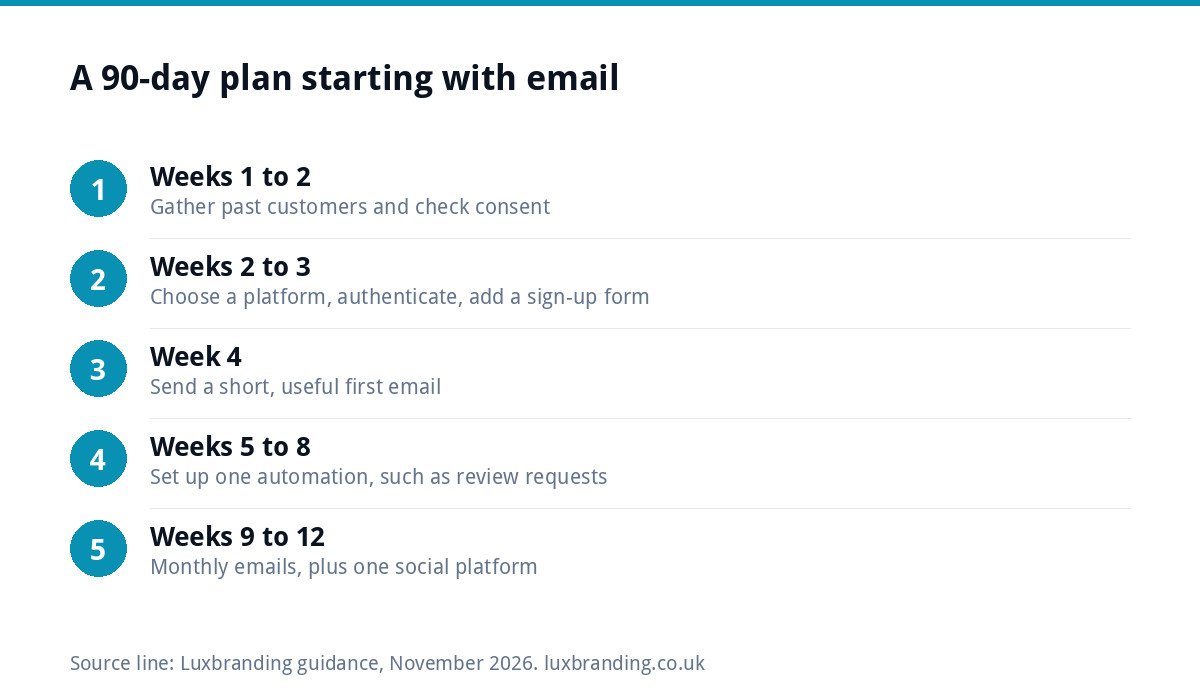
A 90-day plan if you start with email
- Weeks 1 to 2: gather past customers’ details from invoices and your accounts software. Check each one fits the soft opt-in or gave consent.
- Weeks 2 to 3: choose an email platform, authenticate your domain and set up a sign-up form on your website.
- Week 4: send a short, useful first email: a seasonal tip, what you have been working on and a clear way to book.
- Weeks 5 to 8: set up one automation, such as a thank-you and review request after each job.
- Weeks 9 to 12: send one more email a month, and start posting your best job photos on one social platform.
A 90-day plan if you start with social media
- Pick one platform where your customers already spend time, rather than spreading thin across four.
- Post your work two or three times a week: finished jobs, short clips, quick tips.
- Put a sign-up link in your profile, so interested followers can join your email list.
- Reply to every comment and message quickly. Conversations are where enquiries happen.
- From week eight, send your first email to the people who have signed up.
What to send by email without running out of ideas
- Reminders: servicing, inspections, seasonal jobs.
- Useful tips: one practical piece of advice related to your work.
- Recent jobs: a photo and a sentence on what you did.
- Availability: “We have space in March” is honest and effective.
- Referral requests: a simple ask, once or twice a year.
Keep it short, plain and consistent. One useful email a month beats a weekly newsletter you abandon by spring.
How the two channels work together
The strongest setup uses each channel for what it does best. Social media finds new people and shows your work. A sign-up form, on your website and in your profiles, turns interested followers into subscribers. Email then brings those people, and every past customer, back when they need you.
Your website sits in the middle. Both channels should send people to pages that explain your services and make it easy to book or enquire. If your posts and emails look like they come from different businesses, that weakens trust; consistent colours, fonts and tone across both help people recognise you.
Measuring which channel is working
Likes and open rates are easy to see and easy to misread. Judge both channels on what they lead to:
- Enquiries and bookings. Ask every new customer how they found you, and note it in the same place each time. It is the simplest and most reliable measure a small business has.
- Replies. An email that gets three replies asking for a quote has done more than one with a high open rate and none.
- Clicks to your website from emails and from social profiles, which your analytics can show.
- Repeat work. Compare how many past customers came back this year with last year, before and after you started emailing.
Give each channel at least three months before deciding. Both build slowly, and a single quiet month tells you very little.
Mistakes that waste the effort
- Buying an email list. It breaks the consent rules for individuals, damages your sender reputation and rarely produces work.
- Posting only offers. Feeds full of discounts train people to wait for the next one. Show your work and your expertise instead.
- Collecting emails and never sending. A list left for a year goes stale, and people forget they signed up.
- Running every platform at once. Four neglected accounts look worse than one active one.
- Different voices on each channel. Keep the same name, look and tone everywhere, so people recognise you instantly.
Getting set up
We can help with either channel. Our email marketing automation service is the place to start if you would rather have the platform and your first automated emails set up for you. Our social media management runs your accounts, and our social media design templates keep posts on brand if you post yourself. If the website both channels point to needs work, our custom WordPress website is £499 one-off for up to 8 pages, with contact forms connected to your inbox. Every fixed price is on our pricing page.
Get the UK SEO DIY Audit Checklist (free)
A 32-point checklist UK SMEs can run against their own website in an afternoon. Surfaces the quick wins before paying for a paid audit.
No spam. UK GDPR compliant. We only use your email to send this resource, unless you tick the box to hear from us.
Frequently asked questions
Is email marketing better than social media for small businesses? +
Neither is better in every case. Email is usually stronger for repeat work and referrals, because you own the list and messages go to inboxes rather than ranked feeds. Social media is stronger for being discovered by people who have never heard of you. Most small businesses benefit from both, started in the right order.
Can I email my past customers without asking first? +
Often, under the ICO's soft opt-in, if they bought or discussed buying a similar product or service from you, you gave them a clear chance to opt out when you took their details, and every email offers an opt-out. It does not cover prospects or bought lists, and sole traders count as individuals.
How often should a small business send marketing emails? +
Once a month is a sensible, sustainable starting point for most small businesses, with extra emails when there is genuine news such as a seasonal reminder or new availability. Consistency matters more than frequency. Watch replies, clicks and unsubscribes, and adjust if people start opting out after each send.
Which social media platform should I start with? +
Start with the one your customers already use and where your work shows well. Visual trades often suit Instagram or Facebook, local community audiences are strong on Facebook, and business-to-business services usually suit LinkedIn. One platform done consistently beats four done occasionally.
Do I need a website if I use email and social media? +
It helps a great deal. Both channels work best when they send people to pages that explain your services, show your work and make booking or enquiring easy. A website is also the natural home for an email sign-up form, and you control it in a way you never control a social profile.