
Quick answer
If you receive a letter saying your business name infringes someone’s trade mark, do not ignore it and do not reply straight away. Note the deadline, look up their registration on the UK trade mark register, compare their goods and services with yours, then get advice from a trade mark attorney or solicitor before agreeing to anything.
Letters like this are stressful, especially for a small business that has spent years building a name. Disputes like this can often be resolved without court, through a change of name, a transition period or an agreement to coexist. This guide walks through the first steps in order, explains the options, and covers what a rebrand involves if that is where it ends. It is general information, not legal advice.
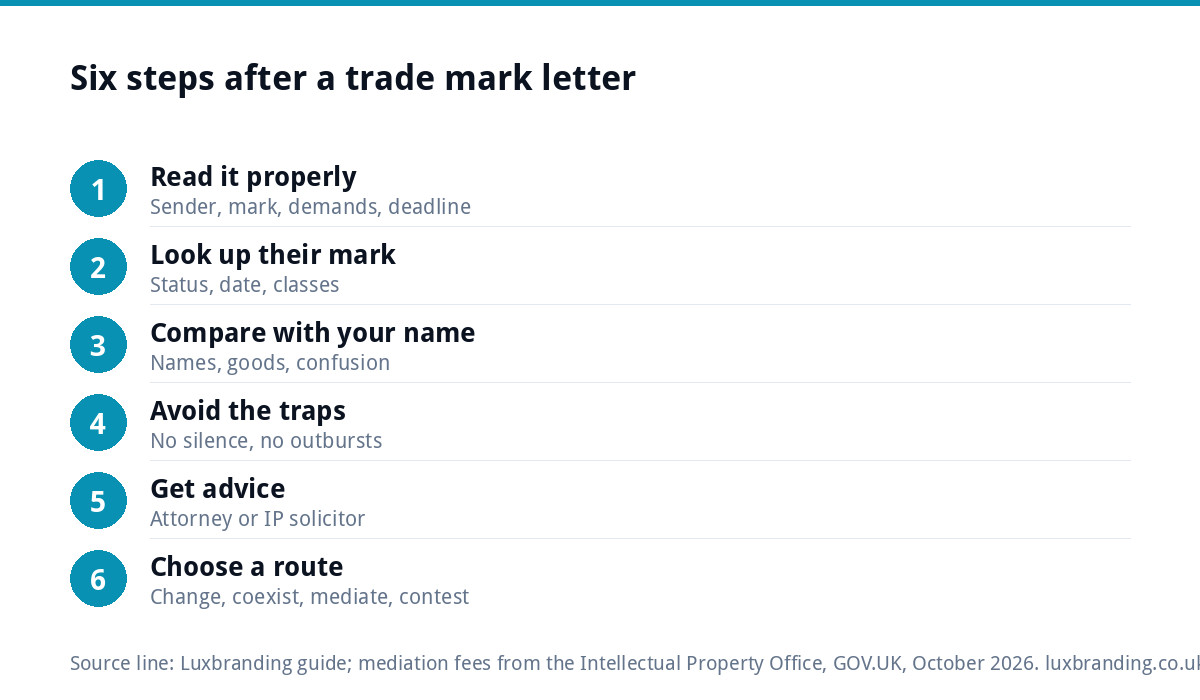
Step 1: read the letter properly
Before reacting, work out exactly what you have received. Four things matter most:
| Look for | Why it matters |
|---|---|
| Who sent it: a solicitor, a trade mark attorney or the business itself | A professional letter usually means the owner is prepared to spend money enforcing it |
| Which trade mark: a registration number, or just “our brand” | A registered mark is much easier for them to enforce than an unregistered name |
| What they want: stop using the name, change it, transfer a domain, pay costs | Defines what you are negotiating about |
| The deadline | Missing it can make things worse; asking for more time is normal |
Some letters are firm but fair. Others ask for far more than the law would give them, such as damages for a small sole trader who has used a name innocently for years. You will not know which you have until you check the facts.
Step 2: look up their trade mark
The UK register is public and free to search. GOV.UK’s search for a trade mark service lets you check whether a mark exists in the UK and who owns it. For the mark named in the letter, note:
- Status: registered, pending, or expired.
- Filing date: compare it with when you started trading under your name.
- Classes and the list of goods and services: a trade mark is registered for particular goods and services, not for everything.
- The exact mark: a word, a logo, or a word in a particular style.
Our guide to logo copyright and trade marks in the UK explains the difference between copyright and a registered trade mark, and how classes work.
Step 3: compare their mark with your name
In broad terms, a trade mark owner has a stronger case when the names are the same or similar, the goods or services are the same or similar, and customers are likely to be confused. Ask yourself honestly:
- Is your name identical to their mark, or just shares a common word?
- Do you sell the same kind of thing, or something unrelated? A plumber and a clothing brand with similar names are in a very different position from two plumbers.
- Has anyone ever confused the two businesses: a misdirected call, an email, a review meant for them?
- Were you using your name before their filing date, and can you prove it with invoices, adverts or a dated website?
Write the answers down with evidence. They are what an adviser will ask for first, and they decide how strong your position is. Gather the earliest dated proof you have: a first invoice, a Companies House record, an old advert, a dated social media post or an archived copy of your website.
Step 4: do not do these things
- Do not ignore the letter. Silence can lead to court action you could have avoided.
- Do not reply angrily or publicly. Posting the letter on social media can make a settlement harder and may create new problems.
- Do not sign anything or agree to pay costs before you have had advice.
- Do not rush to change everything overnight. If a change is needed, a planned transition is usually possible and far cheaper.
It is normal to send a short holding reply saying you have received the letter, are taking advice, and will respond by a stated date. That alone often buys a reasonable extension.
A holding reply you can adapt
If the deadline is close and you have not yet had advice, a short, neutral acknowledgement is usually sensible. Keep it factual and do not admit anything or argue the case:
Dear [name],
Thank you for your letter dated [date] concerning the name [your business name]. We are taking advice on the points you raise and will respond in full by [date, usually two to four weeks away]. Nothing in this letter is an admission of any of the matters you set out.
Yours sincerely,
[name], [business name]
Send it by email and post if the letter arrived both ways, and keep a copy. If they refuse more time, your adviser will want to know straight away.
Step 5: get advice, and know the threats rule exists
A trade mark attorney or a solicitor who handles intellectual property can tell you quickly whether the claim is strong. GOV.UK’s guidance on defending intellectual property describes the usual order for disputes: try to reach an agreement, then use mediation or another form of dispute resolution, with legal action as a last resort, and suggests getting help from an IP professional.
There is also a specific law to be aware of. The Intellectual Property (Unjustified Threats) Act 2017 includes provisions on trade marks. Whether it applies to your letter depends on the details, which is one more reason to have an adviser read it.
Step 6: choose your route
| Route | When it fits | What it involves |
|---|---|---|
| Agree to change, with a transition period | Their claim is strong, or the name is not worth a fight | A written agreement and time to rebrand properly |
| Coexistence agreement | You trade in different sectors or areas and customers are not confused | Both keep the name, with agreed limits |
| Mediation | Both sides want to avoid court | A neutral mediator helps you agree |
| Contest the claim | You used the name first, or the goods are clearly different | Professional representation and evidence |
The Intellectual Property Office runs its own IP mediation service for trade mark and other IP disputes. At the time of writing, October 2026, fees per party start at £75 for a one-hour online session and £152.50 in person, rising with length. The mediator helps both sides reach a solution rather than imposing a decision.
If the answer is a new name
Changing a name is not the end of a business. Done in a planned way, it can be an upgrade: a name you can register, a domain you control and a look that suits where the business is now. Practical order:
- Shortlist new names, then check each one. Our business name checker helps you screen availability, and our guide to business name ideas covers how to find names that work.
- Search the trade mark register for each shortlisted name in your classes before you fall in love with it.
- Secure the domain and social handles.
- Commission the new identity, then roll it out across website, vans, signage, workwear and stationery.
- Tell customers clearly. Our guide on how to announce a rebrand covers the wording and timing.
- Consider registering the new name as a trade mark yourself, so you are the one with the registration next time.
What a forced rebrand costs
The cost depends on how much carries your current name. A sole trader with a website and a van has far less to change than a firm with a fleet, shopfront and printed stock. Our guide to rebranding costs in the UK breaks it down. For reference, our logo design is £129 with unlimited concepts and all layouts included, our brand identity design is £299 and covers the logo, colours, typography, imagery and brand guidelines, and our full rebrand package is £1,999.
Preventing the next letter
Most of these disputes start because nobody searched the register before choosing a name. If you are naming anything new, a product, a second business or a sub-brand, search first, choose something distinctive rather than descriptive, and register it if it matters to you. If you have already applied to register a mark and received an objection from the Intellectual Property Office itself, that is a different process; see our guide to a trade mark objection. Every fixed price we offer is on our pricing page.
Get the UK Branding Budget Worksheet (free)
A printable worksheet: decide what your brand needs now and price it against fixed published prices and the IPO trademark fee.
No spam. UK GDPR compliant. We only use your email to send this resource, unless you tick the box to hear from us.
Frequently asked questions
What should I do if I get a trade mark infringement letter? +
Do not ignore it and do not reply in anger. Note the deadline, look up the mark on the UK trade mark register, compare its goods and services with yours, gather evidence of when you started using your name, and get advice from a trade mark attorney or IP solicitor before agreeing to anything or paying costs.
Can someone stop me using my business name? +
Possibly, if they hold a trade mark for the same or a similar name covering the same or similar goods or services and customers are likely to be confused. Using your name first, trading in a different sector, or the absence of any confusion can all strengthen your position. An adviser can assess your specific facts.
How do I check if a name is trade marked in the UK? +
Use the free search for a trade mark service on GOV.UK. It shows whether a similar mark already exists in the UK, who owns it, its status and filing date, and the classes of goods and services it covers. Check the classes carefully, as a mark is registered for particular goods and services, not everything.
Is there a cheaper alternative to going to court? +
Yes. Many disputes settle by agreement, with a transition period or a coexistence agreement. The Intellectual Property Office also runs a mediation service for IP disputes; at the time of writing, fees per party start at £75 for a one-hour online session and £152.50 for one hour in person.
How much does a rebrand cost if I have to change my name? +
It depends on how much carries your name. With Luxbranding, logo design is £129 with unlimited concepts and all layouts included, brand identity design is £299 covering logo, colours, typography, imagery and guidelines, and our rebrand package is £1,999. Signage, vans and printed stock are extra costs to plan for separately.