
Quick answer
If customers already search for what you do, start with SEO: it puts you in front of people who are ready to buy, and the work keeps paying for months. Start with social media if your product needs to be seen to be wanted. SEO with us is £249 a month; doing either yourself costs mainly time.
Most small businesses cannot do both well from day one, so the useful question is which comes first. The answer depends less on which channel is “better” and more on how your customers behave before they buy. Below we compare the two honestly, give six ways to decide, a table by business type and a sensible order for the first six months.
The core difference: looking vs scrolling
Search and social reach people in completely different states of mind.
- Search captures demand. Someone types “emergency electrician Leeds” or “wedding cake Bath” because they need it now. If you appear, you are answering a question they have already asked.
- Social creates demand. Someone scrolling Instagram was not looking for you. A good post makes them want something they had not planned to buy, or remember you for later.
Neither is better in general. A boiler repair firm lives on search, because nobody scrolls social media hoping to see a boiler. A cake maker or a garden designer can win on social, because the work sells itself visually and people enjoy looking at it.
Side by side
| Question | SEO | Social media |
|---|---|---|
| Who you reach | People actively searching for what you do | Followers and people the platform chooses to show you to |
| How fast it starts | Weeks to months | Days, if a post lands |
| How long a piece of work lasts | A good page can keep bringing visits for years | Most posts fade within days |
| Cost shape | Upfront effort, then upkeep | Constant effort to stay visible |
| Who controls reach | Google, through rankings | Each platform, through its feed |
| Best for | Services people search for, local trades, considered purchases | Visual products, events, community, brand awareness |
Speed: why SEO feels slow
SEO is not instant, and anyone promising page one next week is guessing. Google’s SEO starter guide says some changes can take effect in a few hours while others could take several months, and suggests waiting a few weeks before judging whether your work had a beneficial effect.
That delay is the price of the main benefit: once a page ranks for a search people make every month, it keeps bringing visitors without you posting anything new. Social media is the opposite. A post can reach people today, but next week you need another one.
Reach: who decides who sees you
On social media, the platform decides. Instagram’s own explanation of ranking says there is no single algorithm: Feed, Stories, Explore and Reels each use their own, based on what people are predicted to engage with. Explore and Reels mostly show content from accounts the viewer does not follow, which is how new people discover you, but you cannot control when that happens.
On search, Google decides too, but on a different basis. Its guidance on creating helpful, people-first content says its systems aim to favour helpful, reliable information created to benefit people rather than to manipulate rankings. For a small business, that means clear service pages, real photos, honest prices and answers to the questions customers ask. That is work you control.
What each costs
Both channels cost money or time, usually both.
- DIY SEO: your time to write service pages, keep your Google Business Profile up to date and fix technical problems. Our guide to how much SEO costs in the UK compares DIY, freelance and agency routes.
- Paid SEO: our SEO service is £249 a month and covers rankings, content, technical health, link building and reports.
- DIY social: the hours to plan, shoot, post and reply. Consistency matters more than polish, so be honest about how many hours a week you can give it.
- Managed social: our social media marketing management service takes that work on for you, if you would rather spend the hours running the business.
The hidden cost on social is that the effort never stops. The hidden cost on SEO is the wait before you see a return.
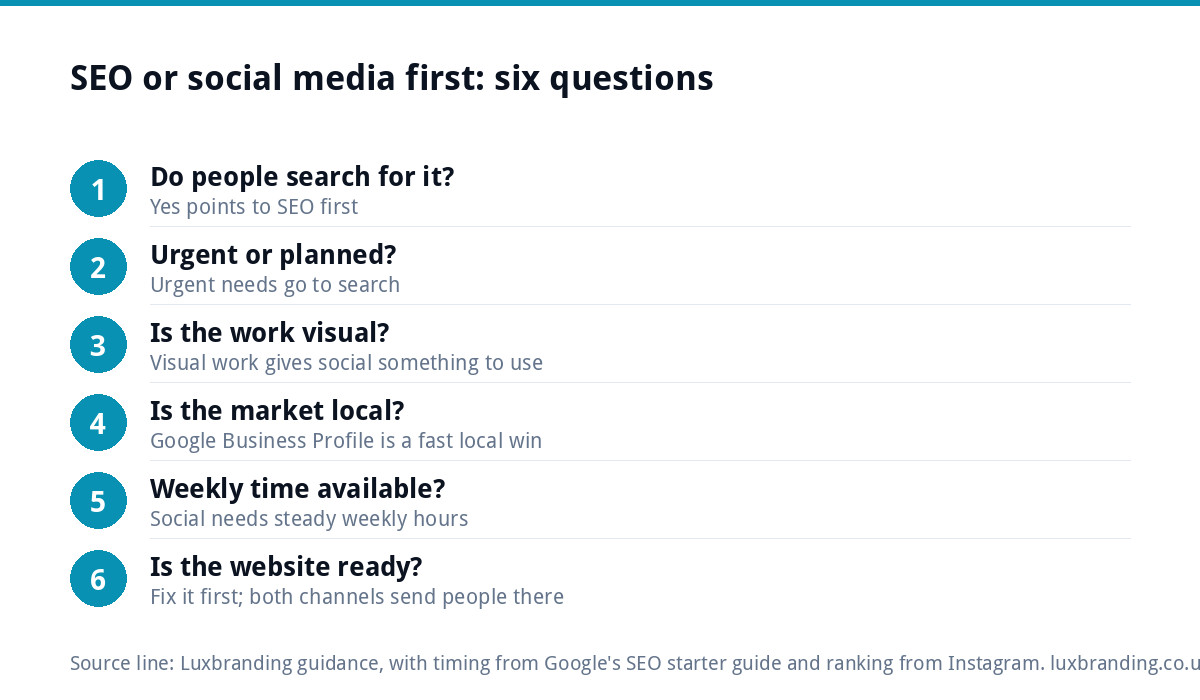
Six ways to decide which comes first
- Do people search for what you sell? Type your main service and town into Google. If competitors appear and there are ads at the top, the demand exists, and SEO should come first.
- Is the purchase urgent or planned? Urgent needs such as a leaking roof or a locked-out customer go to search. Planned, emotional purchases such as a kitchen, a wedding or a gift often start on social.
- Is your work visual? If before-and-after photos make people stop scrolling, social has something to work with.
- Is your market local? Local businesses get a fast SEO win from a well-run Google Business Profile, often quicker than building a following.
- How much time do you have each week? Social needs steady weekly time. SEO needs a burst of effort up front, then a lighter rhythm.
- What does your website look like? Both channels send people to your site. If it is slow, out of date or does not explain your prices, fix that first, or every visitor from either channel is wasted.
Which first, by business type
| Business | Start with | Then add |
|---|---|---|
| Plumber, electrician, roofer, locksmith | Local SEO and Google Business Profile | Social for job photos and trust |
| Accountant, solicitor, consultant | SEO with clear service pages | LinkedIn posts that show expertise |
| Cake maker, florist, garden designer | Social media | SEO for “near me” and occasion searches |
| Online shop with a visual product | Social, plus product-page SEO | Email to bring buyers back |
| Cafe, salon, gym | Google Business Profile | Social for community and offers |
| B2B supplier to trades | SEO for product and trade searches | LinkedIn for relationships |
The fastest SEO win for local firms
For local service businesses, the quickest search visibility usually comes from the Google Business Profile, not the website. The map listings often sit above the ordinary results for local searches. A complete profile with the right categories, real photos and steady reviews can start bringing calls sooner than new website pages. Our guide to Google Business Profile optimisation covers it step by step.
If your site does not appear on Google at all, start with our guide to a website not showing on Google, because no amount of content helps a site Google cannot index.
A sensible first six months
- Month 1: fix the website basics and complete your Google Business Profile. Run our free SEO audit to see what is holding the site back.
- Months 1 to 3: write or improve one page for each main service and area you cover. Ask every happy customer for a Google review.
- Months 2 to 6: pick one social platform where your customers actually spend time, and post on a schedule you can keep. One platform done well beats three done badly.
- Month 6: check which channel brought enquiries, using your analytics and by asking every new customer how they found you. Put more effort where the enquiries came from.
How to tell which one is working
Likes and impressions are not enquiries. Before you judge either channel, set up a few simple ways to see where customers really come from:
- Website analytics: check how many visits come from organic search and how many from each social platform, and which pages they land on.
- Google Business Profile performance: calls, direction requests and website clicks from your listing are search results doing their job.
- Tagged links: add a tracking tag to the link in your social bios, so visits from them show up clearly in analytics.
- Ask every enquiry: “How did you find us?” on the phone or as a field on your contact form. It is low-tech and still the most reliable signal a small business has.
Review the numbers monthly, not daily. Both channels move in weeks, and a single good or bad week tells you very little.
Where we fit
If search is your first channel, our SEO service is £249 a month for rankings, content, technical health, link building and reports, and our guide to SEO costs explains what to expect from any provider. If social suits you better, our social media management service handles the posting so you can get on with the work. Every price we publish is on our pricing page.
Whichever you choose, a clear brand makes both channels work harder: the same name, colours and photos on your Business Profile, website and social accounts help people recognise you the second time they see you. Our guide to branding for trades businesses shows how to get that consistency without overspending.
Get the UK SEO DIY Audit Checklist (free)
A 32-point checklist UK SMEs can run against their own website in an afternoon. Surfaces the quick wins before paying for a paid audit.
No spam. UK GDPR compliant. We only use your email to send this resource, unless you tick the box to hear from us.
Frequently asked questions
Is SEO or social media better for a small business? +
It depends on how your customers buy. If people search for what you sell, especially urgent local services, SEO usually comes first because it reaches people ready to buy. If your product is visual or emotional and people discover it while scrolling, social media can work faster. Most businesses end up using both, one after the other.
How long does SEO take to work? +
Google's SEO starter guide says some changes can take effect in a few hours while others could take several months, and suggests waiting a few weeks before judging results. For a small business, the Google Business Profile often brings local visibility sooner than new website pages. Treat SEO as a months-long investment, not a quick switch.
Why does my social media reach go up and down? +
Each platform decides who sees each post. Instagram says it has no single algorithm: Feed, Stories, Explore and Reels each rank content their own way, based on what people are predicted to engage with. That makes reach unpredictable from post to post, which is why consistent posting matters more than any single post.
How much does SEO cost with Luxbranding? +
Our SEO service is £249 a month and covers rankings, content, technical health, link building and reports. If you would rather start yourself, our free SEO audit shows what is holding your site back, and our guide to SEO costs in the UK compares DIY, freelance and agency routes.
Should a tradesperson focus on SEO or social media? +
For most trades, local SEO and a well-run Google Business Profile come first, because customers search when they need a plumber, electrician or roofer. Social media then helps with trust: photos of finished jobs, before-and-after shots and reviews give people confidence once they have found you. Start with search, then add one social platform you can keep up.