Quick answer
Decide what inactive means first, typically no clicks for six months or more. Then send two or three short emails asking whether they still want to hear from you, with one easy button to stay subscribed. Remove anyone who does not respond. Gmail’s own sender guidance suggests considering removing recipients who do not open your messages.
Most small business email lists slowly fill with people who signed up once and stopped paying attention. They do not unsubscribe; they just ignore you. That quiet section of the list drags down your results and can push your emails towards the junk folder. This guide sets out a simple win-back plan: how to spot inactive subscribers, a three-email sequence with example wording, the legal points for UK businesses and what to do with the people who never reply.
Why inactive subscribers cost you
An unengaged subscriber looks harmless, but they cost you in three ways:
- Deliverability. Inbox providers watch how people react to your emails. Lots of ignored messages, and the occasional spam complaint from someone who forgot signing up, make your mail look less wanted.
- Money. Many email platforms charge by the number of contacts, so you pay to email people who never read.
- Misleading numbers. A big list with low engagement hides how well your emails do with the people who actually care.
Google is explicit about this. Its email sender guidelines advise sending email only to people who want it, periodically checking that subscribers want to stay on your list, and considering removing recipients who do not open or read your messages. It also sets a spam complaint rate to aim below (0.10%) and a level never to reach (0.30%).
Define “inactive” before you do anything
The right definition depends on how often you send. A business emailing weekly can judge inactivity sooner than one sending a seasonal newsletter four times a year. As general guidance, look for six months or more with no meaningful activity, or the last several campaigns ignored, whichever is longer.
| Signal | How reliable it is | Use it for |
|---|---|---|
| Clicked a link | Strong: a real person acted | Your main measure of active |
| Replied to an email | Strong | Always counts as active |
| Bought or booked since signing up | Strong | Keep them; they are customers |
| Opened an email | Weak: some email apps load emails automatically for privacy reasons, which records an “open” nobody made | A supporting hint only |
| Signed up recently | Not enough data yet | Leave out of win-back for now |
Exclude recent sign-ups and recent customers from the inactive segment, then export it so you have a record of who was included.
The three-email win-back sequence
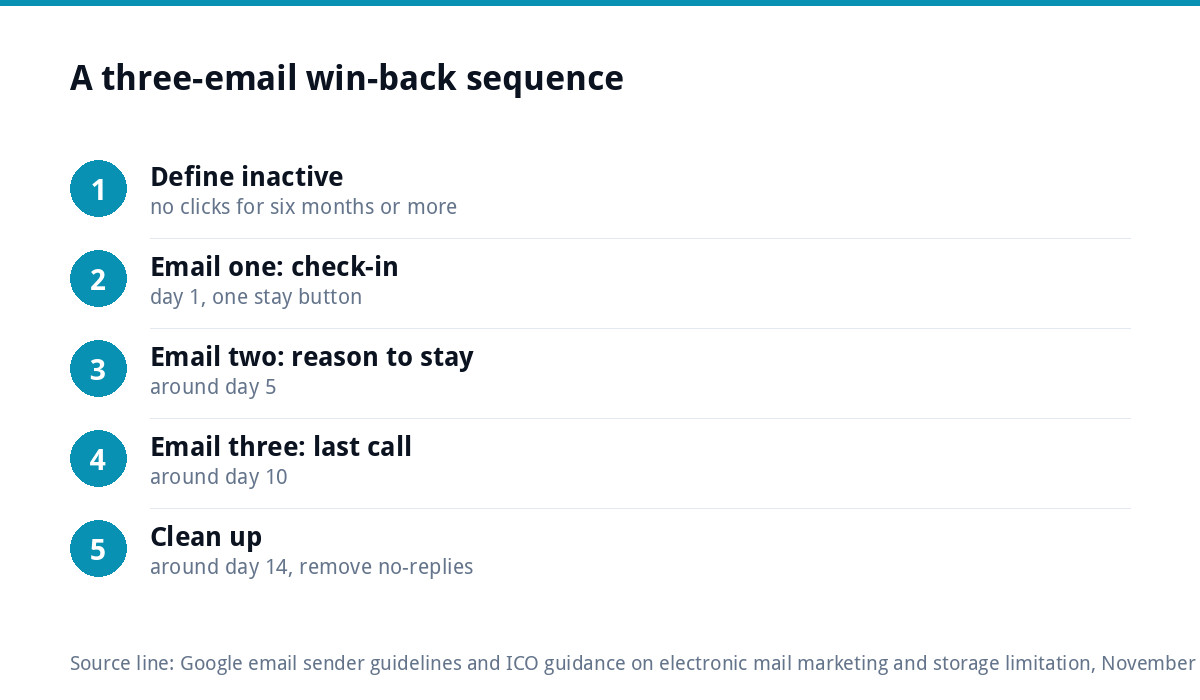
- Email one, the check-in (day 1). Friendly, short, honest: you have not heard from them in a while, here is what they have missed, do they still want your emails? One clear “Yes, keep me subscribed” button.
- Email two, the reason to stay (around day 5). Something genuinely useful: a seasonal tip, a short guide, a preview of what is coming, or an offer if it suits your business. The same button.
- Email three, the last call (around day 10). A plain message saying this is the last email unless they click to stay. People respond to a clear deadline.
- Clean up (around day 14). Anyone who clicked goes back to the main list. Everyone else is removed or suppressed.
Three emails is usually enough. More than that turns a polite check-in into pestering, which risks the spam complaints you are trying to avoid.
What to write: subject lines and copy
Plain, human wording works better than clever wording. Write as the business, the way you would speak to a customer at the counter.
- “Do you still want to hear from us?”
- “Should we keep sending you our seasonal tips?”
- “Is this goodbye? (One click keeps you on the list)”
- “Last email from us unless you say otherwise”
In the body, keep it to a few lines. Say who you are, because they may have forgotten, remind them how they joined, and make the stay button big and obvious. Offer a way to receive fewer emails if your platform supports it, because some people go quiet because you send too often, not because they have lost interest.
If your business has changed since they signed up, such as a new name, look or service, say so. Our guide to announcing a rebrand to customers covers that conversation.
The offer question: discount or not?
A discount in email two can lift responses, but it also teaches people that going quiet earns a reward. It suits shops and businesses with repeat purchases, where a returning customer is worth the margin. For trades and service firms, something useful usually works as well: a maintenance reminder, a seasonal checklist or advance notice of booking slots.
If you do offer something, send people to a simple page built for it rather than your homepage. A focused landing page makes the offer and the action obvious.
Consent and the law
A win-back email is still a marketing email, so the normal UK rules apply. The ICO’s guidance on electronic mail marketing says you need specific consent to email individuals unless the soft opt-in for existing customers applies, and that you must offer a simple way to opt out in every message and act on it promptly.
There is also a data angle. The ICO’s storage limitation principle says personal data should not be kept longer than you need it, and that you should periodically review what you hold and erase or anonymise data you no longer need. A regular list clean-up is a practical way of doing that. This is general information, not legal advice.
A worked example: a dog groomer’s list
Picture a dog grooming salon with a newsletter built up over a few years from its booking form and a sign-up sheet at the counter, with consent recorded for each. It sends a short email every month with booking reminders and seasonal coat-care tips. Looking at the list, a large share of contacts have not clicked anything in the last six months, and many of those are former clients whose dogs have moved on, or people who signed up for one offer and never returned.
The salon excludes anyone who booked in the last year, then sends the three-email sequence to the rest: a friendly check-in with a photo of the salon, a useful winter paw-care tip with a “keep me posted” button, and a short last call. A minority click to stay and are welcomed back. The rest are removed and kept only as a suppression record. The next monthly email goes to a smaller list, and the share of people clicking it rises because the list is now made of people who want it.
Remove, suppress or keep?
| Response | What to do |
|---|---|
| Clicked “keep me subscribed” | Return to the main list; count them as active from today |
| Clicked the offer or a link but not the button | Treat as active |
| Unsubscribed | Suppress permanently and never email again |
| Marked as spam | Suppress permanently |
| No response to any of the three | Remove from marketing, or keep only as a suppressed record so they are not re-added by accident |
Your list will be smaller afterwards. That is the point: a smaller list of people who want your emails usually gets better results than a bigger list of people who ignore them.
Preventing the next wave of inactivity
- Send a welcome email straight after sign-up, while people remember who you are.
- Keep a steady rhythm. Long silences followed by a burst of offers are a common cause of complaints.
- Make every email useful, not just a sales message.
- Look consistent. Emails that match your website and van are recognised faster in a busy inbox. Our brand identity design includes the colours and type to make that easy.
- Run a check-in once or twice a year, rather than letting a large inactive group build up.
Measuring whether it worked
Track three things before and after: how many people clicked in your next few regular campaigns, your spam complaint rate in your email platform or Google Postmaster Tools, and how many emails land in inboxes rather than junk if your platform reports it. If more of your emails were reaching junk before the clean-up, our guide to business emails going to spam covers the technical checks that go alongside it.
Where we fit
Our email marketing and automation service sets up sequences like this once, so they run on their own: welcome emails, win-back emails and the clean-up rules behind them. You can see all our prices on the pricing page, and order online or email us at support@luxbranding.co.uk to talk through your list.
Get the UK SEO DIY Audit Checklist (free)
A 32-point checklist UK SMEs can run against their own website in an afternoon. Surfaces the quick wins before paying for a paid audit.
No spam. UK GDPR compliant. We only use your email to send this resource, unless you tick the box to hear from us.
Frequently asked questions
When is an email subscriber considered inactive? +
It depends on how often you send. As general guidance, someone who has not clicked, replied or bought for six months or more, or has ignored your last several campaigns, is inactive. Leave out people who signed up recently. Opens are a weak signal, because some email apps record opens automatically for privacy reasons.
How many emails should a re-engagement campaign have? +
Two or three is usually enough: a friendly check-in, a reason to stay such as something useful or an offer, and a clear last call. Space them a few days apart. More than three starts to feel like pestering, which can trigger the spam complaints you are trying to reduce.
Should I delete subscribers who do not respond? +
Usually yes, from your marketing list. Gmail's sender guidelines suggest considering removing recipients who do not open or read your messages, and the ICO's storage limitation principle says not to keep personal data longer than you need it. Keep a suppression record so they are not re-added by accident.
Is it legal to send a re-engagement email in the UK? +
Yes, if you had valid consent or the soft opt-in applied when they joined, because it is a normal marketing email. ICO guidance says you must offer a simple way to opt out in every message and act on it promptly. This is general information, not legal advice, so check your own sign-up records.
Should I offer a discount to win subscribers back? +
It can lift responses, especially for shops with repeat purchases, but it can also teach people that going quiet earns a reward. Service businesses often do just as well with something useful, such as a seasonal checklist, a maintenance reminder or early notice of booking slots, sent to a simple focused page.