Quick answer
To set up as a sole trader in the UK, choose a business name, keep records from your first job and register for Self Assessment with HMRC once you earn more than £1,000 in a tax year. Registering is free on GOV.UK. Tell HMRC by 5 October after the tax year you first need to report.
Being a sole trader is the simplest way to run a business in the UK, which is why so many plumbers, electricians, cleaners, gardeners and freelancers start this way. This guide walks through the official steps in order, the paperwork you need, what it costs (very little) and the few things worth sorting in week one so your business looks established from the first quote.
What a sole trader actually is
A sole trader is you, working for yourself, with no separate legal entity. GOV.UK describes it as the simplest business structure to set up and keep records for. You make the decisions, you keep the profit after tax, and you can run it as your only job or alongside employment.
The trade-off is liability. GOV.UK is clear that owners are personally responsible for all of the debts of the business. If a job goes badly wrong or a supplier is not paid, your own savings and assets are exposed. That is the main reason some people later move to a limited company, but for most new trades and service businesses the sole trader route is the sensible starting point.
Sole trader setup in seven steps
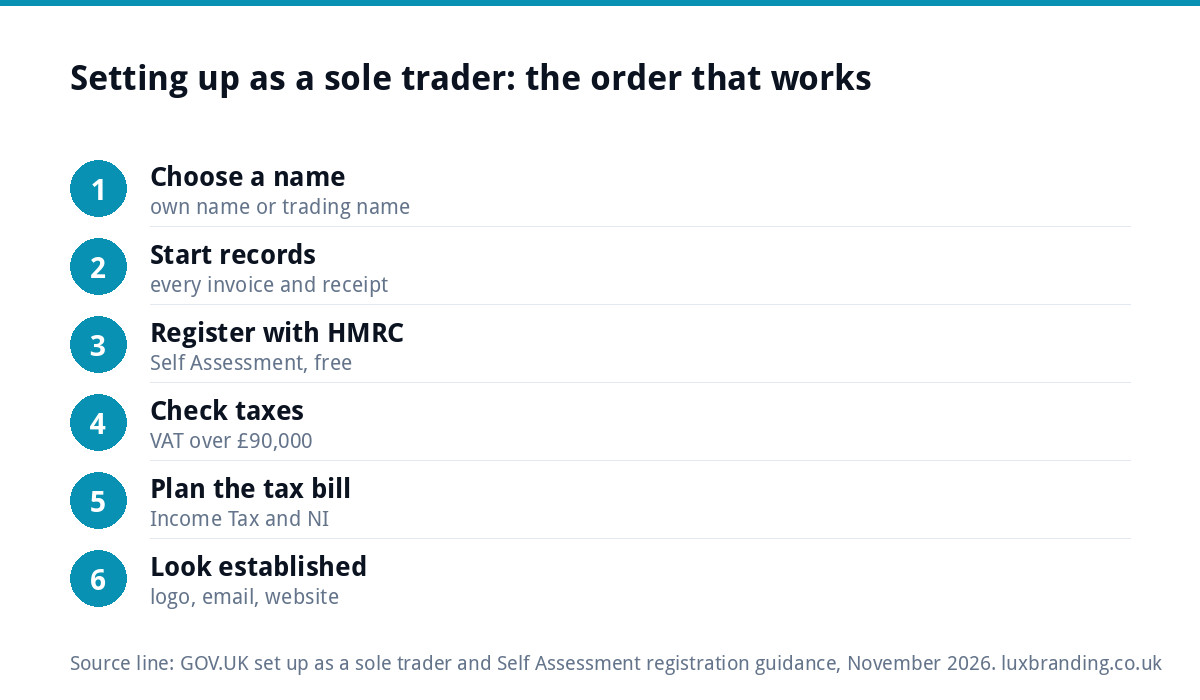
GOV.UK sets out the process as a step-by-step guide. Here it is in the order that works in practice:
- Check a sole trader suits you. Compare it with a limited company if you expect large contracts, staff or significant risk.
- Choose your business name. You can trade under your own name or a trading name.
- Set up your records. Keep every invoice, receipt and bank transaction from day one.
- Register as a sole trader by registering for Self Assessment with HMRC.
- Check which taxes apply, including VAT if your turnover grows.
- Plan for your tax bill. You pay Income Tax and National Insurance on your profits.
- Get help and support where you need it, such as an accountant or bookkeeper.
None of these steps needs a paid service. Formation agents sell “sole trader registration” packages, but HMRC registration itself costs nothing.
Choosing a business name that works
As soon as you start working for yourself you should choose a name. The GOV.UK naming rules for sole traders say your name must not include “limited”, “Ltd”, “LLP” or “plc”, must not be offensive and must not be too similar to another company’s trade mark. You must also show your own name and your business name on documents such as invoices and letters.
There is no register of sole trader names, so nobody else is stopped from using the same one. That makes a quick check worthwhile before you spend money on vans, workwear or a website. Our free business name checker looks at domains and the company register in one go, and our guide to business name ideas covers how to pick a name customers remember.
A practical test: say the name down the phone. If you have to spell it twice, customers will struggle to find you on Google.
Registering with HMRC for Self Assessment
Registration is how HMRC knows you exist as a sole trader. GOV.UK states that you must register for Self Assessment as a sole trader if you earn more than £1,000 in a tax year, which runs from 6 April to 5 April. You can start trading before you register, and you can register earlier if you prefer.
The deadline matters. HMRC’s registration page says you must tell HMRC by 5 October after the end of the tax year you need to file for. For the tax year ending 5 April 2026, that means by 5 October 2026. Telling HMRC late can lead to a penalty.
Once registered, you receive a Unique Taxpayer Reference (UTR) and file a Self Assessment tax return each year, reporting your income and allowable expenses.
What it costs to start as a sole trader
The legal setup is free. The real start-up costs are the things that let you trade properly. This table separates the two.
| Item | Required? | Typical cost |
|---|---|---|
| HMRC Self Assessment registration | Yes, once over £1,000 a year | Free |
| Business bank account | Recommended, not legally required | Varies by bank, many free |
| Bookkeeping app or spreadsheet | Records are required; the tool is your choice | Free to a monthly subscription |
| Public liability insurance | Often asked for by customers and sites | Quote from insurers |
| Logo and brand basics | Optional, but customers judge on it | Our Logo Design is £129 |
| Website | Optional, but expected for most trades | Our One-Page Website is £299 |
Avoid paying a third party for a “registration certificate”. HMRC does not issue one, and the registration is free.
Records you must keep
GOV.UK says you must keep records once you start trading, because they are how you work out your profit or loss for your tax return. In practice that means:
- Every sales invoice and payment received
- Receipts for materials, tools, fuel and other business costs
- Bank statements, ideally from a separate business account
- Mileage logs if you claim for vehicle use
- Records of money you take out for yourself
Keeping these tidy from week one saves hours at tax-return time and makes it obvious which jobs actually pay.
The other habit worth starting now is a tax pot. Nobody deducts tax from your earnings as a sole trader, so the bill arrives in one go after the tax year ends. Moving a fixed share of every payment into a separate savings account, at a level agreed with your accountant, means the bill is already sitting there rather than coming out of next month’s materials budget.
Making Tax Digital is coming for sole traders
Making Tax Digital for Income Tax changes how many sole traders report. HMRC’s eligibility guidance sets the start dates by qualifying income:
| Start date | Qualifying income | Based on tax year |
|---|---|---|
| 6 April 2026 | Over £50,000 | 2024 to 2025 |
| 6 April 2027 | Over £30,000 | 2025 to 2026 |
| 6 April 2028 | Over £20,000 | 2026 to 2027 |
If you are starting out now, choose bookkeeping software that supports Making Tax Digital so you are not switching systems mid-year when your income crosses a threshold.
VAT, and when it applies
Most new sole traders do not need to register for VAT straight away. GOV.UK says you must register if your total taxable turnover for the last 12 months goes over £90,000. You can register voluntarily below that, which can make sense if most of your customers are VAT-registered businesses and you buy a lot of materials. For domestic customers, staying below the threshold keeps your prices lower. Check the rules with an accountant before you decide.
Look established from the first quote
Registration makes you legal. It does not make customers trust you. A homeowner choosing between three quotes often picks the one that looks most organised: a proper logo on the van and invoice, a matching business card and a website that shows real jobs. Our guide to branding for trades businesses covers where to spend first.
For most new sole traders, the order is:
- A logo you own outright, supplied in every file format. Our Logo Design is £129 one-off, with unlimited concepts and stacked, horizontal and icon-only layouts included.
- A domain name and a business email address. See our UK domain names guide.
- A simple website. A One-Page Website at £299 covers most new trades.
- Full brand identity later, once you know your market. Our Brand Identity Design is £299.
All our prices are listed on the pricing page.
Sole trader now, limited company later?
You can start as a sole trader and form a limited company later. The usual triggers are rising profits, bigger commercial contracts that ask for a company, taking on staff or wanting to separate personal and business risk. Moving does not mean starting again with your branding: your logo, website and reputation carry over, though invoices and paperwork need the new company details.
Your first-week checklist
- Pick and check your business name
- Open a separate bank account
- Set up a simple record-keeping system
- Register for Self Assessment once you expect to pass £1,000 in a tax year
- Arrange insurance suited to your trade
- Get a logo and business email so quotes look professional
Do these in order and you are trading legally, with the paperwork in place, before the first invoice goes out.
Get the UK Branding Budget Worksheet (free)
A printable worksheet: decide what your brand needs now and price it against fixed published prices and the IPO trademark fee.
No spam. UK GDPR compliant. We only use your email to send this resource, unless you tick the box to hear from us.
Frequently asked questions
Does it cost anything to register as a sole trader? +
No. Registering for Self Assessment with HMRC is free on GOV.UK. Some formation agents charge for a sole trader registration service, but you can do it yourself in one sitting. Your real start-up costs are things like insurance, bookkeeping software, a logo and a website, none of which HMRC requires you to buy.
When do I have to register as a sole trader? +
GOV.UK says you must register for Self Assessment if you earn more than £1,000 in a tax year, which runs from 6 April to 5 April. You must tell HMRC by 5 October after the end of the tax year you need to file for. You can start trading first and register earlier if you prefer.
Can I be a sole trader and employed at the same time? +
Yes. GOV.UK says you can run a sole trader business as your only job or alongside employment. Your employer keeps deducting tax through PAYE on your wages, and you report your self-employed profits separately through your Self Assessment tax return each year. Keep your business income and costs in separate records.
Do I need to register my business name as a sole trader? +
There is no official register of sole trader names. You can trade under your own name or a trading name, but GOV.UK says it must not include Ltd, LLP or plc, must not be offensive and must not be too similar to a trade mark. Show your own name and business name on invoices and letters.
What branding does a new sole trader need first? +
Start with a logo you own in every file format, then a domain and business email, then a simple website. Our Logo Design is £129 one-off with all layouts included, and our One-Page Website is £299. Full brand identity at £299 can wait until you know your market and customers.