
Quick answer
Registering a limited company with Companies House costs £100 online, paid by card, and the company is usually registered within 24 hours. A postal application on form IN01 costs £124 and takes 8 to 10 days. You need a company name, a registered office address, at least one director, a shareholder and a SIC code.
You do not need a formation agent to do this, although many people use one. This guide covers what Companies House asks for, the identity checks for directors, the naming rules that trip people up, the cost of each route and what to set up in the first month so your new company looks the part on every invoice and quote.
Online or by post: cost and timing
The GOV.UK registration page sets out two routes. At the time of writing, November 2026, the figures are:
| Route | Fee | Payment | Typical time | Best for |
|---|---|---|---|---|
| Online with Companies House | £100 | Debit or credit card | Usually within 24 hours | Almost everyone |
| By post on form IN01 | £124 | Cheque to Companies House | 8 to 10 days | Names without “Limited”, unusual articles |
| Through a formation agent | Agent’s fee plus filing | Set by the agent | Varies | Bundled extras such as an address service |
GOV.UK notes one reason to use the postal route: if you do not want “limited” in your company name, you must register by post. For most small businesses, the online route is faster and cheaper.
What you need before you start
Gather these before you open the form. It saves the frustration of a half-finished application timing out.
| Requirement | What GOV.UK asks for | Tip |
|---|---|---|
| Company name | Must meet the naming rules | Check the register and domains first |
| Registered office address | An official address for the company | It appears on the public register |
| Directors | At least one | Each may need to verify identity |
| Shareholders | At least one for a company limited by shares | Can be the same person as the director |
| SIC code | A code describing what the company does | Pick the closest match to your main trade |
| Memorandum and articles | How the company will be run | Model articles suit most small firms |
| People with significant control | Confirmed during registration | Usually the owners |
| Government Gateway | A user ID and password for the company | Keep the login safe for annual filings |
Identity checks for directors
Companies House now asks people to verify their identity. GOV.UK says you may need to verify using GOV.UK One Login, after which you receive a personal code. If your company has more than one director, you need each director’s personal code to complete the registration. You only verify once, and if you already have a code it sits in your Companies House account.
Build a day or two into your plans for this step, especially if a co-director is slow with paperwork.
Company name rules that catch people out
Naming is where most new companies get stuck. The GOV.UK naming guidance sets the rules:
- The name usually ends in “Limited” or “Ltd” (Welsh companies can use “Cyfyngedig” or “Cyf”).
- It cannot be the same as another registered company’s name.
- “Same as” includes names that differ only by punctuation, special characters or common terms. GOV.UK’s example: “Hands UK Ltd” and “Hand’s Ltd” count as the same as “Hands Ltd”.
- If someone complains that your name is too like theirs, and Companies House agrees, you may have to change it.
- Offensive names are not allowed, and “sensitive” words such as “Accredited” need permission.
- A name too similar to another company’s trade mark may need to change if someone complains.
That last point matters more than people expect. Registering a company name does not give you a trade mark, and owning a trade mark is what protects your brand. Our guide to logo copyright and trade marks in the UK explains the difference. Run your shortlist through our free business name checker before you commit.
Registering step by step
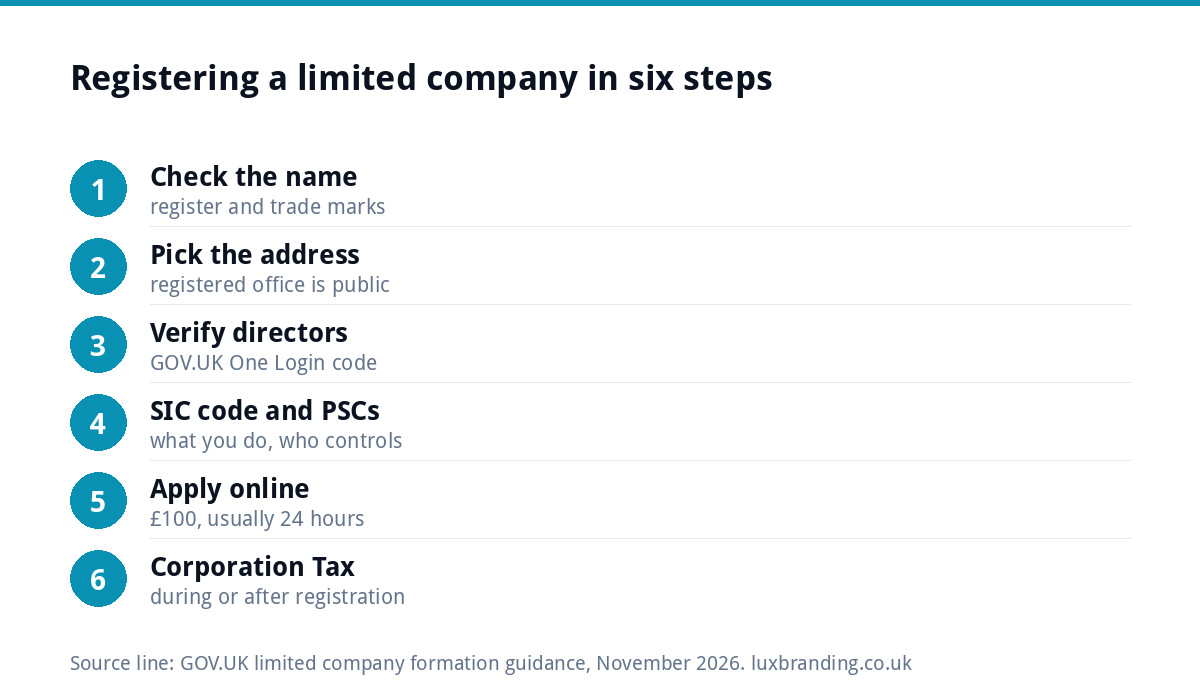
- Check the name on the Companies House register and against existing trade marks.
- Decide your registered office address. Remember it will be public.
- Confirm directors and shareholders, and get each director verified.
- Choose your SIC code and confirm people with significant control.
- Prepare the memorandum and articles. The standard model articles suit most small companies.
- Apply online and pay £100. Most companies are registered within 24 hours.
- Set up Corporation Tax. You can do this during registration or afterwards.
Corporation Tax after you register
A limited company pays Corporation Tax on its profits. GOV.UK’s Corporation Tax page says you can arrange it while you register the company with Companies House. If you skip that option, you add Corporation Tax services to your business tax account afterwards and then manage it online. Talk to an accountant early: the way you pay yourself from a company is different from being a sole trader, and getting it right from the start is far cheaper than fixing it later.
Your duties as a director from day one
Registering is the easy part. Running the company comes with legal duties that a sole trader never has. GOV.UK’s guide to running a limited company says a director must follow the company’s rules set out in the articles of association, prepare annual accounts, complete a Company Tax Return and file both, and report certain changes about the company. It also lists filing a confirmation statement with Companies House among the related tasks.
Two points from that page are worth reading twice. First, even if an accountant does the work, you are still legally responsible for your company’s records, accounts and performance. Second, a director who does not meet these responsibilities may be fined, prosecuted or disqualified. In practice, most small company owners hand the filings to an accountant from the first year and put the deadlines in a shared calendar.
Formation agents: what the extra fee buys
Formation agents file the same Companies House application you can file yourself. What you pay for is convenience and add-ons, typically:
- A registered office or service address, so your home address stays off the public register
- Pre-checked forms, which helps if you have several directors or shareholders
- Printed share certificates and company registers
- Bundled bank account introductions or accountancy offers
If you only need a straightforward company with one or two directors, the £100 online route is usually enough. If address privacy matters, an agent’s address service can be worth paying for. Compare what is included rather than the headline price.
What registration does not give you
A certificate of incorporation makes the company legal. It does not:
- Protect your brand name or logo (that needs a trade mark)
- Reserve the matching domain name or social handles
- Give you a business bank account
- Make customers trust you
Grab the domain the same day you register. Our UK domain names guide covers .co.uk versus .com and what each costs.
Your company details must appear on paperwork
Once registered, your full company name belongs on invoices, quotes, letterheads, emails and your website, and it should match the register exactly. This is the moment to design your paperwork properly rather than typing “Ltd” onto an old sole trader template. A consistent set of documents (logo, letterhead, invoice, email signature and business cards) makes a one-person company look like an established firm. Our business card design service builds cards that match your logo and colours.
Budgeting for the first month
Here is a realistic first-month list for a new limited company that wants to look credible from day one:
- Companies House registration: £100 online
- A logo you own in every format: our Logo Design is £129 one-off, all layouts included
- Full brand identity with colours, typography and guidelines: our Brand Identity Design is £299
- Domain and business email: from a few pounds a year
- Accountant and insurance: quotes vary by trade
Our guide to how much branding costs in the UK shows what each level of spend gets you, and every Luxbranding price sits on our pricing page.
Sole trader first, or straight to limited?
Many businesses start as sole traders and incorporate once profits, contracts or risk justify it. Others go straight to limited because a main contractor, landlord or commercial client expects it. Either route works. What matters is that your name is clear, your paperwork is consistent and the brand you build now still fits when the business is twice the size. If you change structure later, your logo and website carry over; only the legal details on documents change.
Get the UK Branding Budget Worksheet (free)
A printable worksheet: decide what your brand needs now and price it against fixed published prices and the IPO trademark fee.
No spam. UK GDPR compliant. We only use your email to send this resource, unless you tick the box to hear from us.
Frequently asked questions
How much does it cost to register a limited company in the UK? +
At the time of writing, November 2026, GOV.UK says registering online with Companies House costs £100, paid by debit or credit card. Registering by post on form IN01 costs £124, paid by cheque. Formation agents add their own fee on top of the filing, often bundled with extras such as an address service.
How long does it take to register a company? +
GOV.UK says a company registered online is usually registered within 24 hours. Postal applications on form IN01 take 8 to 10 days. Allow extra time if a director still needs to verify their identity through GOV.UK One Login, because you need each director's personal code to complete the application.
Can I register a company without a formation agent? +
Yes. You can register directly with Companies House online. You need a company name, a registered office address, at least one director, at least one shareholder for a company limited by shares, a SIC code, memorandum and articles, and a Government Gateway user ID for the company. Agents mainly sell convenience and extras.
Does registering a company protect my business name? +
Only partly. Companies House stops another company registering the same name, but it does not give you a trade mark. GOV.UK warns that a name too similar to someone else's trade mark may have to change if they complain. Check trade marks before you register and consider protecting your own brand.
What should I do straight after registering my company? +
Set up Corporation Tax if you did not do it during registration, open a business bank account, secure the matching domain and update every document with your full company name. A consistent logo, letterhead and invoice make a new company look established. Our Logo Design is £129 one-off with all layouts included.