Quick answer
Follow up a quote twice: once two or three days after sending it to check for questions, and once about a week before it expires to offer a start date. Keep each message under 60 words, give the customer a useful reason to reply, and stop after a third contact unless they answer.
Below are nine follow-up messages you can copy, written for UK trades and small service businesses, with a timing table, replies for the objections you will actually hear, and a simple way to stop quotes slipping through the cracks.
Why most quotes die of silence
A customer who asks for three quotes is not ignoring you out of rudeness. They are busy, they are comparing, and the job is one of twenty things on their mind. The business that follows up politely is often the one that gets the job, simply because it is the one still in the conversation.
The aim of every message below is to be helpful, not needy. Each one gives the customer a reason to reply that benefits them: an answer to a question, a date in the diary, a price that is about to change. None of them say “just checking in”.
Before you copy them, fill in the brackets properly. A message that names the job, the street or the material you discussed shows you remember the customer, which a generic “following up on your quote” never does. Write as you speak: if you would never say “per our correspondence” on a doorstep, do not type it either. Short sentences, the customer’s first name, and your own name at the end.
The follow-up schedule
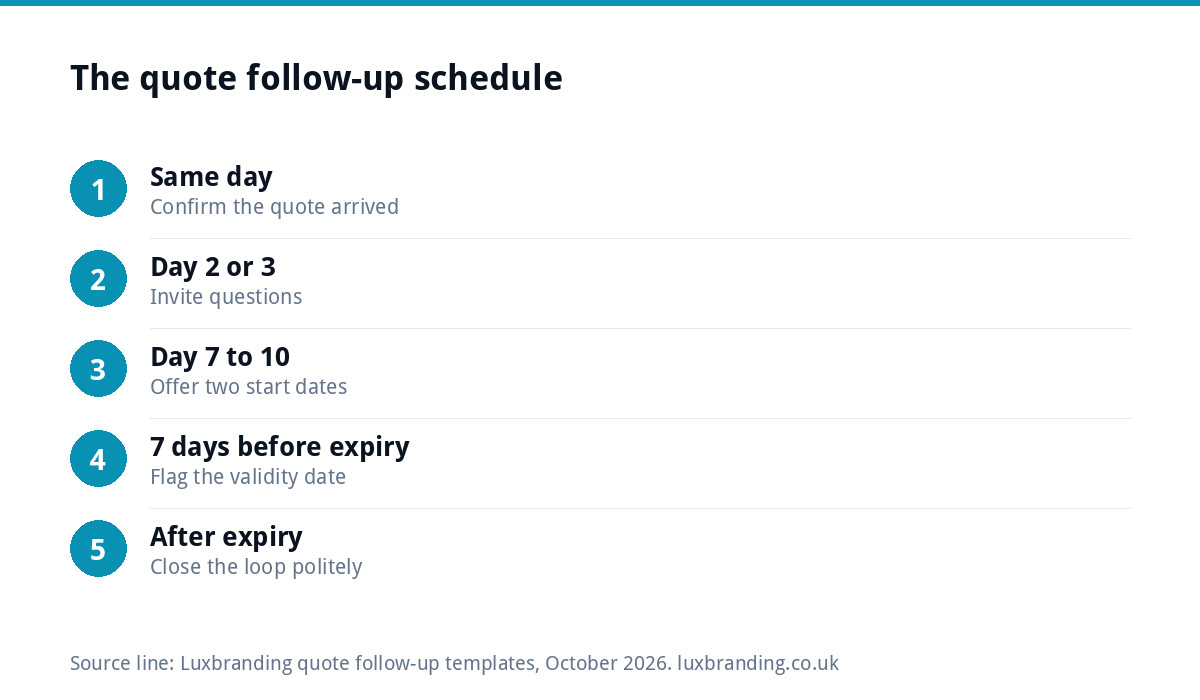
Use this timing as your default. Adjust it for urgent jobs, such as a leaking roof, where the first follow-up should come the same day.
| When | Channel | Purpose | Template |
|---|---|---|---|
| Same day as the quote | Text or WhatsApp | Confirm it arrived | 1 |
| Day 2 or 3 | Text or email | Invite questions | 2 |
| Day 7 to 10 | Offer a start date | 3 | |
| About 7 days before expiry | Text or email | Flag the validity date | 4 |
| After expiry, no reply | Close the loop politely | 5 |
Three or four touches over a few weeks is persistent. Daily messages are pestering, and they make customers wonder how you will behave once you have their deposit.
Templates 1 to 3: the first week
Template 1: quote sent (same day)
Hi [name], it’s [your name] from [business]. I’ve just emailed your quote for [job]. Could you let me know it’s come through? Sometimes they land in junk. Thanks.
This is the most useful message of the lot. Quotes really do go to spam, and if yours does, every later follow-up is chasing a document the customer never saw. If it keeps happening, our guide to business emails going to spam walks through the fixes.
Template 2: invite questions (day 2 or 3)
Hi [name], any questions on the quote for [job]? Happy to walk you through any part of it, or adjust the spec if you’d like a different option. [your name], [business]
Template 3: offer a start date (day 7 to 10)
Hi [name], I’m planning the diary for [month]. If you’d like to go ahead with [job], I can start on [date] or [date]. Just reply with whichever suits and I’ll confirm. Thanks, [your name]
Offering two specific dates turns a vague “we’ll think about it” into an easy decision between two options.
Templates 4 and 5: the deadline and the close
Template 4: the validity date is coming
Hi [name], a quick note that the quote for [job] is valid until [date]. After that I’d need to re-price it, as material costs move. If you’d like to lock it in, a reply before then is all it takes.
This only works if your quote states a validity date. If yours does not, add one: 30 days is common for domestic work.
Template 5: closing the loop
Hi [name], I haven’t heard back about [job], so I’ll assume you’ve gone another way or put it on hold, which is completely fine. If anything changes, just reply here and I’ll pick it up. All the best, [your name]
Oddly, this is the message that gets the most replies. People feel a small obligation to answer a polite close, and some will tell you why they went elsewhere, which is worth knowing.
Templates 6 to 9: the awkward situations
Template 6: after a site visit
Dear [name], thank you for showing me round on [day]. As discussed, your quote for [job] is attached. It includes [two key inclusions] and is valid until [date]. If anything we talked about isn’t covered, let me know and I’ll update it. Kind regards, [your name]
Template 7: a commercial or trade client
Dear [name], following our quotation ref [number] dated [date], I wanted to check whether you need anything further for your approval process, such as insurance certificates, RAMS or a revised schedule. We can hold the programme dates until [date]. Regards, [name], [business]
Commercial buyers rarely say no; they stall waiting for paperwork. Offering the documents up front removes the stall. Our guide to winning commercial contracts as a trade covers what those buyers usually ask for.
Template 8: the voicemail script
“Hi [name], it’s [your name] from [business], calling about the quote for [job]. Nothing urgent, I just wanted to check you’d had it and see if you had any questions. I’ll drop you a text with my number. Thanks.”
Template 9: after you lose the job
Hi [name], thanks for letting me know. Would you mind telling me what tipped it, whether price, timing or something else? It helps me improve. And if the work ever needs a second pair of hands, I’m here.
What to say when they push back
Most replies to a follow-up fall into a handful of patterns. Have an answer ready for each.
| They say | A good reply | Avoid |
|---|---|---|
| “It’s more than we expected” | Explain what is included, then offer a reduced-scope option at a lower price | Knocking money off the same job straight away |
| “We’ve had a cheaper quote” | Ask what it includes and compare like for like, in writing | Criticising the other trade |
| “We’ll think about it” | Offer two start dates and the validity date | Asking when they will decide |
| “Can you start sooner?” | Give the honest earliest date, or say what would make it possible | Promising a date you cannot keep |
| “We’re waiting on [partner, landlord, board]” | Offer a one-page summary they can forward | Pushing for a decision they cannot make |
Reducing scope rather than price protects your rate. If the customer wants the cheaper option, they get less work, not the same work for less money.
Make your quotes and messages look the part
A follow-up reminds the customer to open your quote again, so the quote has to stand up to a second look. A clear header, your registered details, consistent colours and a tidy layout all suggest a business that will turn up and finish the job. Our guide to branding for trades businesses covers quote templates alongside vans and workwear, and matching business cards help when you leave something behind after a site visit.
Staying on the right side of the rules
Following up on a quote the customer asked for is part of the conversation they started. Marketing them later is different. The ICO’s guidance on electronic mail marketing explains the “soft opt-in” for existing customers and people who discussed buying from you, and it is clear that you must give a simple way to opt out, both when you collect their details and in every marketing message. If a lost lead goes onto your newsletter list, include that opt-out.
Stop relying on memory
The real reason follow-ups get missed is that they live in your head. Three practical fixes:
- Save the templates as shortcuts. The WhatsApp Business app lets you create quick replies for messages you send often, so Template 2 is two taps away.
- Schedule the next message when you send the quote. Gmail’s app lets you schedule an email to send later, so Template 3 can be queued on day one.
- Keep a simple tracker. A list of open quotes with columns for sent, followed up and outcome tells you, within a few months, which jobs you win and why.
When the volume outgrows a list, automation takes over. Our email marketing automation service can set up follow-up sequences so the next message goes out on time, and our custom business software service builds tools that bring quotes, follow-ups and invoices together. See our pricing page for everything with a fixed price.
Get the UK SEO DIY Audit Checklist (free)
A 32-point checklist UK SMEs can run against their own website in an afternoon. Surfaces the quick wins before paying for a paid audit.
No spam. UK GDPR compliant. We only use your email to send this resource, unless you tick the box to hear from us.
Frequently asked questions
How soon should I follow up on a quote? +
Send a short message the same day to confirm the quote arrived, then a proper follow-up two or three days later inviting questions. For urgent jobs, such as leaks or breakdowns, follow up the same day. Leaving it more than a week means the customer has often already chosen someone who stayed in touch.
How many times should I chase a quote? +
Three or four contacts over a few weeks is persistent without being pushy: the arrival check, an invitation to ask questions, a start-date offer and a note before the quote expires. After that, send a polite closing message and stop. Daily chasing tends to put customers off rather than win the job.
Should I follow up by text, email or phone? +
Match how the customer contacted you. Domestic customers usually prefer a text or WhatsApp message, commercial clients prefer email with documents attached, and a short voicemail works when a message has gone unanswered. Whatever the channel, keep each follow-up under 60 words and give one clear next step.
What do I say when a customer says my quote is too expensive? +
Explain what the price includes first, then offer a reduced-scope option at a lower price rather than cutting the same job. That protects your rate and gives the customer a real choice. If they mention a cheaper quote, ask what it includes and compare the two like for like, in writing.
Can I add people who asked for a quote to my mailing list? +
The ICO's guidance on the soft opt-in covers people who discussed buying from you, but only if you gave them a clear chance to opt out when you collected their details, and you must offer an opt-out in every marketing message. Following up on the quote itself is part of the conversation they started.