Quick answer
If bad reviews suddenly flood your Google profile, do not reply to each one in anger. Screenshot everything with dates, work out whether a real incident or a coordinated attack caused it, report reviews that break Google’s policies through your Business Profile, post one calm public statement, then appeal any refused reports. Google’s evaluation typically takes several days.
A sudden wave of one-star reviews is frightening, and it usually comes with a strong urge to do something immediately. This guide gives you a triage order for the first two days, explains which reviews Google will actually remove, and shows how to protect your rating while the process runs. It is about the wave, not about replying to a single unhappy customer.
Step 1: stop, and do not reply yet
The worst responses happen in the first hour. Replying to each review defensively, accusing reviewers of lying, or posting about it on social media can turn a bad day into a story that spreads. A wave of reviews often means someone is watching for a reaction.
Give yourself an hour. Tell your team not to reply to anything on any platform. Then move to evidence.
Step 2: capture the evidence
Before anything is removed or edited, record it. For each new review:
- Take a screenshot showing the reviewer name, the rating, the text and the date.
- Note whether the reviewer has a profile picture, other reviews, or reviews of businesses far away.
- Check whether the name matches anyone in your customer records or bookings.
- Look for repeated phrases, identical wording or reviews arriving within minutes of each other.
Keep this in a single document with times, and save a copy somewhere other than your phone. If the same accounts have reviewed other local businesses on the same day, note that too; a pattern across several businesses is strong evidence of a coordinated attack. You will need it for reports, for any appeal, and if the situation turns out to involve threats or demands for money.
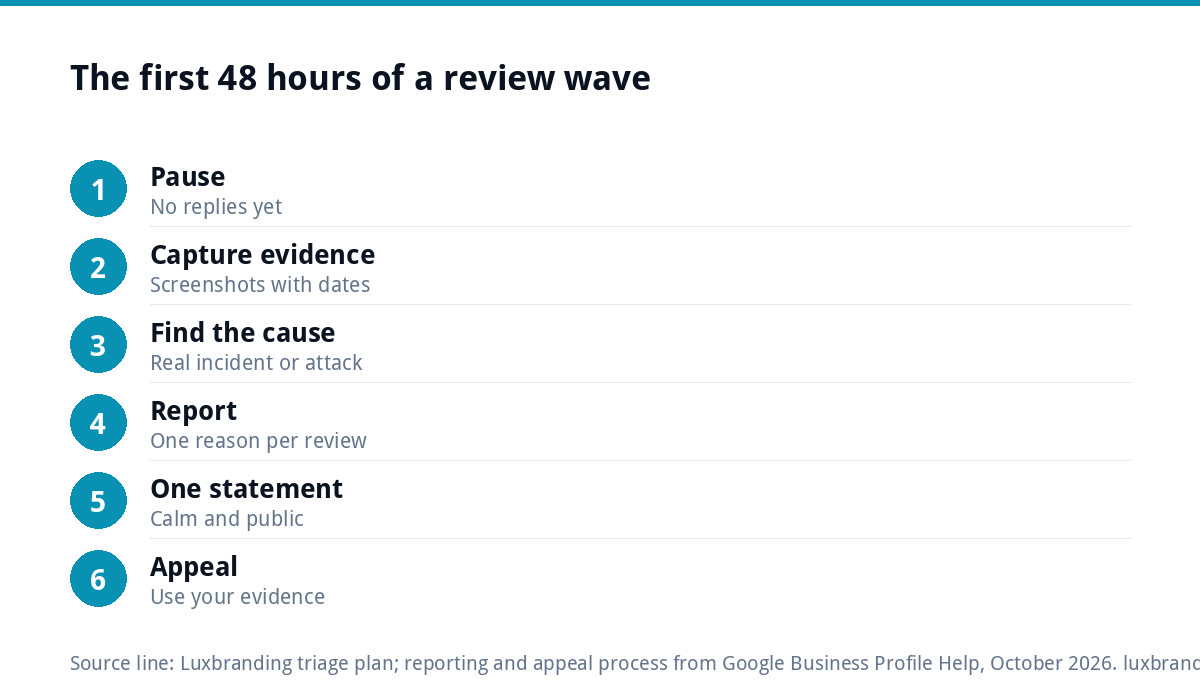
Step 3: work out what is causing it
The response depends entirely on the cause. Use this triage table.
| What you see | Likely cause | First action |
|---|---|---|
| Reviews mention a real recent event (a missed job, a staff incident) | Genuine customer anger, possibly shared online | Fix the problem and post one public statement |
| Reviewers mention a news story, social post or opinion, not a visit | Off-topic pile-on after something went viral | Report as off-topic; post a short statement |
| Many reviews in a short time from profiles with no history | Coordinated or fake reviews | Report each as fake engagement or rating manipulation |
| Reviewers who are former staff or a known rival | Conflict of interest | Report as conflict of interest, with evidence |
| A message demanding payment to stop the reviews | Extortion | Do not pay; keep the messages; report to Google and the police |
Be honest at this step. If the reviews describe something that really happened, reporting them will not work and will not help. The fix is the problem, not the reviews.
Step 4: report the reviews that break the rules
Google’s prohibited and restricted content policy for Maps reviews sets out what can be removed. The categories that apply to a review wave are:
- Fake engagement: content “not based on a real experience”, including paid-for reviews.
- Rating manipulation: the policy prohibits “content exhibiting unusual volumes or patterns of review contributions” intended to manipulate a place’s rating. This is the clause that covers review bombing.
- Off-topic: reviews should be based on an experience at the location, not political, social or general commentary.
- Conflict of interest: including current or former employees and competitors.
- Harassment: content that threatens people or exposes personal details.
To report, Google’s help page on removing reviews that break policy gives the steps: open your Business Profile, select Read reviews, choose the report option next to the review, pick the reason and send the report. Report each review individually and choose the most accurate reason. Google says evaluation typically takes several days.
What Google will and will not remove
| Review type | Likely to be removed? |
|---|---|
| From an account with no sign of a visit, posted in a sudden burst | Often, under fake engagement or rating manipulation |
| About a news story or opinion rather than a visit | Often, under off-topic |
| From a former employee or competitor | Possibly, if the conflict is clear |
| Containing threats, slurs or personal details | Usually, under harassment |
| Harsh but describing a real experience | No |
| Unfair, but from a real customer | No; reply to it instead |
Step 5: post one calm public statement
While reports are pending, future customers are reading your profile. One short reply on the most visible review, or a profile post, does more than dozens of replies. For example:
“We’ve received a large number of reviews in the last day from people we have no record of serving. We’ve reported them to Google. If you are a customer with a genuine concern, please contact us directly at [email or number] and we will put it right.”
If the wave is about a real incident, change the statement: acknowledge it, say what you are doing about it, and give a direct contact. Keep personal details and blame out of it either way.
Step 6: appeal what is refused
Not every report succeeds first time. Google’s help page explains that if a reported review is found not to break policy, you can submit a one-time appeal through the Reviews Management Tool, and that you can appeal up to ten eligible reviews at once. The result comes by email. Appeal with your evidence: timings, the lack of any customer record, identical wording. If the appeal fails, the review stays, and your reply becomes the main tool.
When the wave follows a viral post
Some waves start somewhere else entirely: a customer’s video, a local Facebook group thread, or a news story that mentions your business. Within hours, people who have never visited start leaving one-star reviews. Three things help:
- Find the source. Search your business name on social media and local groups. Knowing what people are reacting to tells you whether there is something real to address.
- Respond where it started. A calm, factual reply on the original post often does more than anything on Google, because that is where the audience is.
- Report the off-topic reviews. Reviews that discuss the post or the story rather than a visit fall under Google’s off-topic category. Say so in each report.
If the original complaint is fair, say so plainly and explain what you are changing. A visible, honest fix ends most pile-ons faster than any removal request, and future customers who find the reviews will also find your answer.
Step 7: protect your profile while it settles
- Keep asking real customers for reviews, as you normally would. Genuine recent reviews put the wave in context for anyone reading.
- Do not buy or swap reviews to balance things out. The CMA’s guidance on fake reviews (CMA208), published in April 2025, explains what consumer protection law prohibits around consumer reviews, and buying them can also break Google’s own policies.
- Check the rest of your profile. Make sure no one has suggested edits to your hours, phone or website during the wave.
- Watch for suspension. A heavily targeted profile occasionally attracts other problems; our guide to a suspended Google Business Profile covers what to do.
If some of the bad reviews later vanish without your report succeeding, or genuine good reviews disappear at the same time, our guide to Google reviews that disappeared explains the usual causes.
After the wave: making the profile harder to knock over
A profile with a handful of reviews can be dragged down by twenty fake ones in an afternoon. A profile with a steady stream of recent, detailed reviews from real customers absorbs the same attack with far less damage, and the fake reviews stand out to readers and to Google. The long-term defence is the ordinary work: a complete profile, a habit of asking every happy customer, and replies to genuine reviews. Our free Google Business Profile checklist and our Google Business Profile optimisation guide cover the routine.
If you would rather have it set up properly, our Google Business Profile setup and optimisation is £199 and includes categories, keywords, photos, a review strategy and tracking. For wider search visibility, our SEO service is £249 a month. All fixed prices are on our pricing page.
Get the UK SEO DIY Audit Checklist (free)
A 32-point checklist UK SMEs can run against their own website in an afternoon. Surfaces the quick wins before paying for a paid audit.
No spam. UK GDPR compliant. We only use your email to send this resource, unless you tick the box to hear from us.
Frequently asked questions
What should I do if I get lots of bad reviews at once? +
Do not reply to each one in anger. Screenshot every review with its date, work out whether a real incident or a coordinated attack caused the wave, report the reviews that break Google's policies through your Business Profile, post one calm public statement, and appeal any reports Google refuses. Keep asking real customers for reviews meanwhile.
Can Google remove review bombing? +
Google's prohibited content policy for Maps reviews covers rating manipulation, including content showing unusual volumes or patterns of review contributions meant to manipulate a rating. Reviews that are fake, off-topic, from people with a conflict of interest, or harassing can also be reported. Reviews describing a real experience, however harsh, are not removed.
How long does Google take to remove reported reviews? +
Google's help page says evaluation of a reported review typically takes several days. If Google decides a review does not break policy, you can submit a one-time appeal through the Reviews Management Tool, and the result is sent by email. There is no guaranteed timescale for appeals.
Should I reply to fake reviews? +
Reply to the most visible one with a short, calm statement rather than answering every review. Say you have no record of the reviewers, that you have reported the reviews to Google, and give a direct contact for any genuine customer. Avoid accusations, personal details and arguments, because future customers will read every word.
Someone is demanding money to stop posting bad reviews. What do I do? +
Do not pay. Keep every message with dates and screenshots, report the reviews to Google with that evidence, and report the demand to the police, because it is a form of extortion. Paying gives no guarantee that the reviews will stop or will not return later.