Quick answer
In the UK, an A-board on the public pavement is controlled by your council as highway authority. Many councils allow one board per business, placed against your own frontage, leaving a clear walkway of around 1.5 to 2 metres, with public liability insurance. Some require a paid licence; some streets ban boards entirely. Check your council’s policy first.
A-boards are cheap, flexible and still work for cafés, salons, barbers, garages and shops. They are also one of the most common sources of complaints from pedestrians, especially blind and partially sighted people and wheelchair users, which is why councils regulate them. This guide covers the rules you are likely to meet, how to check yours, and how to design a board that earns its place on the pavement.
Who decides whether your A-board is allowed
If the board stands on the public footway, the decision sits with the highway authority, which is your county, unitary or city council. Under section 137 of the Highways Act 1980, it is an offence to wilfully obstruct free passage along a highway without lawful authority or excuse, and a board in the wrong place can be treated as an obstruction. Councils also have powers to permit objects on the highway, including for advertising, and many run an A-board policy or licence scheme on that basis.
If the board stands on your own forecourt, inside your property boundary, highway rules may not apply, but advertisement rules from the local planning authority still can. Where a board goes on private land you do not own, such as a shopping centre walkway, the landlord’s rules come first.
What council policies typically say
Policies differ between councils, but they cover the same ground. Two published examples show the range.
Nottingham City Council’s A-board policy and guidelines permits boards on most city centre streets subject to its guidance. Boards must stand against the building line with a minimum 2 metre unobstructed zone, or 1.5 metres where the street is physically constrained. They must be directly outside your own business, not within 2 metres of street furniture, removed when the premises are closed or in high winds, around A1 to A0 size, and limited to one per business. It advises public liability insurance of at least £5 million and lists streets where boards are not automatically allowed, or not allowed at all.
Calderdale Council’s A-board guidance for its Hebden Bridge pilot area goes further and requires a licence. At the time of writing, November 2026, it lists a £100 fee for a new licence and £50 for a renewal, a board size of 60 by 100cm, a site plan, a minimum of 1.8 metres from the edge of the board to the kerb, a £5 million public liability certificate and a seven-day public consultation.
A-board rules compared
| Rule | Common approach | Nottingham example | Calderdale pilot example |
|---|---|---|---|
| Permission | Policy, sometimes a licence | Allowed if guidance is followed | Licence required |
| Fee | None to a modest annual fee | None stated | £100 new, £50 renewal |
| Number | One per business | One per business | Set by licence |
| Position | Against your own frontage | Against building line, outside your business | Shown on a site plan |
| Clear walkway | Roughly 1.5 to 2 metres | 2 metres, 1.5 minimum | 1.8 metres to the kerb |
| Size | About A1 to A0 | A1 to A0, about 1.1m high | 60 by 100cm |
| Insurance | Public liability | At least £5 million advised | £5 million certificate |
| Hours | Only while open | Removed when closed | Per licence |
Treat these as examples, not rules for your street. Your own council’s page is the only one that counts.
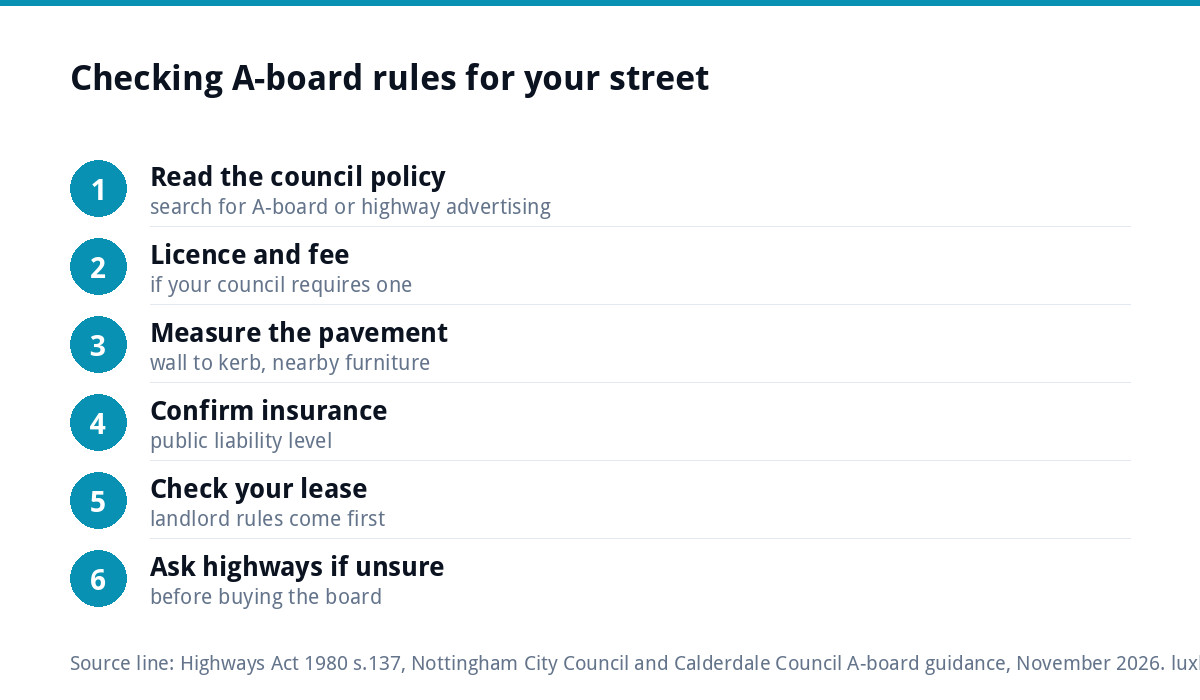
How to check the rules for your street
- Search your council’s website for “A-board” or “advertising boards on the highway”. Many publish a policy, a map of restricted streets or an application form.
- Check whether a licence is needed and the fee, and whether it renews yearly.
- Measure your pavement. Note the width from your wall to the kerb and any bins, posts or benches nearby.
- Confirm your insurance includes public liability at the level the policy asks for.
- Check your lease if you rent, because some landlords ban street furniture.
- If unsure, ask the highways team before you buy a board. It costs nothing and avoids a removal notice.
What happens if you get it wrong
Most councils start with a conversation or a written request to move or remove the board. If that is ignored, they can remove it, sometimes charging you for the trouble, and persistent obstruction can lead to prosecution. Nottingham’s policy says boards that present an immediate danger will be removed straight away. The bigger risk for most businesses is not the council at all: it is a pedestrian tripping over the board and a claim landing on you, which is why insurance appears in nearly every policy.
Designing an A-board people read in three seconds
People pass an A-board at walking pace, often from the side. You have a moment, not a minute. Good boards share a few habits:
- One message per side. “Walk-ins welcome” or “Lunch deal £6.50” beats a list of eight services.
- Short lines, big type. Three to five lines a side is plenty. If it needs a paragraph, it belongs on your website.
- Strong contrast. Dark on light or light on dark, never mid-grey on a photo.
- Your brand at the top. Logo and colours make the board look like part of the shop, not a hand-me-down.
- A reason to step in now. Today’s offer, opening hours or “free consultation inside”.
- Weather in mind. Laminated or rigid inserts survive rain; paper in a plastic sleeve rarely does.
Chalkboard or printed insert?
Chalkboards suit cafés and pubs that change the message daily, but handwriting quality varies and rain smudges it. Printed poster inserts in a snap frame look sharper, keep your branding consistent and can be swapped seasonally. Many businesses use both: a printed header with the brand and a small chalk panel for the daily special.
Sizes and print specification
| Format | Insert size | Good for | Artwork notes |
|---|---|---|---|
| A1 snap frame | 594 x 841mm | Most shopfronts, narrow pavements | Check the frame’s visible area and add bleed |
| A0 snap frame | 841 x 1189mm | Wide streets, precincts | Larger type; check your council’s size limit |
| Custom board | Set by the maker | Branded shapes, forecourts | Get the exact template before design starts |
Ask the printer for their template, including bleed and the area hidden by the frame edge, before anyone designs. Our guide to print-ready artwork explains what printers mean by bleed, CMYK and resolution.
If A-boards are banned on your street
Busy pedestrian streets, conservation areas and narrow pavements are where bans are most likely. Nottingham’s policy, for example, points traders towards alternatives such as fascia and projecting signs, subject to planning, and says shared boards may be considered in precincts and arcades with several businesses. If your street is off-limits, these options do a similar job:
- Window graphics. Vinyl on the inside of the glass can carry your offer, hours and services, and changes as easily as a poster.
- A projecting sign. A hanging sign at right angles to the frontage is seen by people walking along the pavement, which is exactly the view an A-board was trying to catch. It may need advertisement consent.
- A shared precinct board. Worth asking the council or your landlord about if you trade in an arcade or courtyard.
- Your own forecourt. If you have private land in front of the shop, a board there may avoid highway rules, though advertisement rules can still apply.
- Online visibility. Many people decide where to go from Google Maps before they reach the street. A complete Google Business Profile with photos of the frontage helps them recognise you when they arrive.
Whichever you choose, keep the design consistent with the rest of your branding, so the window, the sign and the website all look like one business.
Getting the board designed
An A-board insert is effectively a poster that lives outdoors. Our poster and banner design is £89 one-off: built as vector, supplied as a print-ready CMYK PDF at 300dpi with bleed and trim marks, plus editable text layers so you can update offers. We do not print, but we can recommend suppliers and brief them. If you already have artwork that just needs setting up for the printer, print-ready artwork is £49.
For the wider frontage, our signage design starts from £99, and the shopfront signage guide covers fascia signs, materials and planning in more depth. The poster design guide is useful if you are designing the inserts yourself. Every price is on our pricing page.
Before you put the board out
- Council policy checked and any licence in place
- Board directly outside your own premises, against the building line
- Clear walkway measured and kept, away from bins, posts and crossings
- Stable, weighted base that will not blow over
- Public liability insurance confirmed
- Brought in at closing and in high winds
- Message readable from a few steps away
Get those right and an A-board stays what it should be: a small, cheap nudge that turns passers-by into customers, without a letter from the council.
Get the UK Print-Ready Artwork Checklist (free)
A one-page checklist for any UK designer or printer covering CMYK, bleed, fonts and resolution. Saves you the pre-press fix-up fees.
No spam. UK GDPR compliant. We only use your email to send this resource, unless you tick the box to hear from us.
Frequently asked questions
Do I need permission for an A-board in the UK? +
If it stands on the public pavement, your council as highway authority decides. Some councils allow boards that follow their policy without a licence, others require a paid licence, and some streets ban boards entirely. A board on your own forecourt may avoid highway rules but can still fall under advertisement rules. Check your council's website first.
How much pavement space must I leave? +
It depends on the council, but policies commonly ask for a clear walkway of around 1.5 to 2 metres. Nottingham's policy asks for a 2 metre unobstructed zone, or 1.5 metres on constrained streets. Calderdale's pilot asks for 1.8 metres from the board to the kerb. Measure your pavement before buying a board.
Do I need insurance for an A-board? +
Most councils expect it. Both published policies we looked at mention public liability insurance of £5 million, either advised or required as a certificate. If a pedestrian trips over your board, the claim is likely to come to you, so check your policy covers street furniture outside your premises.
What size should an A-board be? +
Common inserts are A1, 594 by 841mm, or A0, 841 by 1189mm. Some councils set a size limit; Nottingham allows roughly A1 to A0, about 1.1 metres high, and Calderdale's pilot specifies 60 by 100cm. Get the frame maker's template, including bleed and the hidden edge, before design starts.
Can you design my A-board insert? +
Yes. Our poster and banner design is £89 one-off, supplied as a print-ready CMYK PDF at 300dpi with bleed and trim marks, plus editable text layers for changing offers. We do not print, but we can recommend suppliers and brief them. Setting up existing artwork for print is £49.