

Quick answer
YMYL (“Your Money or Your Life”) is Google’s term for topics that could significantly affect someone’s health, finances, safety or wellbeing. Pages on those topics are held to a higher standard of trust. If you are an accountant, adviser, clinic, solicitor or safety-critical trade, show real expertise: named authors, credentials, accurate up-to-date advice and clear business details.
Most small business owners never hear the term until rankings dip or an SEO report mentions it. It is not a penalty or a setting; it is a way of describing which pages Google’s systems are more careful about. This guide explains what counts as YMYL, how it affects small business websites, and a practical checklist for making your pages trustworthy enough to compete.
What YMYL means
Google’s guidance on creating helpful, reliable, people-first content says its systems give even more weight to content that aligns with strong E-E-A-T for topics that could significantly impact the health, financial stability or safety of people, or the welfare of society. Google calls these “Your Money or Your Life” topics, or YMYL for short.
The same page says that for YMYL topics, content must be highly accurate and consistent with established expert consensus. In other words, a page about mortgage advice or gas safety is judged more strictly than a page about the best colour for a garden shed.
Is your business in YMYL territory?
| Business type | Likely YMYL content | Example page |
|---|---|---|
| Accountants and bookkeepers | Tax, payroll, financial planning | “How to pay less tax as a sole trader” |
| Financial and mortgage advisers | Investments, pensions, borrowing | “Remortgaging explained” |
| Solicitors and legal services | Rights, disputes, wills, property law | “What happens if you die without a will” |
| Clinics, therapists, dentists, pharmacies | Health, treatment, medication | “Signs you need a root canal” |
| Gas, electrical and safety trades | Safety advice in the home | “Is it safe to reset a tripped fuse box?” |
| Care providers and childcare | Wellbeing of vulnerable people | “Choosing a care home” |
| Online shops selling health or safety products | Product claims that affect health or safety | Supplement or child-seat product pages |
A plumber’s page about choosing tap finishes is not YMYL. The same plumber’s page about carbon monoxide warning signs probably is. It is the topic of the page that counts, not the whole business.
YMYL and E-E-A-T: how they fit together
E-E-A-T stands for experience, expertise, authoritativeness and trustworthiness. Google added the first “E” for experience in its December 2022 update, explained in its post E-A-T gets an extra E for Experience. Google’s helpful content guidance says trust is the most important of the four, and that E-E-A-T itself is not a single ranking factor; rather, its systems use a mix of signals that tend to identify content with good E-E-A-T.
The link to YMYL is simple: the higher the stakes of the topic, the more those trust signals matter.
Who decides: algorithms, not inspectors
Google employs search quality raters who assess sample results using its published Search Quality Rater Guidelines. Google’s own guidance states that raters have no control over how pages rank and that rater data is not used directly in its ranking algorithms; it compares their feedback to a restaurant’s comment cards. Nobody is going to visit your website and mark it down. But the guidelines are a useful window into what Google’s systems are designed to reward, and they spend a lot of time on YMYL topics.
Practical trust signals for a small business site
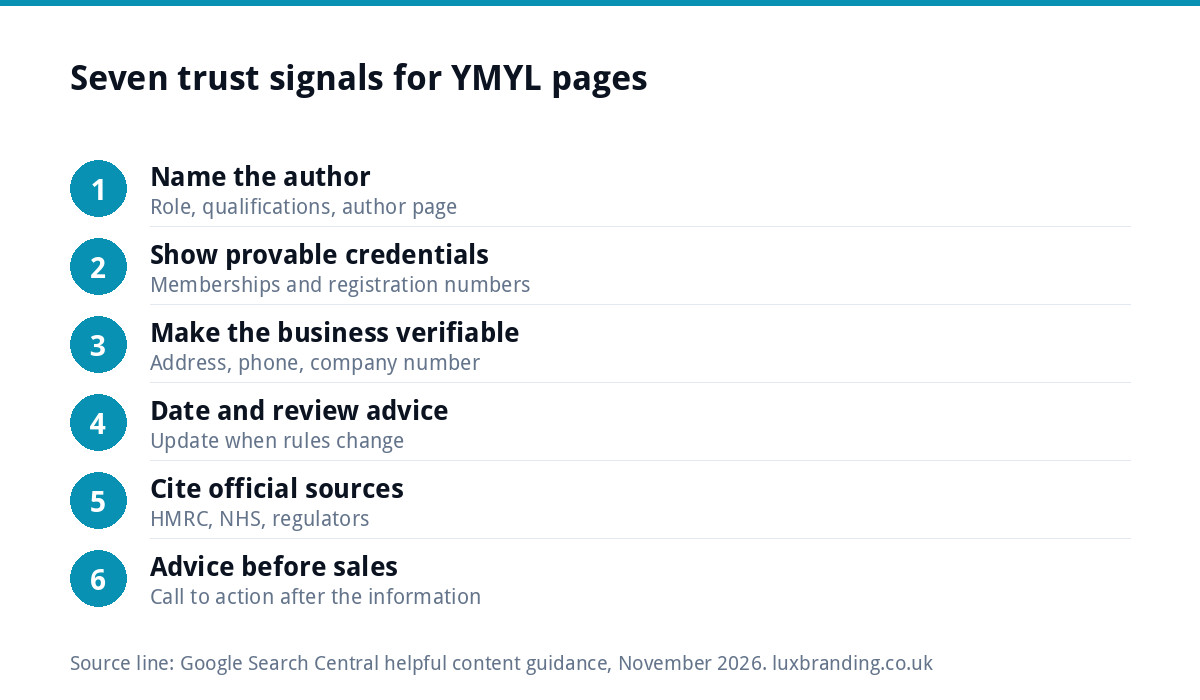
- Name the author. Put a real person’s name on advice pages, with their role and relevant qualifications, and link to a short author page.
- Show credentials you can prove. Professional body memberships, registrations and accreditations, with a registration number where relevant, so they can be checked.
- Make the business easy to verify. Full business name, address or service area, phone number, and for limited companies the company number.
- Date your advice and review it. Show when a page was last reviewed, and update it when rules or rates change.
- Cite your sources. Link to the official guidance you rely on, such as HMRC, the NHS or the relevant regulator.
- Separate advice from sales. Explain the topic honestly first; put the call to action after the information, not instead of it.
- Be clear about limits. Say when a reader should get individual professional advice rather than relying on a general article.
A worked example
Picture a hypothetical two-partner accountancy practice in Exeter with a blog post titled “Sole trader expenses you can claim”. The original version had no author, no date and figures from three tax years ago, and ended with a hard sell for a fixed-fee package. The revised version names the partner who wrote it, shows her professional body membership and a “last reviewed” date, links to HMRC’s guidance on allowable expenses, checks every figure against the current tax year, and moves the package to a short paragraph at the end. The advice is the same in spirit; the evidence that a qualified person stands behind it is now visible.
Author pages that actually build trust
An author page does not need to be long. It should say who the person is, what they do in the business, their relevant qualifications and memberships, how long they have worked in the field, and which topics they write about. Add a professional photo if you are comfortable with it, and link each article back to the page. For regulated professions, include the details a reader would need to check the registration themselves.
What weak YMYL content looks like
- Health or money advice with no author, no date and no sources.
- Out-of-date figures, such as last year’s tax thresholds or retired schemes.
- Bold promises such as “guaranteed results” or “pay no tax”.
- Thin pages copied from other sites or generated in bulk with no expert review.
- Pages that bury the business’s identity, with no address, company details or named people.
Some of those problems are also legal or regulatory problems for regulated professions, so fixing them helps on more than one front.
A YMYL page audit in 30 minutes
| Check | Pass looks like |
|---|---|
| Author | Named, with role, qualifications and an author page |
| Date | Published or reviewed date visible and recent |
| Accuracy | Figures and rules match current official guidance |
| Sources | Links to the regulator or official body for key facts |
| Business identity | Name, contact details and registration numbers easy to find |
| Tone | No guarantees or exaggerated claims |
| Next step | Clear route to professional advice, after the information |
Start with your five most-visited advice pages. If you are not sure which those are, our free SEO audit gives a quick technical snapshot, and our guide to SEO audit costs explains what a fuller review covers.
Does YMYL explain a traffic drop?
Sometimes. When Google updates its core systems, sites with weaker trust signals on sensitive topics can lose ground to better-evidenced competitors. But a sudden drop has many possible causes, from a broken page or a lost redirect to a technical error. Our guide to a website traffic drop walks through how to rule out the technical causes before rewriting content.
If the technical checks come back clean and the pages that lost ground are your health, money or safety advice, compare them honestly with the pages that now rank above you. Look at who wrote them, how recently they were reviewed, how thoroughly they cite official guidance and how clearly the business behind them is identified. The gap is usually visible within a few minutes of side-by-side reading.
Writing YMYL content without a big team
You do not need a newsroom. You need the person with the expertise involved in what is published. A workable routine for a small practice:
- The expert outlines the key points and caveats for each article.
- A writer turns that into a clear, plain-English draft.
- The expert checks every figure and claim against official sources before it goes live.
- The page shows the expert as author or reviewer, with a date.
- Each article is diarised for review when rules typically change, such as the new tax year.
Our content and blog writing service works this way, with your expertise kept at the centre.
Get help building trust and rankings
If your business works in a sensitive area, trust signals are not optional extras. Our SEO service is £249 a month and covers rankings, content, technical health, link building and reports. Our guide to how much SEO costs in the UK sets out what to expect from any provider, and every service price is on our pricing page.
Get the UK SEO DIY Audit Checklist (free)
A 32-point checklist UK SMEs can run against their own website in an afternoon. Surfaces the quick wins before paying for a paid audit.
No spam. UK GDPR compliant. We only use your email to send this resource, unless you tick the box to hear from us.
Frequently asked questions
What does YMYL stand for? +
YMYL stands for "Your Money or Your Life". Google uses it for topics that could significantly affect a person's health, financial stability or safety, or the welfare of society. Google's guidance says its systems give more weight to content showing strong experience, expertise, authoritativeness and trustworthiness on these topics, and that such content must be highly accurate.
Is YMYL a Google penalty? +
No. YMYL is not a penalty or a setting; it describes topics where Google's systems are more careful about quality and trust. Pages on those topics need stronger evidence of expertise and accuracy to compete. A site can rank well for YMYL topics if it shows named experts, accurate up-to-date information and clear business details.
Does YMYL apply to tradespeople? +
It can. A page about choosing tile colours is not YMYL, but pages about gas safety, electrical faults, carbon monoxide or structural problems can be, because they affect people's safety. It is the topic of each page that matters. Safety advice should be accurate, reviewed by a qualified person and clear about when to call a professional.
What is the difference between YMYL and E-E-A-T? +
YMYL describes the topic: content that could affect health, money or safety. E-E-A-T describes qualities of the content and its creator: experience, expertise, authoritativeness and trustworthiness. Google says trust is the most important of the four. The more a topic is YMYL, the more those qualities matter for how well the content performs.
Do search quality raters affect my rankings? +
Not directly. Google uses quality raters to check whether its algorithms are producing good results, and their ratings do not change the ranking of individual pages. Their published guidelines are still useful, because they show what Google's systems are designed to reward, especially on YMYL topics such as health, finance and safety.


