Quick answer
A website stuck on page two of Google is usually close but outmatched: the page does not quite fit what searchers want, covers the topic less fully than the top ten, competes with another page on your own site, or has fewer links and local signals. Find those searches in Search Console, then fix intent, content, internal links and duplicates.
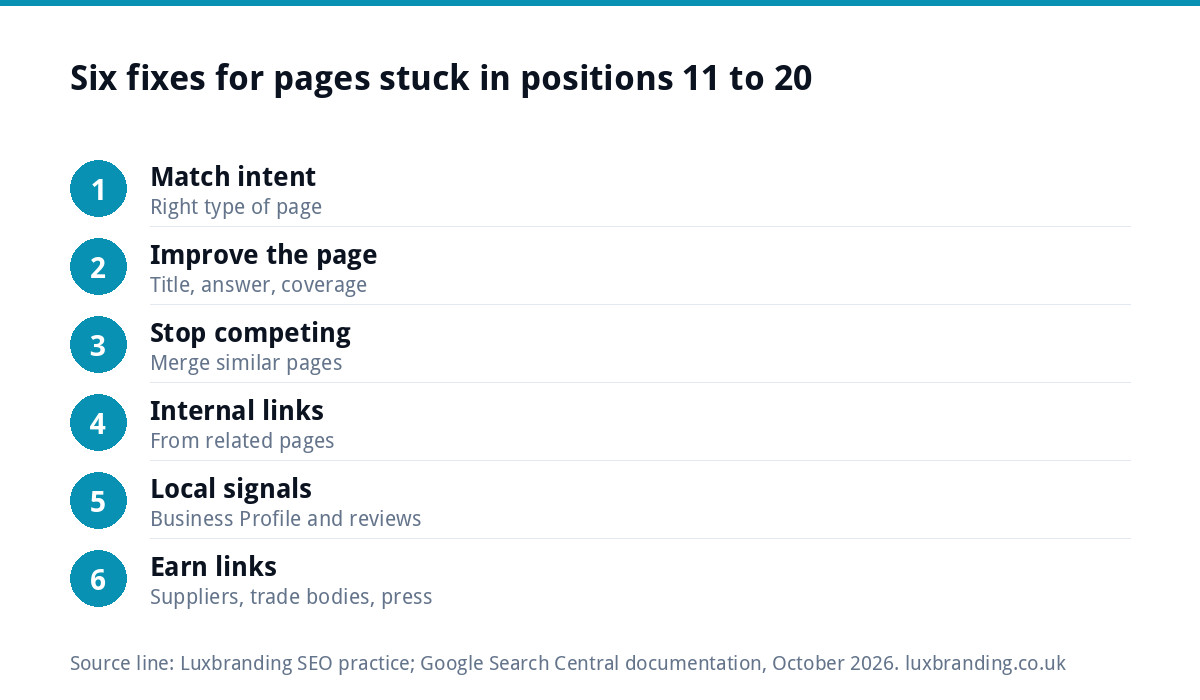
Page two is frustrating because Google clearly thinks your page is relevant; it just thinks ten others are more so. The good news is that pages in positions 11 to 20 are often the quickest SEO wins on a small site. This guide shows how to find them, how to diagnose why each one is stuck, and six fixes in the order we would try them.
First, confirm it really is page two
Checking your position by searching Google yourself is unreliable. Results change with location, device and search history, so what you see is not what customers see. Use Google Search Console instead. In the Performance report, open the Queries tab, turn on Average position, and look at the last three months.
Filter or sort for queries with an average position between about 11 and 20 and a meaningful number of impressions. Those are your page-two searches. Then click each query and open the Pages tab to see which page is ranking for it.
If your pages are not appearing at all, that is a different problem; start with our guide to a website not showing on Google, which covers indexing.
Diagnose before you fix
Search the query yourself in a private window and study the top ten results. Then compare your page with them using this table.
| What you notice | Likely cause | First fix |
|---|---|---|
| Top results are a different type of page (guides vs service pages, lists vs single products) | Intent mismatch | Fix 1: match the page type |
| Top results cover questions, prices or details your page skips | Thin coverage | Fix 2: improve the page for the query |
| Two of your own pages swap places for the query | Pages competing with each other | Fix 3: merge or differentiate |
| Few other pages on your site link to it | Weak internal links | Fix 4: link to it from related pages |
| Map pack and local firms dominate | Weak local signals | Fix 5: strengthen the Business Profile |
| Top results are established brands and directories | Authority gap | Fix 6: earn relevant mentions and links |
Fix 1: match what searchers actually want
Google ranks the type of page that satisfies the search. If the top ten for “how much does a loft conversion cost” are all detailed price guides and your page is a short service page with a contact form, you are offering the wrong format. Either adapt the page (add a proper price section, ranges and what affects them) or create the right type of page and link it to the service page.
The same applies the other way round. If the top results for “electrician Bristol” are service pages and business listings, a blog post will struggle however good it is.
Fix 2: improve the page for that exact query
Once the format is right, make sure the page answers the query better than the pages above it:
- Title. Include the query naturally and make it specific. Google’s guidance on title links asks for descriptive, concise titles unique to each page.
- Opening paragraph. Answer the main question directly in the first few lines.
- Coverage. Add the sub-topics the top results cover that you do not: prices, timescales, steps, local details, FAQs.
- Evidence. Real photos, examples of your work and clear facts, not padding.
- Description. Google may use your meta description in results when it describes the page better than other text, according to its snippet guidance. Write one that makes the click worthwhile.
Do not just add words. A longer page is not a better page unless the extra content answers questions searchers have. Read your page aloud after editing; if a section would bore a customer, it will not impress Google either.
Fix 3: stop your own pages competing
Small sites often have two or three pages that say similar things: a service page, an old blog post and a location page all aimed at the same search. Google may alternate between them and rank neither well. In Search Console, click the query and check the Pages tab; if more than one of your pages appears, that is a sign.
The usual fix is to choose the strongest page, merge the useful content from the others into it, and permanently redirect the weaker addresses to it. If the pages genuinely serve different needs, make the difference obvious in their titles and content and link between them.
Fix 4: link to the page from inside your site
Internal links tell Google which pages you consider important and help it understand what they are about. A service page that is only linked from the menu, while your blog posts never mention it, sends a weak signal. Add links from related pages, using descriptive link text such as “boiler servicing in Leeds” rather than “click here”. Three to five relevant internal links from pages that already get visits can make a noticeable difference to a page sitting just outside the top ten.
Fix 5: strengthen local signals
For searches with a place name or “near me”, the map results and local firms dominate. Your website’s position for those searches is linked to how strong your Google Business Profile is: the right primary category, services listed, accurate details, photos and steady genuine reviews. Make sure the town names on your site match the areas listed on your profile. Our guide to Google Business Profile optimisation covers each setting.
Fix 6: earn relevant mentions and links
When the top ten are established brands and directories, the gap is often authority. A handful of relevant links can matter more than any on-page change: your suppliers’ “find an installer” pages, trade body directories, local business groups, partners you work with, local news coverage of real events. Avoid buying links; Google treats links created mainly to manipulate rankings as spam, and it can harm the site.
A 30-day plan for page-two pages
| Week | Task |
|---|---|
| 1 | List page-two queries in Search Console; pick the five with the most impressions and commercial value |
| 2 | Compare each with the top ten; fix intent and content gaps; rewrite titles and descriptions |
| 3 | Merge competing pages; add internal links from related pages |
| 4 | Update the Business Profile; ask for reviews; request links from suppliers and partners |
Then wait. Google needs to re-crawl and re-evaluate the pages, so judge the changes over the following weeks, not days, by watching the average position and impressions for those queries in Search Console.
Here is how that might play out for a hypothetical garden landscaper in Cheltenham. Search Console shows “garden design Cheltenham” at an average position of 14 with steady impressions. The ranking page is an old blog post about patio ideas, while the top ten are service pages with portfolios and price guidance. The landscaper also has a proper garden design service page, but it barely appears. That is two problems at once: wrong page type and two pages competing.
The fix is to strengthen the service page with a short price section, project photos captioned with nearby towns and an FAQ, rewrite its title to name the service and the town, link to it from the patio post and three other relevant posts, and add “garden design” as a service on the Business Profile. The blog post stays, but now points readers to the service page rather than competing with it.
When it is something else
If many pages are stuck at once, or your positions dropped suddenly from page one, look for site-wide causes: very slow loading on phones, a recent redesign without redirects, or a technical fault. Our guide to website speed for small businesses covers the speed side, and our free SEO audit flags common technical problems in a few minutes.
Getting help
Pushing pages from positions 11 to 20 onto page one is a core part of our SEO service, which is £249 a month and covers rankings, content, technical health, link building and reports. Nobody can guarantee a position, but these fixes give a near-miss page its best chance. All prices are on our pricing page.
Get the UK SEO DIY Audit Checklist (free)
A 32-point checklist UK SMEs can run against their own website in an afternoon. Surfaces the quick wins before paying for a paid audit.
No spam. UK GDPR compliant. We only use your email to send this resource, unless you tick the box to hear from us.
Frequently asked questions
Why is my website on page two of Google and not page one? +
Usually because the page is relevant but outmatched. Common reasons are that it is the wrong type of page for the search, it covers the topic less fully than the top ten, another page on your own site competes for the same search, it has few internal links, or competitors have stronger local signals and links.
How do I find which searches I rank on page two for? +
Use Google Search Console. In the Performance report, open Queries, switch on Average position and sort or filter for positions between about 11 and 20 with meaningful impressions. Click each query and open the Pages tab to see which page ranks. Searching Google yourself is unreliable because results are personalised.
How long does it take to move from page two to page one? +
There is no fixed time. Google has to re-crawl and re-evaluate the changed pages, so judge changes over the following weeks rather than days. Content and internal-link fixes can show movement relatively quickly; authority gaps against established competitors take longer to close.
Will adding more words get my page onto page one? +
Not by itself. Extra content helps only when it answers questions searchers have that the page currently skips, such as prices, steps, timescales or local details. Padding a page with general text rarely helps and can make it harder to read. Match the format and coverage of the top results instead.
Can Luxbranding help my website move up from page two? +
Yes. Improving near-miss pages is a core part of our SEO service at £249 a month, which covers rankings, content, technical health, link building and reports. Nobody can guarantee a position, but these fixes give a page its best chance. You can start with our free SEO audit.