What logo file do embroiderers, sign makers and van wrappers need?
Embroiderers, signwriters and vehicle wrappers all need the same starting point, clean vector artwork (EPS/AI/SVG), because thread, vinyl and large-format print are all cut or stitched along paths, not printed from pixels. If you have the vectors, you’re ready (expect only the embroiderer’s standard £10 to £30 digitising fee, per published price lists). If you have a JPG, a £79 redraw creates the pack; if your logo is too detailed for thread or single-colour vinyl, a £50 simplified variant completes the set.
Who can make that file properly? Anyone who redraws rather than traces, and that is what our Recreate & Vectorise does at Luxbranding. Starting from a JPG, a screenshot or an AI image, every edge becomes a smooth path a digitiser or a vinyl cutter can follow, and the reversed version for dark vans and fascias comes with it. We supply the vector your embroiderer digitises from, not the stitch file itself, for £79 for one layout.
Why these three suppliers are stricter than your printer
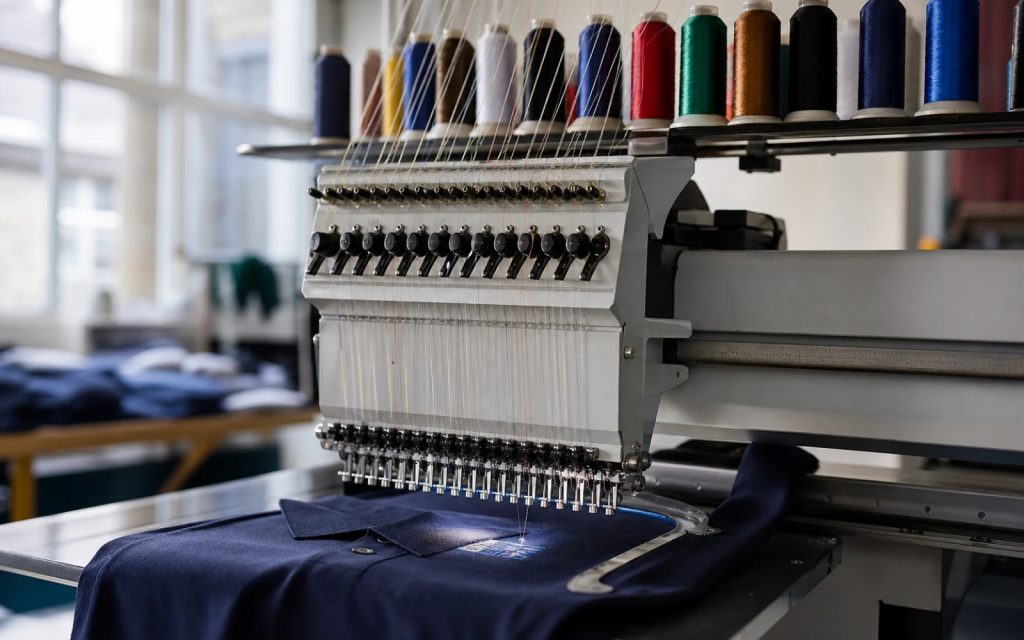
Paper printing is forgiving, enough pixels and decent colour gets through. Thread and vinyl are not. An embroidery machine doesn’t print your logo; it reconstructs it from thousands of individual stitches following digitised paths, and a vinyl cutter drags a blade along outlines. Both processes need to know exactly where every edge is, which is precisely the information a pixel image doesn’t contain. That’s why these suppliers ask for files by name (EPS especially) and why “can’t you just use the JPG?” gets a sigh: they can auto-trace it, badly, or redraw it at your cost. Our JPG rescue guide covers that situation end to end.

What each supplier needs, exactly
| Supplier | Files they want | Plus | Their process |
|---|---|---|---|
| Embroiderer | EPS or AI vector | Thread colour choices; digitising fee £10 to £30 (published rates) | Digitises artwork into a stitch file their machines run |
| Signwriter (cut vinyl) | EPS/AI/vector PDF | Exact colours (Pantone/CMYK); the all-white logo version for dark fascias | Cuts letterforms and shapes along your vector paths |
| Vehicle wrapper | Vector artwork | Vehicle make/model for templates; photos of the actual van | Designs the wrap layout around your mark, prints + cuts large-format |
| Workwear printer (DTF/screen) | Vector preferred; high-res transparent PNG acceptable | Colour count matters for screen printing costs | Prints or presses; simpler artwork = cheaper setup |
Van livery: what the wrapper or signwriter needs from you
A van is the least forgiving place a logo goes. It is printed or cut at full panel size, read from across a car park, and applied to a white, silver or dark body. Before you book the wrapper or signwriter, have four things ready:
- the logo as vector artwork (EPS, AI, or a PDF with vectors inside), because cut vinyl follows paths and large-format print enlarges every flaw;
- a reversed version (white artwork on a transparent background) for a dark van, and a one-colour version for single-vinyl jobs;
- your exact colours as CMYK or the nearest Pantone, so the van matches your cards and website;
- the van’s make and model, plus photos of each side, so they work from the right template.
If all you have is a JPG or an AI image, the first item is the gap. Our redraw fills it, and the reversed and one-colour versions come with it. If you also want the livery itself designed, our Vehicle Wrap & Signage design starts at £99.
The simplification question (why some logos need a stitch version)
Detail that sings on screen dies in thread. Gradients can’t be stitched, they become banded colour blocks; strokes thinner than a millimetre or two disappear; text below roughly 4 to 5mm tall turns to knots; and photographic elements are simply out. If your logo leans on any of those, the answer isn’t a new logo, it’s a production variant: gradients flattened to solid brand colours, strokes thickened, small text dropped or enlarged, possibly the icon alone rather than the full lockup. This is exactly the “simplified icon version” a complete handover includes (see our handover checklist); missing it, a £50 logo edit creates it once, and every embroiderer and engraver you ever use benefits.
The auto-trace came back wobbly: what the supplier will see
A traced logo can look fine on screen and still fail here. An embroiderer digitising a lumpy outline gets uneven stitch edges; a vinyl cutter follows every nick in the path; letters that merged in the trace stay merged at full size. Tidying a trace point by point can take longer than redrawing it.
If a supplier has sent your trace back, send us the original image rather than the trace. Order a redraw, reply to your order confirmation email with the original, and we redraw from the source, by hand, and check it side by side against your original before delivery.
Legibility rules of thumb, medium by medium
| Medium | Minimum text height | Other limits worth knowing |
|---|---|---|
| Embroidery (left chest) | ~4 to 5mm letter height | Logo typically 80 to 100mm wide; max ~8 to 12 thread colours; no gradients |
| Cut vinyl (van/window) | Bigger is the rule, readable at 20m+ | Very thin strokes weed badly (peel during production); counters in letters need care |
| Printed wrap | Flexible (it’s print) | Complex artwork fine; contrast against vehicle colour is the real constraint |
| Engraving / laser | ~3mm | Single colour only, this is where the all-black version works |
| Screen print (workwear) | ~5mm | Each colour is a separate screen and cost; simpler = cheaper per unit |
The pattern across every row: production media reward bold simplicity. It’s why the strongest trade logos, the ones that look inevitable on a van, tend to be chunky wordmarks with one clear icon, and why a logo designed with production in mind from day one (the brief every specialist studio works to) never needs this article at all.
Briefing all three suppliers at once (the uniform-launch scenario)
Kitting out a new business or rebrand usually means van, signage and workwear landing in the same month, brief them together and the brand arrives consistent. Send each the same package: vector masters, the simplified variant if one exists, exact colour references (CMYK + Pantone), and the all-white version. Then add one line that saves surprising amounts of pain: “Please confirm which file you’ll work from and flag anything about the artwork that won’t reproduce well in your medium before production.” Good suppliers answer specifically (an embroiderer might flag your thin tagline; a signwriter might suggest dropping the strapline at distance), and you make those calls once, deliberately, instead of discovering them garment by garment. Total artwork cost for the whole launch, assuming you start from just a JPG: £79 redraw + £50 variant = £89 once, serving every supplier you’ll ever use.
AI-generated logos on uniforms and signs
Logos made with ChatGPT, Midjourney or Canva’s AI tools are hardest on exactly these three suppliers. Embroidery cannot reproduce soft gradients or fine highlights, a vinyl cutter needs clean closed shapes, and a sign maker enlarging the image finds the pixel edges. The same image can look perfect on a phone and be unusable on a polo shirt.
The route that works is to redraw the design as vector first, with the colours pinned to exact codes, and then decide whether it needs a simpler stitch version. We do the redraw for £79 for one layout; if the design has to be simplified to stitch well, that is a Logo Edit at £50. Your embroiderer then digitises from the vector, which is the file they ask for.
Colour: the part that goes wrong even with good files
Vector files solve shape; colour needs its own care. Embroiderers match your colours to thread charts, signwriters to vinyl ranges, wrappers to print profiles, and “the blue from our website” translates differently into each unless you give exact references. Send your brand colours as CMYK values plus Pantone references if you have them (they’re on the usage sheet of any complete brand pack). For vehicles and fascias, also send the all-white version of your logo: dark backgrounds are the norm out there, and the white variant is the difference between a £400 wrap that looks intentional and one that looks like a sticker. Our guide to vehicle signage costs covers the wrap-side budgeting.
What the digitising fee actually buys
The embroiderer’s £10 to £30 digitising charge confuses people who’ve already paid for vectors, didn’t we just do this? Different job: digitising converts your vector shapes into a stitch program, the sequence, direction, density and underlay of thousands of stitches, tuned to the garment fabric. Stitch direction changes how colour catches light; density wrong for the fabric puckers polos and sinks into fleece; a good digitiser makes the same artwork look crisp on both. It’s genuine craft, the file is reusable for every future order, and the fee is standard across the industry, so pay it happily once, and make sure the embroiderer keeps (and will share) your stitch file. What you shouldn’t pay is a digitising fee plus an artwork-cleanup fee for arriving with a JPG: that second charge is the one this article’s £79 redraw permanently deletes.
One brand, every surface: the consistency payoff
It’s worth naming why this file discipline matters beyond avoiding surcharges. For a local business, the van, the shopfront, the workwear and the invoices are usually seen by the same customers in the same week, consistency across them is what makes three exposures compound into recognition rather than register as three unrelated businesses. Identical artwork from identical masters with identical colour references is the mechanical half of that; the judgement half (which version at which scale, when the strapline drops, how the icon works alone) is what the simplified-variant decision above encodes. Get both right once and every future supplier order, the second van, the summer polos, the banner for the trade show, becomes a reorder rather than a design project. That, more than any single fee saved, is what the £129 total buys.
The order of operations that saves money
Doing this in the right sequence costs £79 to £129 once; the wrong sequence pays per supplier forever. Right: get the vector pack first (£79 redraw if you don’t have it), add the simplified variant if your mark needs one (£50), then brief all suppliers from the same master files with the same colour references. Wrong: send each supplier the JPG, pay each one’s £30 to £50 redraw charge, and end up with a van, a fascia and twenty polo shirts wearing three subtly different logos, the most common uniform-brand failure in the trades. If you’re kitting out workwear beyond the logo itself, our workwear and merch design guide picks up where this one ends; every price mentioned lives on the price list.
Further reading: Pantone colour systems · Workwear printing price lists (Clothes2Order).
Get the UK Branding Budget Worksheet (free)
A printable worksheet: decide what your brand needs now and price it against fixed published prices and the IPO trademark fee.
No spam. UK GDPR compliant. We only use your email to send this resource, unless you tick the box to hear from us.
Frequently asked questions
What logo file does an embroiderer need? +
A clean vector file (EPS or AI) they can digitise into stitches. Embroiderers convert your artwork into a stitch file for their machines; fuzzy JPGs digitise badly and fine detail under ~4 to 5mm simply can't be stitched. Expect a small one-off digitising fee on top. That's industry standard.
What file does a signwriter or vehicle wrapper need? +
Vector artwork (EPS, AI or PDF with vectors inside), because vinyl is cut along paths and large-format print needs artwork that scales. They'll also want your exact brand colours, ideally as Pantone or CMYK references, so the van matches the business card.
Why does my logo need simplifying for embroidery? +
Thread is a chunky medium: gradients can't be stitched, thin lines vanish, and small text becomes knots. A good embroidery version flattens gradients to solid colours, thickens fine strokes and drops or enlarges small text: a standard simplification any designer can produce.
How much does it cost to get my logo ready for these suppliers? +
If you have vector files, usually nothing: the supplier handles their own setup. If you only have a JPG or PNG, a redraw from us at Luxbranding (£79 for one layout) produces the vector pack every supplier needs, including the reversed and one-colour versions. If your mark needs a simplified version for thread or single-colour vinyl, that is a £50 Logo Edit.
What is a digitising fee? +
The embroiderer's one-off charge for converting your vector artwork into a machine stitch file, commonly £10 to £30 per logo size per their published price lists. It's separate from garment costs, you pay it once per design, and good embroiderers reuse the stitch file for every future order.
My auto-traced logo is wobbly and the embroiderer or sign maker won't use it. Who can fix it? +
Luxbranding can. Order a redraw and send us the original image, not the trace, by replying to your order confirmation email, and we redraw the logo by hand as clean vector paths a digitiser or vinyl cutter can follow. It is £79 for one layout and £39 for each additional layout, delivered in 2 to 3 working days as SVG, AI, EPS, PDF, PNG, JPG and ICO. We do not make the stitch file (DST or PES); your embroiderer digitises from our vector.