
Quick answer
Yes. Google does not restrict using a competitor’s trade mark as a keyword, so you can bid on their business name in the UK. Using their name in your ad text is different: Google may restrict it if the owner complains. Competitor clicks often cost more and convert worse, so test with a small, separate budget.
Bidding on a rival’s name is one of the most debated tactics in Google Ads. Some business owners see it as fair game, others as underhand, and many are simply unsure whether it is allowed. This guide explains what Google’s policy permits, the legal line to stay behind, why these clicks tend to be expensive, when the tactic is worth trying, how to set it up properly, and what to do if a competitor is bidding on your name. It is general information, not legal advice.
What Google allows: keywords versus ad text
Google’s trademarks policy draws a clear distinction. It states that it will not restrict using trademarks as keywords. The restrictions apply to how a trade mark appears in the ad itself.
| What you do | Allowed by Google? | Notes |
|---|---|---|
| Bid on a competitor’s name as a keyword | Yes | Google does not restrict trademarks as keywords |
| Use their name in your headline or description | Often restricted | Google may restrict it after a complaint, and restricts use in ads from a direct competitor |
| Use their name in a confusing or misleading way | No | Google restricts deceptive or confusing use |
| Describe your own services in ordinary words that happen to match a brand | Usually yes | Descriptive use in its ordinary meaning is not restricted |
| Bid on your own business name | Yes | Often the cheapest, best-converting clicks you will buy |
Google also says violations of this policy do not lead to immediate suspension; it gives at least 7 days’ warning before suspending an account.
Is it legal in the UK?
Bidding on a competitor’s name as a keyword is a common, long-established practice in the UK. The legal risk comes from ads that could make a searcher think you are the competitor, or are connected to them. If your ad is clearly yours, names your business and does not borrow their brand, you are in a far safer position than if it imitates them.
It helps to know whether the competitor’s name is a registered trade mark at all. GOV.UK’s trade mark search lets you check whether a similar mark exists in the UK and who owns it. If you are unsure about a specific situation, take legal advice before running the campaign.
Why competitor clicks are expensive
Even when it is allowed, bidding on a rival’s name usually costs more per click than bidding on your own services. The reason is Quality Score. Google’s help page on Quality Score says it is a 1 to 10 rating for each keyword, made up of three parts:
- Expected click-through rate: how likely your ad is to be clicked. People searching for “Smith Roofing” mostly want Smith Roofing, so they rarely click your ad.
- Ad relevance: how closely your ad matches the intent behind the search. Your ad is, by design, not about the business they searched for.
- Landing page experience: how relevant your page is to the searcher. Your page is about you, not them.
All three tend to score low on competitor terms, which pushes up the cost of each click. On top of that, many searchers are existing customers looking for a phone number, and they will not switch.
When competitor bidding can work
- “Alternative” and comparison searches, such as a competitor’s name with “alternative”, “prices” or “reviews”, where the searcher is still shopping around.
- National brands against a local specialist. Someone searching a big national firm’s name may welcome a local option with faster availability.
- A competitor that has closed, retired or stopped covering an area, leaving customers looking for a replacement.
- A clear, provable difference, such as published prices, a guarantee or availability this week.
When to leave it alone
- Small local trades where everyone knows each other. The reputational cost of being seen bidding on a neighbour’s name can outweigh a few leads.
- Tight budgets. If your core service keywords are not yet fully funded, spend there first.
- When your own offer is weaker. If the competitor is cheaper, better reviewed and available sooner, your ad is asking searchers to choose the worse option. Fix the offer before paying to put it in front of their customers.
- When it starts a bidding war. If they retaliate by bidding on your name, both of you pay more for clicks you used to get cheaply or free.
How to set up a competitor campaign properly
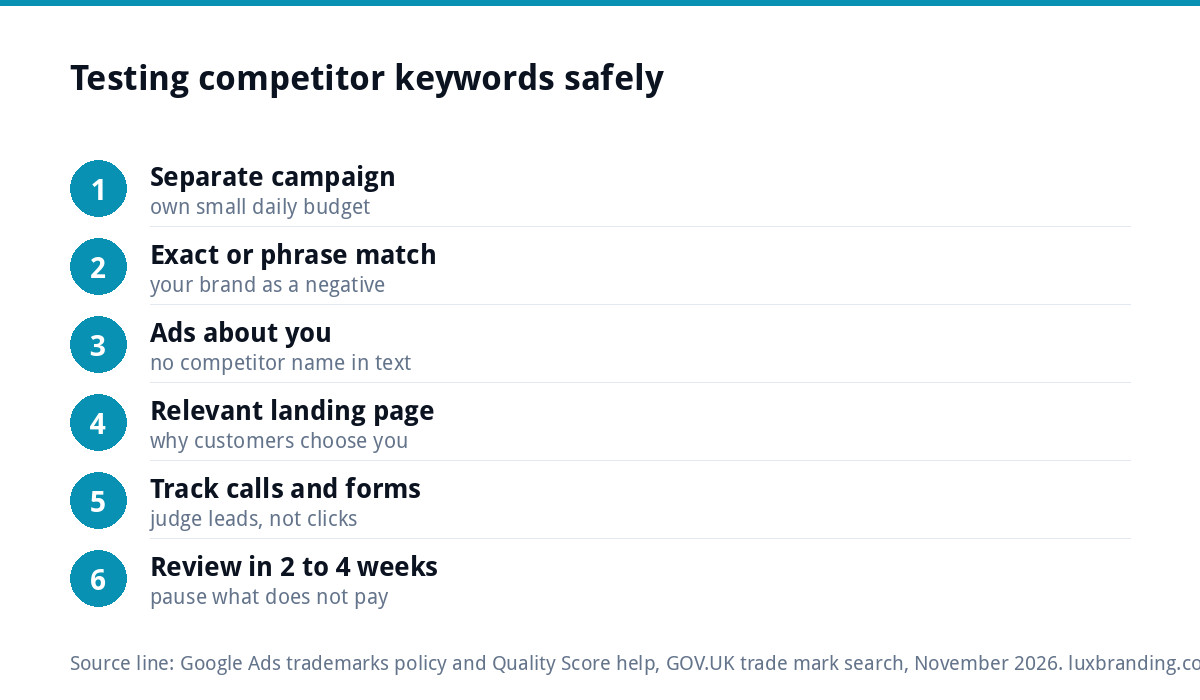
- Use a separate campaign with its own daily budget, so competitor terms can never eat your main budget.
- Use exact or phrase match on the competitor names, and add your own brand as a negative keyword in that campaign.
- Write ads about you: your name, your strongest proof and a reason to compare, with no mention of theirs.
- Send clicks to a relevant landing page that explains why customers choose you, rather than your homepage.
- Track calls and form enquiries as conversions, so you judge leads rather than clicks.
- Review after two to four weeks and pause terms that spend without producing enquiries.
A focused page makes a large difference to Quality Score. Our landing page design is £199 if you need one built for the campaign.
A worked example: local firm against a national brand
Picture an independent window cleaning firm in a city where a national franchise advertises heavily. People who search the franchise’s name fall into two groups: existing franchise customers looking for a phone number, and people who saw the franchise’s van and are now shopping around.
The local firm sets up a separate campaign on the franchise name plus “prices”, “reviews” and “alternative”, with a modest daily cap. Its ad says nothing about the franchise. It leads with the firm’s own name, its published prices and “local team, same cleaner every visit”. Clicks go to a page explaining exactly that, with a short quote form.
After three weeks, the bare brand-name terms have spent money and produced almost nothing, because those searchers wanted the franchise. The “prices” and “alternative” terms have produced a handful of enquiries at a cost the firm is happy with. It pauses the bare name and keeps the rest. That is how most competitor tests end: a few narrow terms that work, and a lot that do not.
Writing the ad without crossing the line
Keep the competitor’s name out of your ad text entirely. Lead with your own business name so nobody mistakes the ad for theirs. Make claims you can back up, such as “Fixed prices published online” or “Gas Safe registered”, and avoid knocking the competitor directly; it rarely persuades and invites complaints. If you make a comparison, it should be fair, accurate and checkable.
If a competitor is bidding on your name
First, bid on your own business name. It is usually cheap because your Quality Score is high, and it pushes their ad down. Make sure your brand is distinctive enough that a searcher can tell you apart at a glance.
If they use your name in their ad text, and you own a registered trade mark, Google’s policy says trade mark owners can submit a complaint, which Google will review and may restrict use of the mark. Our guide to logo copyright and trade marks in the UK explains registering your own, and our business name checker helps when choosing a name that can be protected.
How to judge whether it is working
| Measure | What to compare it with | Warning sign |
|---|---|---|
| Click-through rate | Your service keyword campaigns | Very low, meaning searchers want the competitor only |
| Cost per click | Your average across the account | Well above your service terms |
| Conversion rate | Your service keyword campaigns | Clicks but no calls or forms |
| Cost per lead | The value of a typical job | Higher than the margin on the work |
| Lead quality | Leads from other campaigns | Callers asking for the competitor by name |
Getting help with Google Ads
If you would rather hand competitor testing and the rest of your account to someone else, see our Google Ads management. If you are weighing ads against organic search, our SEO service is £249 a month. All our prices are on the pricing page.
Get the UK SEO DIY Audit Checklist (free)
A 32-point checklist UK SMEs can run against their own website in an afternoon. Surfaces the quick wins before paying for a paid audit.
No spam. UK GDPR compliant. We only use your email to send this resource, unless you tick the box to hear from us.
Frequently asked questions
Is it allowed to bid on a competitor's name in Google Ads? +
Yes. Google's trademarks policy says it will not restrict the use of trademarks as keywords, so you can bid on a competitor's business name. The restrictions apply to the ad itself: using their trade mark in your ad text can be restricted after a complaint, and confusing or misleading use is not allowed.
Can I put a competitor's name in my ad text? +
It is best avoided. Google may restrict a trade mark in ad text when the owner complains, and its policy restricts use in ads from a direct competitor and any confusing or misleading use. Ads that could make searchers think you are the competitor also carry legal risk. Lead with your own business name instead.
Why are competitor keyword clicks so expensive? +
Because Quality Score tends to be low. It rates expected click-through rate, ad relevance and landing page experience on a 1 to 10 scale for each keyword. People searching a competitor's name mostly want that business, so they rarely click your ad and your page does not match their intent, which pushes up cost per click.
What should I do if a competitor bids on my business name? +
Bid on your own name, which is usually cheap because your Quality Score is high, and it pushes their ad down. Make your brand distinctive. If they use your name in their ad text and you own a registered trade mark, Google lets trade mark owners submit a complaint, which it reviews and may act on.
How do I test competitor keywords without wasting money? +
Put them in a separate campaign with its own small daily budget, use exact or phrase match, write ads about your own business, send clicks to a relevant landing page and track calls and forms as conversions. Review after two to four weeks and pause any terms that spend without producing enquiries worth having.