
Quick answer
Put most of your effort into evergreen content: answers to questions customers ask every year, such as how often to service a boiler or what a £129 logo should include. These keep earning visits long after publishing. Use timely posts sparingly, for news your customers genuinely care about, and update evergreen pages properly instead of just changing the date.
Small businesses rarely have time to publish every week, so what you write matters more than how often. This guide explains the difference between evergreen and timely content, shows which suits which goal, suggests a realistic mix for a small firm, and covers how to keep older posts useful without falling foul of Google’s guidance. It is written for owners who write their own posts or brief someone else to.
Evergreen and timely content: what each means
Evergreen content answers a question that stays relevant for years. “How long does a kitchen fit take?”, “What is included in an end of tenancy clean?” and “Do I need planning permission for a fence?” are all evergreen. The answer may need occasional updating, but the question does not go away.
Timely content is tied to a moment: news about your business, a local event, a change in rules, a seasonal offer or a comment on something in the headlines. It can be useful and interesting, but its value usually fades within weeks or months.
There is a useful middle ground, too: seasonal evergreen content. “Getting your garden ready for spring” or “Clearing gutters before winter” comes round every year, so the same page can do its job annually with a light refresh.
Evergreen vs timely: side by side
| Factor | Evergreen | Timely |
|---|---|---|
| Example for a roofer | “How long does a flat roof last?” | “Storm damage: we are prioritising emergency repairs this week” |
| Traffic pattern | Builds slowly, then steady for years | Spike, then fades |
| Search visibility | Can rank for questions people keep asking | Short window, competing with news sites |
| Effort to keep useful | Occasional updates | None needed; it simply dates |
| Best for | Being found by new customers | Showing existing customers you are active |
| Best channel | Your website, linked from service pages | Social media, email, Google Business Profile posts |
Why evergreen suits most small businesses
A small firm cannot win a race to publish news first. It can, however, write the clearest answer to a question its customers ask every week. That answer works for you while you are on a job, and it compounds: each good evergreen post adds to the pages that can bring in visitors.
Evergreen posts also help in conversation. When a customer asks how long a job takes or what affects the price, you can send them the link. That saves time and positions you as the business that explains things properly.
Google’s guidance on creating helpful content supports this approach. It describes people-first content as content created primarily for people, not to manipulate search rankings. A clear answer to a real customer question fits that description well.
Where timely content earns its place
Timely content is not wasted, but it works best in a supporting role:
- Changes your customers must know about, such as new opening hours, a new service area or a regulation that affects them.
- Proof you are busy and real: a finished project, a new van, a team member joining.
- Local events you are part of, such as a fair, a sponsorship or a charity day.
- Seasonal offers, when there is a genuine reason to act now.
Much of this fits better on social media, in an email to past customers or as a post on your Google Business Profile than as a permanent blog post. If you do put it on the website, keep it short.
A realistic content mix for a small business
There is no magic ratio, but a simple rule works for most owners: make the large majority of website posts evergreen, and treat timely items as occasional extras. In practice, that might look like this for a business publishing a couple of times a month:
- One evergreen guide answering a question customers keep asking.
- One evergreen update: improving an older post with new examples, prices or photos.
- Timely items on social media and email as they happen, with only the important ones on the website.
Updating counts as publishing. A strong existing post made better is often worth more than a thin new one.
Keeping evergreen content fresh, honestly
Evergreen does not mean “never touch it”. Prices change, methods improve and photos date. When you update a post, change something that matters: new figures, a better explanation, a fresh example, answers to new questions.
Do not just change the date. Google’s helpful content guidance lists “changing the date of pages to make them seem fresh when the content has not substantially changed” as a warning sign of search engine-first content. Its guidance on publication dates recommends a visible date on the page, labelled clearly, for example “Published” or “Last updated”, and consistent with any date in the page’s structured data.
A simple habit: when you substantially update a post, add a “Last updated” date and a line saying what changed.
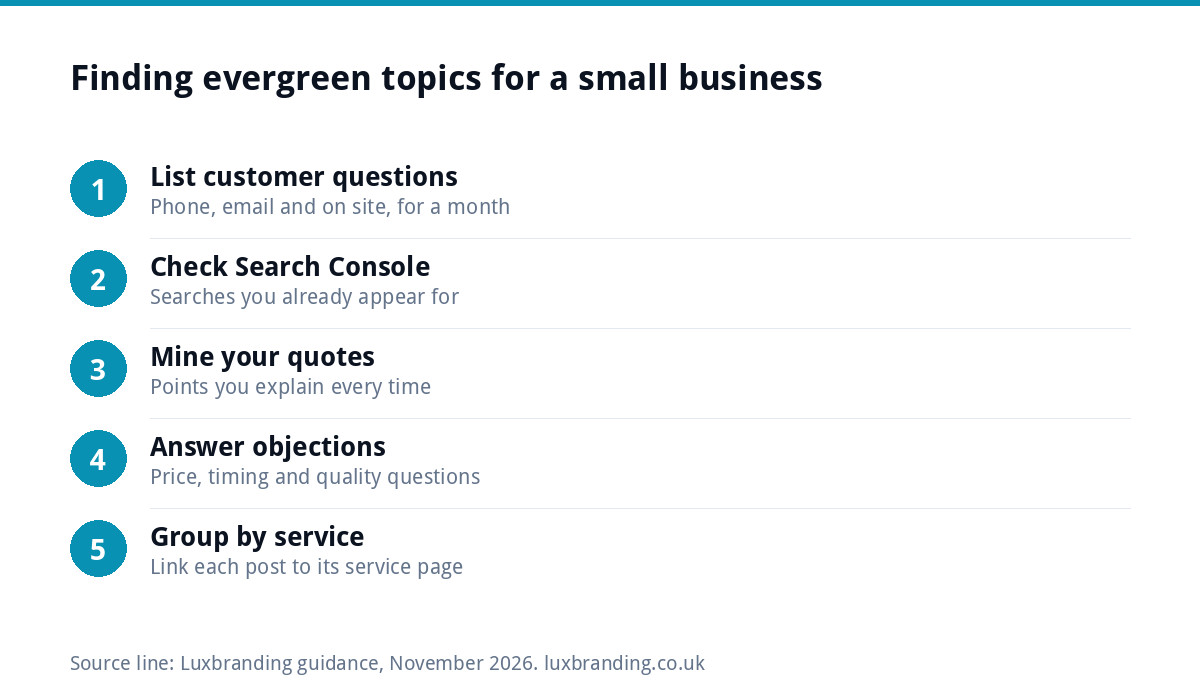
How to find evergreen topics
- List the questions customers ask on the phone, by email and on site. Write them down for a month.
- Check your search data. Google Search Console is a free service that shows the searches your site already appears for. Questions in that list are strong candidates.
- Look at your quotes. The points you explain in every quote, such as what affects price or how long a job takes, make good posts.
- Turn objections into answers. “Why is a proper job more expensive than the cheapest quote?” is an evergreen post.
- Group topics around your services, so each post links naturally to the service page it supports.
Turning a timely post into an evergreen one
Many timely posts contain an evergreen question. “We fixed twelve storm-damaged roofs this week” is news; “What to do if a storm damages your roof” is evergreen. Write the news for social media, and write the guide for the website, with the recent example as a case study inside it.
The same works for seasonal posts. Instead of “Our spring offer”, publish “How to get your garden ready for spring” and mention the offer in a short box you can change each year.
Measuring what each type does
Judge the two types by different measures:
| Content type | What to measure | Where |
|---|---|---|
| Evergreen guides | Search impressions and clicks over months; enquiries from the page | Search Console, analytics, your enquiry log |
| Timely posts | Engagement and replies in the first week | Social insights, email replies |
| Updated posts | Change in clicks after the update | Search Console, comparing date ranges |
Do not expect evergreen content to perform in its first week. Give it a few months before deciding whether a topic works. If your posts are not appearing in search at all, our guide to why a website is not showing on Google covers the usual causes.
Common mistakes with both types
- A blog full of “We are pleased to announce” posts. Old news makes a site look abandoned. Archive or merge stale announcements, and keep the blog focused on useful guides.
- Evergreen posts with dates in the headline. “Best patio materials for 2024” dates itself. Leave the year out of the headline unless the post is genuinely about that year, and update the content instead.
- Two posts answering the same question. Writing a new version of an old guide splits attention between two pages. Improve the original instead.
- No link to the service. A helpful guide that never mentions what you do, or how to book it, leaves readers with nowhere to go. Add one clear link to the relevant service page.
- Chasing national news. Commenting on headlines rarely brings customers to a local or specialist business. Your own expertise is the stronger angle.
- Writing for everyone. A post aimed at “homeowners” in general is weaker than one written for the people you actually serve, in the areas you cover, with the jobs you actually do.
Getting help with content
If writing is the job that always slips, our blog writing and content marketing service plans and writes evergreen posts around your services. For a wider push, our SEO service at £249 a month covers rankings, content, technical health, link building and reports; our guide to SEO costs explains what that kind of budget buys. Start with a free SEO audit to see where your site stands, and see every fixed price on our pricing page.
Get the UK SEO DIY Audit Checklist (free)
A 32-point checklist UK SMEs can run against their own website in an afternoon. Surfaces the quick wins before paying for a paid audit.
No spam. UK GDPR compliant. We only use your email to send this resource, unless you tick the box to hear from us.
Frequently asked questions
What is evergreen content? +
Evergreen content answers a question that stays relevant for years, such as how long a job takes, what affects the price or how to maintain something. The answer may need occasional updates, but people keep searching for it, so a good evergreen post can bring visitors long after it is published.
Should a small business blog post news at all? +
Yes, but sparingly. News about new services, opening hours, finished projects or local events shows you are active, and it suits social media, email and Google Business Profile posts best. Put only important updates on the website blog, and keep them short so they do not crowd out your evergreen guides.
Does updating the date on a post help it rank? +
Not on its own. Google's helpful content guidance lists changing page dates to make them seem fresh, when the content has not substantially changed, as a warning sign. Update the substance first, such as figures, examples or explanations, then show a clearly labelled last updated date.
How often should I update evergreen posts? +
Review your main guides at least once a year, and sooner if prices, methods or rules in your industry change. Prioritise posts that already get search impressions or enquiries. Add new questions customers have asked, refresh examples and photos, and note what changed alongside the updated date.
How long before an evergreen post brings visitors? +
It varies with your site's history, the competition and the quality of the post, so there is no fixed timescale. Expect weeks to months rather than days. Watch impressions in Google Search Console first, because they usually rise before clicks do, and give a topic a few months before judging it.